|
Question 1206483: A bug lives on a corner of a cube and is allowed to travel only on the edges of the cube. In how many ways can the bug visit each of the other seven corners once and only once, returning to its home corner only at the end of the trip?
Found 4 solutions by ikleyn, KMST, greenestamps, n2:
Answer by ikleyn(54069)   (Show Source):
You can put this solution on YOUR website! .
See the solution 2 under this link
https://artofproblemsolving.com/wiki/index.php/2006_AMC_12A_Problems/Problem_20
They say that if you are able to understand it, then you are officially good in Math.
Answer by KMST(5484)  (Show Source):
You can put this solution on YOUR website! This is my translucent cube with the bug's home marked, and the corners numbered.
The green edges would not be visible if I had not made it translucent.
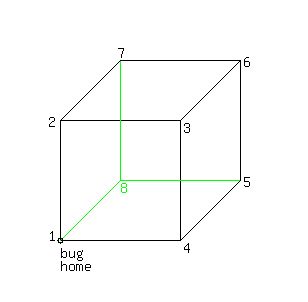
The bug has to visit each corner once and only once, and then return home.
No one said the bug has to travel along each and every edge.
That would be exhausting, and it would end up visiting corners twice.
He just goes from each corner to the next number corner, in order.
At the end of the trip, from corner 8 it goes back home.
I will add red arrows to show the bug's path, just in case my explanation is not clear.

Answer by greenestamps(13395)  (Show Source):
You can put this solution on YOUR website!
I will use the nice figure from the response from the other tutor.
The question -- not answered by the other tutor -- was how many ways the bug can start from his home and visit the other seven corners once each and return home, only traveling on the edges of the cube.
Counting his home corner, the first three corners the bug visits must be on a single face of the cube. Using the numbers on the figure, those sequences of corners must be one of these 6:
1-2-3
1-4-3
1-2-7
1-8-7
1-4-5
1-8-5
From each of these starts to the bug's trip, there are two possible ways for it to move next. It can either go next to the fourth corner on the same face, or it can go to a corner on a different face. That gives 6 times 2 equals 12 possibilities for the first four corners the bug visits:
1-2-3-4
1-4-3-2
1-2-7-8
1-8-7-2
1-4-5-8
1-8-5-4
1-2-3-6
1-4-3-6
1-2-7-6
1-8-7-6
1-4-5-6
1-8-5-6
Note that in every case where the bug moves to a fourth corner that is not on the same face as the first three corners, the fourth corner is the corner that is opposite the bug's home.
Investigation shows that, for any one of these 12 choices for the first four corners, there is exactly one way for the bug to complete the trip successfully.
So there are 12 ways for the bug to complete the prescribed trip.
ANSWER: 12
Answer by n2(98)  (Show Source):
You can put this solution on YOUR website! .
A bug lives on a corner of a cube and is allowed to travel only on the edges of the cube.
In how many ways can the bug visit each of the other seven corners once and only once,
returning to its home corner only at the end of the trip?
~~~~~~~~~~~~~~~~~~~~~~~~~~~~~~~~~~~~~
The solution by tutor @greenestamps is good and valid.
In this post, I will give another solution from a different perspective,
with different logic and a different description.
A unified geometric-combinatorial description can be provided for all possible configurations.


The cube has 6 faces that can be combined in opposite pairs (front, back), (left, right), and (upper, lower)
in parallel planes.

Each path under the imposed conditions comprises an open loop of three sequential edges (four vertices)
on one face of the cube and a similar open loop of three sequential edges (four vertices) on the opposite face,
traveled in mutually opposite directions.
These open loops on opposite faces are connected by connecting edges — or "bridges" — which are
also traveled in mutually opposite directions.

Thus, for example, in the cube 12345678 in the figure, the first open loop of three edges (four vertices)
is the path 1234, while the second open loop of three edges (four vertices) is the path 5678.
The first bridge is 45; the second bridge is 81 - it closes the whole path from 1 to 1.


OK, very good.


Now, there are 3 edges emanating from vertex 1: 12, 14, and 18.

For each of these edges, there are two open loops starting from these edges:

   1278 and 1234 for edge 12;
   1432 and 1458 for edge 14;
   1872 and 1854 for edge 18.


Thus, we have 2*3 = 6 open loops listed above, created by edges 12, 14, and 18,
when they are starting edges in these open loops.
It creates/generates 6 possible paths satisfying the imposed conditions.


The other 6 paths arise when edges 12, 14, and 18 are the bridges for the other open loops.


In all, it gives 6 + 6 = 12 possible different paths satisfying the imposed conditions.


ANSWER.  There are 12 possible paths for the ant that satisfy the imposed conditions.
Solved.
| |
|
| |
