|
Tutors Answer Your Questions about Inequalities (FREE)
Question 759176: Find the exact value solution
log (5x) + log (x-1) = 2
Answer by MathTherapy(10806)   (Show Source): (Show Source):
You can put this solution on YOUR website!
Find the exact value solution

log (5x) + log (x-1) = 2
*************************************
x = 5 or  -  4, as stated by the other person, is partly WRONG!

log (5x) + log (x - 1) = 2
Looking at the logarithmic equation, the smaller log argument, x  -  1 MUST be > 0.
So, x  -  1 > 0, and therefore, x > 1.

We then have: log (5x) + log (x - 1) = 2, with x > 1

So, x = 5 is the ONLY solution, as x = - 4 is EXTRANEOUS.
Question 61887: Couls someone help please?
Solve the following inequalitites. Write the answers in interval notation.
x^2 +7x-18=>0
3x-4/2x+1 <=6
Found 2 solutions by MathTherapy, ikleyn:
Answer by MathTherapy(10806) (Show Source):
You can put this solution on YOUR website!
Couls someone help please?
Solve the following inequalitites. Write the answers in interval notation.
x^2 +7x-18=>0
3x-4/2x+1 <=6
***********************************************************************
Solution for # 2, in INTERVAL NOTATION: ( ] ∪ ( ] ∪ ( ) )
Answer by ikleyn(53748)  (Show Source): (Show Source):
You can put this solution on YOUR website! .
Could someone help please?
Solve the following inequalities. Write the answers in interval notation.
(a) x^2 + 7x - 18 => 0
(b) (3x-4)/(2x+1) <= 6
~~~~~~~~~~~~~~~~~~~~~~~
The solutions by @jai_kos are incorrect for both inequalities.
I came to bring correct solutions for both problems.
(a) Your starting inequality is
x^2 + 7x - 18 => 0. (1)
Factor left side quadratic polynomial
(x+9)*(x-2) >= 0.
Critical points are x = -9 and x = 2.
On the left of the critical point x = -9, both factors (x+9) and (x-2) are negative, so their product is positive.
Between the critical points -9 < x < 2, factor (x+9) is positive, while factor (x-2) is negative,
so their product is negative.
On the right of the critical point x = 2, both factors (x+9) and (x-2) are positive, so their product is positive.
Thus the solution set for inequality (1) is x < -9 or x > 2,
or, in interval notation, the union ( , , ) U ( ) U ( , , ). ).
Part (a) is solved correctly.
(b) Your starting inequality is
 <= 6. (1)
Transform it equivalently this way
- 6 <= 0 <<<---=== moving 6 from right side to left side with changing the sign
- <= 6. (1)
Transform it equivalently this way
- 6 <= 0 <<<---=== moving 6 from right side to left side with changing the sign
-  <= 0 <<<---=== writing '6' with the common denominator <= 0 <<<---=== writing '6' with the common denominator
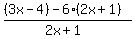 <= 0 <<<---=== simplifying <= 0 <<<---=== simplifying
 <= 0 <<<---=== simplifying further
Now, the left side rational function can be non-positive if and only if
EITHER the numerator is non-negative and denominator is negative
-9x - 10 >= 0 and 2x + 1 < 0 (2)
OR the numerator is non-positive and denominator is positive
-9x - 10 <= 0 and 2x + 1 > 0. (3)
In case (2), 9x <= -10 and x < -1/2, which is the same as
x <= -10/9 and x < -1/2.
These both inequalities, taken together, have the solution set x <= -10/9.
In case (3), 9x >= -10 and 2x > -1, which is the same as
x >= -10/9 and x > -1/2.
These both inequalities, taken together, have the solution set x >= -1/2.
Thus the final solution to the given inequality is this set of real numbers { x <= -10/9 } OR { x >= -1/2 }.
In the interval notation, the solution set is the union of two sets (, <= 0 <<<---=== simplifying further
Now, the left side rational function can be non-positive if and only if
EITHER the numerator is non-negative and denominator is negative
-9x - 10 >= 0 and 2x + 1 < 0 (2)
OR the numerator is non-positive and denominator is positive
-9x - 10 <= 0 and 2x + 1 > 0. (3)
In case (2), 9x <= -10 and x < -1/2, which is the same as
x <= -10/9 and x < -1/2.
These both inequalities, taken together, have the solution set x <= -10/9.
In case (3), 9x >= -10 and 2x > -1, which is the same as
x >= -10/9 and x > -1/2.
These both inequalities, taken together, have the solution set x >= -1/2.
Thus the final solution to the given inequality is this set of real numbers { x <= -10/9 } OR { x >= -1/2 }.
In the interval notation, the solution set is the union of two sets (, ] U ( ] U ( ,). ,).
Both problems/questions are solved correctly.
Question 63264: solve. x-2/x+1 greater or equal to 3
thank you
Found 2 solutions by n2, ikleyn:
Answer by n2(79) (Show Source): (Show Source):
You can put this solution on YOUR website! .
.
solve the rational inequality (x-2)/(x+1) >= 3.
~~~~~~~~~~~~~~~~~~~~~~~~
They want you solve this inequality
 >= 3. (1)
Transform it equivalently this way
- 3 >= 0 <<<---=== moving 3 from right side to left side with changing the sign
- >= 3. (1)
Transform it equivalently this way
- 3 >= 0 <<<---=== moving 3 from right side to left side with changing the sign
-  >= 0 <<<---=== writing '3' with the common denominator >= 0 <<<---=== writing '3' with the common denominator
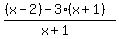 >= 0 <<<---=== simplifying >= 0 <<<---=== simplifying
 >= 0 <<<---=== simplifying further
Now, the left side rational function can be non-negative if and only if
EITHER the numerator is non-negative and denominator is positive
-2x - 5 >= 0 and x + 1 > 0 (2)
OR the numerator is non-positive and denominator is negative
-2x - 5 <= 0 and x + 1 < 0. (3)
In case (2), -2x >= 5 and x > -1, which is the same as
x <= -5/2 and x > -1.
These both inequalities, taken together, has no solution.
In case (3), -2x <= 5 and x < -1, which is the same as
x >= -5/2 and x < -1.
Thus the final solution to the given inequality is this set of real numbers -5/2 <= x < -1,
or, in the interval notation, the set [ >= 0 <<<---=== simplifying further
Now, the left side rational function can be non-negative if and only if
EITHER the numerator is non-negative and denominator is positive
-2x - 5 >= 0 and x + 1 > 0 (2)
OR the numerator is non-positive and denominator is negative
-2x - 5 <= 0 and x + 1 < 0. (3)
In case (2), -2x >= 5 and x > -1, which is the same as
x <= -5/2 and x > -1.
These both inequalities, taken together, has no solution.
In case (3), -2x <= 5 and x < -1, which is the same as
x >= -5/2 and x < -1.
Thus the final solution to the given inequality is this set of real numbers -5/2 <= x < -1,
or, in the interval notation, the set [ , , ). ).
Solved.
Answer by ikleyn(53748) (Show Source):
You can put this solution on YOUR website! .
solve. x-2/x+1 greater or equal to 3
~~~~~~~~~~~~~~~~~~~~~~~~
The solution in the post by @jai_kos in incorrect.
It is incorrect methodologically and gives incorrect answer.
See my correct solution below.
They want you solve this inequality

     >= 3.    (1)


Transform it equivalently this way

     - 3 >= 0             <<<---===  moving 3 from right side to left side with changing the sign

     -  >= 0    <<<---=== writing '3' with the common denominator

     >= 0       <<<---===  simplifying

     >= 0               <<<---===  simplifying further


Now, the left side rational function can be non-negative if and only if

    EITHER the numerator is non-negative and denominator is positive

        -2x - 5 >= 0  and  x + 1 > 0    (2)

    OR     the numerator is non-positive and denominator is negative

        -2x - 5 <= 0  and  x + 1 < 0.   (3)


In case (2),  -2x >= 5  and  x > -1,  which is the same as

              x <= -5/2 and  x > -1.

              These both inequalities, taken together, has no solution.


In case (3),  -2x <= 5  and  x < -1,  which is the same as

              x >= -5/2 and  x < -1.


Thus the final solution to the given inequality is this set of real numbers  -5/2 <= x < -1,
or, in the interval notation, the set [,).
Solved.
The error made by @jai_kos is that when he multiplies both sides of the original inequality by (x+1),
he misses the case when (x+1) is negative, which requires different treatment.
This error, which jai_kos makes solving the problem, is a typical error, which beginners make
when trying to solve such inequalities,
until the more experienced teachers/tutors will explain their error and will show a right way solving.
Question 264297: 3a^2+a-10>0
we are using delta = b^2-4*a*c
my solution to this equation is [-5/2,3} the book says the solution is (-oo,-2)U(5/3,oo)
please help me find what I am doing wrong
Answer by ikleyn(53748) (Show Source):
You can put this solution on YOUR website! .
Your error is that you treat it as an equation and find the roots of the equation,
while in the problem, you are given an inequality and should treat it as an inequality.
Question 262987: what value of k will make 16x^2/9 (fraction) - kx + 36 a perfect square trinomial?
Answer by ikleyn(53748) (Show Source):
You can put this solution on YOUR website! .
what value of k will make 16x^2/9 (fraction) - kx + 36 a perfect square trinomial?
~~~~~~~~~~~~~~~~~~~~~~~~~~~~~~~~~~~
The post by @mananth gives incorrect answer to the problem's question.
See my solution below for correct, complete and clear solution.
I will give you / (show you) two ways to solve the problem, for your benefits.
S o l u t i o n 1
Your trinomial has a form a^2*x^2 - kx + 36, where a^2 =  , a = , a =  = =  .
It will be a complete square if and only if
k = +/- .
It will be a complete square if and only if
k = +/-  = +/- = +/-  = +/- (2*4*2) = +/- 16. <<<---=== ANSWER
S o l u t i o n 2
Consider the discriminant of the given polynomial
d = " b^2 - 4ac ", where b = -k, a = , c = 36.
So, d = (-k)^2 - 4*(16/9)*36 = k^2 - 16^2.
The given polynomial is a perfect square if and only if the discriminant is zero
k^2 = 16^2, which implies k = +/- 16.
You get the same answer as in Solution 1 above. = +/- (2*4*2) = +/- 16. <<<---=== ANSWER
S o l u t i o n 2
Consider the discriminant of the given polynomial
d = " b^2 - 4ac ", where b = -k, a = , c = 36.
So, d = (-k)^2 - 4*(16/9)*36 = k^2 - 16^2.
The given polynomial is a perfect square if and only if the discriminant is zero
k^2 = 16^2, which implies k = +/- 16.
You get the same answer as in Solution 1 above.
Solved correctly and completely, in clear and transparent form.
Question 1011163: -3 < w/-2 + 10 + w/4
Can you please show me how to solve this problem? I get confused as to whether you need to multiply the left side by -2 (to balance out the w/-2) and 4 (to balance out the w/4).
So, does it end up -3 - 10 < w/-2 + + 10 - 10 + w/4
-13 < w/-2 + w/4 ?
Answer by MathTherapy(10806) (Show Source):
Question 730044: Annie plans to grow vegetables in her backyard. She wants to grow onions and tomatoes,and plans to buy 6 times as many onion plants as tomato plants. Tomato plants cost $0.99 each and onion plants cost $0.08 each. Annie has $60 to spend. If Annie buys exactly 6 times as many onion plants as she buys tomato plants, how many onion plants can she buy without going over $60?
Can you help me? I've tried: (x=onion,y=tomato)
0.08(6)x <= $60-0.99 y <- but i got 9.35
Answer by ikleyn(53748) (Show Source):
You can put this solution on YOUR website! .
Annie plans to grow vegetables in her backyard. She wants to grow onions and tomatoes, and plans to buy 6 times
as many onion plants as tomato plants. Tomato plants cost $0.99 each and onion plants cost $0.08 each.
Annie has $60 to spend. If Annie buys exactly 6 times as many onion plants as she buys tomato plants,
how many onion plants can she buy without going over $60?
~~~~~~~~~~~~~~~~~~~~~~
Let x be the number of the tomato plants (the value under the problem's question).
Then the number of the onion plants is 6x, according to the problem.
Write your inequality for the total money
0.99x + 0.08*(6x) <= 60 dollars.
Simplify
(0.99+0.08*6)x <= 60,
1.47x <= 60,
x <=  = 40.82...
In this problem, we should round this decimal number down, to the closest lesser integer number, which is 40.
ANSWER. Within this scheme and within the budget, Annie can buy 6*40 = 240 onion plants. = 40.82...
In this problem, we should round this decimal number down, to the closest lesser integer number, which is 40.
ANSWER. Within this scheme and within the budget, Annie can buy 6*40 = 240 onion plants.
Solved.
Question 737467: the average male blue whale weighs 16 times the weight of the average African elephant. two elephants and a blue whale together would weigh 135 tons. how much does the average male blue wale weigh?
Answer by ikleyn(53748) (Show Source):
You can put this solution on YOUR website! .
the average male blue whale weighs 16 times the weight of the average African elephant.
two elephants and a blue whale together would weigh 135 tons. how much does the average male blue wale weigh?
~~~~~~~~~~~~~~~~~~~~~~~~~~~~~~~~~~~~~~~~~~~~~
    x + x + 16x = 135  tons

      18x       = 135

        x       = 135/18 = 7.5  tons

16x = 16*7.5 =  120 tons.    ANSWER
Solved.
Question 304943: Suppose a chemist is performing an experiment that requires the ratio of carbon (c) to hydrogen (h) to be greater than 1, but no more than 3. Which inequality describes the range of the ratio?
A. 1 < ch / ch < 3
B. 1 c / h < 3
C. 1 < c / h 3
D. 1 cc / h 3
Found 2 solutions by AnlytcPhil, ikleyn:
Answer by AnlytcPhil(1810)  (Show Source): (Show Source):
Answer by ikleyn(53748) (Show Source):
You can put this solution on YOUR website! .
Suppose a chemist is performing an experiment that requires the ratio
of carbon (c) to hydrogen (h) to be greater than 1, but no more than 3.
Which inequality describes the range of the ratio?
A. 1 < ch / ch < 3
B. 1 c / h < 3
C. 1 < c / h 3
D. 1 cc / h 3
~~~~~~~~~~~~~~~~~~~~~~~~~~~
The correct form inequality, describing the situation word-in-word should be


    1 < c/h <= 3.


No one option in your list is correct.
Would I be a CEO in the company, where some employee composes such nonsense
as this posted problem, I would fire such an employee next day.
Question 476572: its all about non linear inequalities. (x-5)(x-4) is greater than or equal to 0.
Found 2 solutions by AnlytcPhil, ikleyn:
Answer by AnlytcPhil(1810) (Show Source):
Answer by ikleyn(53748) (Show Source):
You can put this solution on YOUR website! .
its all about non linear inequalities. (x-5)(x-4) is greater than or equal to 0.
~~~~~~~~~~~~~~~~~~~~~~~~~~~
The methods Theo uses to teach students in his posts very often
are monstrously verbose, and needlessly long.
The true Math explanations are usually much shorter, much more straightforward,
much clearer, and more instructive.
So, they want you solve inequality (x-5)*(x-4) >= 0.
In this problem the function is presented as the product of two linear binomials, (x-5) and (x-4).
In order for the product of these two binomials would be non-negative, the factors/binomials
should be of the same sign or zero.
First factor, (x-5) is negative or zero in the area x <= 5 and non-negative or zero in the area x >= 5.
Second factor, (x-4) is negative or zero in the area x <= 4 and non-negative or zero in the area x >= 4.
Thus we see that both factors are negative or zero in the domain x <= 4,
and both factors are non-negative in the domain x >= 5.
Thus the solution set is the union of two semi-infinite intervals x <= 4 and x >= 5.
At this point, the solution is fully complete.
ANSWER. The solution is the set x <= 4 or x >= 5.
i.e. the area out of the interval between the roots of the function (but the solution set includes the roots).
To make sure that the solution is correct, you may plot the function. See this plot below.
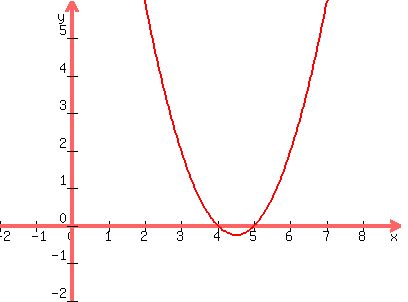 Plot y = (x-5)*(x-4)
The function is a parabola opened upward. Its branches are in the upper (non-negative) half-plane out the interval
on x-axis between x-intercepts, but including the x-intercepts.
The part of the parabola between the roots is in the lover (negative) half-plane.
So, this figure confirms the logical reasoning in algebraic solution.
Plot y = (x-5)*(x-4)
The function is a parabola opened upward. Its branches are in the upper (non-negative) half-plane out the interval
on x-axis between x-intercepts, but including the x-intercepts.
The part of the parabola between the roots is in the lover (negative) half-plane.
So, this figure confirms the logical reasoning in algebraic solution.
By the way, the answer in the post by @Theo, which is given as x < 4, x > 5,
is INCORRECT: it excludes the roots of the function.
Actually, the roots must be included.
///////////////////////////////////////////////
Couple of words about evolution of online solutions in the internet.
The era of online solutions and corresponding online websites started somewhere about the year ~ 2000.
First years it was at the mostly amateur level, but starting from the year ~ 2005, it transformed into
a commercial enterprise.
The flow of online Math problems and online solutions was huge, and practically nobody tracked
the quality of the solutions, as well practically nobody cared about it, because the major goal
was to capture territory.
Due to this reason, good and correct solutions were placed side by side with unprofessional posts.
This development continued till approximately the year 2024, when the Artificial Intelligence came.
The audience of users and readers grew from thousands to millions.
But the base of solved problems for Artificial Intelligence was half of professional posts
and half of unprofessional quality. So, the tone and the quality of many solutions produced by AI,
were often below commonly accepted standards both in Math and in Math education.
This situation was heavily criticized by the community, and for this reason, starting from August 2025,
the situations began to improve — the tone of many solutions changed; they are becoming increasingly acceptable.
And I'm proud to be contributing to improving the quality of online solutions.
Question 1210414: James has given up baking and is now focused on healthier eating. For lunch, he chooses between two meals: pasta or tofu. The table below lists the amount of protein, carbohydrates, and vitamins each meal provides along with the amount of cholesterol each contains. James needs at least 200g of protein, 960g of carbohydrates, and 40g of vitamin C for lunch each month. How many days should he have the pasta meal, and how many days the tofu meal so that he gets the adequate amount of nutrients and at the same time minimizes his cholesterol intake?
               Pasta   Tofu
Protein         8g     16g
Carbohydrates  60g     40g
Vitamin C       2g      2g
Cholesterol    60mg    50mg
Answer by ikleyn(53748) (Show Source):
You can put this solution on YOUR website! .
James has given up baking and is now focused on healthier eating. For lunch, he chooses between two meals: pasta or tofu.
The table below lists the amount of protein, carbohydrates, and vitamins each meal provides along with the amount of
cholesterol each contains. James needs at least 200g of protein, 960g of carbohydrates, and 40g of vitamin C for lunch
each month. How many days should he have the pasta meal, and how many days the tofu meal so that he gets the adequate
amount of nutrients and at the same time minimizes his cholesterol intake?
Pasta Tofu
Protein 8g 16g
Carbohydrates 60g 40g
Vitamin C 2g 2g
Cholesterol 60mg 50mg~~~~~~~~~~~~~~~~~~~~~~~~~~~~~~~~~~
Let introduce variable 'x':

Let 'x'  be the number of days of the month James eats pasta for lunch;

then the number of days James eats tofu for lunch is (30-x)   //  assuming 30 days in a month.


So, the problem is to minimize

    H = 60x + 50(30-x)    (1)


under restriction

     8x + 16(30-x) >= 200,    (2)   (protein restriction)

    60x + 40(30-x) >= 960,    (3)   (carbohydrate restriction)

     2x + 2(30-x)  >=  40     (4)   (vitamin C restriction)

     0 <= x <=  30.           (5)


Let' simplify expression (1) and inequalities (2) - (5).


In simplified form, we want to minimize

    H = 10x + 1500            (1')

under restrictions

    -8x +  480 >= 200,  which we transform to  8x <= 280,    which we transform  x <= 35;     (2')

    20x + 1200 >= 960,  which we transform to  20x >= -240,  which we transform  x >= -12;    (3')

            60 >=  40,                                                                        (4')

     0 <= x <= 30.             (5')


Looking at these transformed restrictions, we see that in the domain  0 <= x <= 30 they (the restrictions)
are held at any value of x.


So, if we want to minimize (1'), we should take x = 0.


The solution is that James should not eat pasta and should eat tofu every day for lunch.
Solved.
-----------------------------------
The problem can be solved by applying different reasoning.
Indeed, with the given input data, it is clear that James can eat either pasta or tofu every day

    (a)  consuming protein will be more than 200 grams in either case;

    (b)  consuming carbohydrate will be more that 960 grams in either case;

    (c)  consuming vitamin C will be more than 40 grams in either case.


So, in reality, these three restrictions are not the restrictions, at all.


Therefore, if James wants to minimize cholesterol, he should eat tofu every day,
since tofu provides lesser cholesterol.
So, from the first glance, this problem looks like as a Linear Programming problem,
but in reality it is a FALSE Linear Programming problem.
It is a mathematical joke to make a reader smiling as he/she find the solution at the end.
Solved in two different ways for your better understanding.
Hope, you will smile at the end.
Question 499019: Please tell me how I would graph this. The question is:
Graph the solution set of the following system of inequalities:
x^2+y^2 less than or equal to 25
y greater than or equal to |x|
Answer by ikleyn(53748) (Show Source):
You can put this solution on YOUR website! .
Please tell me how I would graph this. The question is:
Graph the solution set of the following system of inequalities:
x^2+y^2 less than or equal to 25
y greater than or equal to |x|
~~~~~~~~~~~~~~~~~~~~~~~~~~~~~~~~~~~~~
Equation  x^2 + y^2 = 25  describes a circle of the radius of 5 units,
centered at the origin of the coordinate system.


Inequality  x^2 + y^2 <= 25  describes the interior of this circle,
including the circle itself.


Equation y = |x|  describes two rays on the plane.
One ray bisects first quadrant; the other ray bisects the second quadrant.

So, inequality y >= |x|  describes the set of points on the coordinate plane between these rays.


The system of inequalities

    x^2 + y^2 <= 25,

    y >= |x|


describes the intersection of these two sets.


In other words, it is the interior of the circle, which is concluded between the two rays.

All the boundaries are included to the set.
Solved.
Question 1167856: The athletic boosters for a local college raise money by selling popcorn at a concession stand. They charge customers $2.25 per box.
The popcorn machine and supplies (unpopped kernels, popping oil, and butter) are provided by a company that charges a fee of $250 per game plus $0.15 per box of popcorn sold. The boosters must supply their own empty boxes to fill. Empty boxes are sold in packages of various quantities, as shown in the table below. Remember that the boosters must purchase the empty boxes in these quantities. For example, if they only needed 20 boxes, they would still need to purchase 75 as that is the smallest amount they come in.
Number of boxes per package
75
200
300
400
Price per box
0.25
0.21
0.19
0.17
The boosters have 40 empty boxes on hand from the last game and will need to buy more for the next game against Oregon. They know from previous experience that they can expect to sell no more than 310 boxes at each game.
Part A: Determine how many new boxes the boosters need to purchase for the next game against Oregon.
Part B: Using the table above, determine how much money the boosters need to purchase the new boxes.
Part C: Set up and solve an inequality to determine how many boxes the boosters need to sell at the next game against Oregon to make a profit (break-even point).
I think I figured out how to calculate part A and B, but am having trouble formulating the inequality to solve.
Answer by KMST(5345)  (Show Source): (Show Source):
You can put this solution on YOUR website! They will need to buy at least 310-40=270 boxes. They should get a package of 300 boxes at 0.19 a box for a cost of 300x0.19=57, because ordering apackage of 200 and a package of 75 would cost more.
Their total costs depends of the number of boxes. Let's say they sell n boxes.
Their total cost would be 57+250+0.15n if tthey sell n boxes.
The proceds from the sale of those n boxes would be 2.25n.
If 2.25n=57+250+0.15n they are breaking even.
2.25n=57+250+0.15n -> 2.25n-0.15n=57+250 -> 2.10n=307 -> n=307/2.10=146.190467...
They cannot sell that number of boxes, because it is not a wnole number, but if they sell 147 they will turn a small (very small) profit.
As an inequality you would have that to turn a profit, n must be such that
2.25n>57+250+0.15n -> 2.25n-0.15n>57+250 -> 2.10n>307 -> n>307/2.10 n>146.190467... or n greater than or equal to 147.
with n=147 they collect 2.25x147=330.75 with total costs of
57+250+0.15x147=329.05 . That would be a profit of 330.75-329.05=1.70.
Question 1210328: A student requires at least three school uniforms and three social clothes. The uniform costs N600 and the social wear costs N360 each. If the student has N3 600 to spend and he decides to spend as much as possible of the N3 600, a) in how many ways can he spend the money? b) Which of these ways uses the much
(MOST, not "much") of the N3600
Found 4 solutions by ikleyn, Edwin McCravy, greenestamps, mccravyedwin:
Answer by ikleyn(53748) (Show Source):
You can put this solution on YOUR website! .
A student requires at least three school uniforms and three social clothes.
The uniform costs N600 and the social wear costs N360 each.
If the student has N3 600 to spend and he decides to spend as much as possible of the N3 600,
a) in how many ways can he spend the money?
b) Which of these ways uses the much
(MOST, not "much") of the N3600
~~~~~~~~~~~~~~~~~~~~~~~~~~~~~~~~~~~~~~~~~~~
In this problem, the number of points under the interest is 4.
Imagine for a minute, that there are 40 or 70 solutions in integer numbers
in such or similar problem. How will you find them ?
There is very mechanical way to do it, practically without thinking.
Plot the restriction lines in a graph paper.
Then you will see the integer grid points inside the feasible area
(may be, including those on the boundaries).
Count all of them, and you will get the answer.
Such plot can be produced electronically, using appropriate plotting tool, for example, in this site
https:\\www.desmos.com/calculator/
You only need to take care about units on the axes, in order for
the points of interest were all integer points of the grid.
For it, you should simplify your restriction equations to make them
as simple as possible - - - or to select the units in the axes by an appropriate way.
I do not state that this method will work everywhere or always, but in many practical cases
(in 95% typical school Math problems of this kind) it will work effectively.
So, keep it in your mind.
Answer by Edwin McCravy(20077)  (Show Source): (Show Source):
You can put this solution on YOUR website!
Indeed, since this problem has only 4 possible ways to buy the uniforms and
social clothes and spend no more than N3600, it can be solved informally.

However, I believe this problem was assigned to lead the student to understand
linear programming problems, which require graphical solutions, for instance,
like this one:

A factory manufactures two types of gadgets, regular and premium. Each gadget
requires the use of two operations, assembly and finishing, and there are at
most 12 hours available for each operation. A regular gadget requires 1 hour of
assembly and 2 hours of finishing, while a premium gadget needs 2 hours of
assembly and 1 hour of finishing. Due to other restrictions, the company can
make at most 7 gadgets a day. If a profit of $20 is realized for each regular
gadget and $30 for a premium gadget, how many of each should be manufactured to
maximize profit?

This problem requires graphical methods, and no doubt is the sort of problem
this student will very soon be required to solve.  That's why I chose to solve
the given problem as close to the way to solve the above problem as possible.

Edwin
Answer by greenestamps(13327)  (Show Source): (Show Source):
You can put this solution on YOUR website!
The other tutor has provided a response showing a very formal mathematical solution.
Here is an informal solution.
Start by buying the minimum required number of uniforms and social clothes. The cost is 3(360) + 3(600) = 1080+1800 = 2880.
The amount left to spend is 3600-2880 = 720.
You can of course buy only the required minimum number of items, so the first possible way to spend the money is 3 uniforms and 3 social clothes.
(1) (3,3); 2880
With 720 remaining, you can only buy one more uniform at 600 each. So a second possibility is 4 uniforms and 3 social clothes.
(2) (4,3); 3480
Or, with the remaining 720, you can buy either 1 or 2 more sets of social clothes at 360 each.
(3) (3,4); 3240
(4) (3,5); 3600
ANSWERS:
(a) There are 4 ways to spend the money
(b) Buying 3 uniforms and 5 sets of social clothes uses the largest amount (all) of the available money
Answer by mccravyedwin(421)  (Show Source): (Show Source):
You can put this solution on YOUR website!
Let x = the number of school uniforms
Let y = the number of social clothes
Maximize  subject to the constraints


 Simplify the third constraint by dividing through by 120
Maximize
subject to the constraints
Simplify the third constraint by dividing through by 120
Maximize
subject to the constraints
 In a first quadrant graph, we graph the constraint lines:
x=3, y=3, 5x+3y=30
In a first quadrant graph, we graph the constraint lines:
x=3, y=3, 5x+3y=30
 The feasible region is
on and above the line y=3
on and right of the line x=3
on and below the line 5x+3y=30
The feasible region is the triangle marked F.R., but since values must be
integers, only the lattice points are feasible. These are all marked.
The corner points of the feasible region are found by solving the systems
The feasible region is
on and above the line y=3
on and right of the line x=3
on and below the line 5x+3y=30
The feasible region is the triangle marked F.R., but since values must be
integers, only the lattice points are feasible. These are all marked.
The corner points of the feasible region are found by solving the systems
 , ,  , ,  The corner points are (3,3), (4.2,3), and (3,5)
But the corner point (4.2,3) is not a feasible point because we can
only choose lattice points (which have both coordinates as non-negative
integers) in the feasible region. So we choose the corner point
(4,3), as the feasible point nearest the corner point (4.2,3).
corner point of
feasible region
(or feasible point
nearest corner point) Value of C
(3,3) 600(3)+360(3) = 2880
(4,3) 600(4)+360(3) = 3480
(3,5) 600(3)+360(5) = 3600
a) in how many ways can he spend the money?
This includes every feasible point within the entire feasible region.
These are (3,3),(3,4), (3,5), (4,3)
So the answer is there are 4 ways to spend the money
b) Which of these ways uses the MOST (not "much") of the N3600
The feasible point (3,5) has the maximum money spent at N3600, so this
is when he buys 3 uniforms and 5 social clothes.
Edwin
The corner points are (3,3), (4.2,3), and (3,5)
But the corner point (4.2,3) is not a feasible point because we can
only choose lattice points (which have both coordinates as non-negative
integers) in the feasible region. So we choose the corner point
(4,3), as the feasible point nearest the corner point (4.2,3).
corner point of
feasible region
(or feasible point
nearest corner point) Value of C
(3,3) 600(3)+360(3) = 2880
(4,3) 600(4)+360(3) = 3480
(3,5) 600(3)+360(5) = 3600
a) in how many ways can he spend the money?
This includes every feasible point within the entire feasible region.
These are (3,3),(3,4), (3,5), (4,3)
So the answer is there are 4 ways to spend the money
b) Which of these ways uses the MOST (not "much") of the N3600
The feasible point (3,5) has the maximum money spent at N3600, so this
is when he buys 3 uniforms and 5 social clothes.
Edwin
Question 1167808: A rectangular plot of ground is to be enclosed by a fence and then divided down the middle by another fence. The fence down the middle costs Php40.00 per running foot and the other costs Php100.00 and Php 38 400 worth of fencing materials to be used. let x felt be the length of the fence down the middle: express the number of square feet in the area of the plot as a function of x.
Answer by ikleyn(53748) (Show Source):
Question 1170192: Bernite is selling candy bars for a school fundraiser. The school paid $20.00 for a box of 15 king-size candy bars and Bernite sells them for $2.00 each. What is the relationship between the amount of candy sold and the amount of money earned?
Answer by CPhill(2189)  (Show Source): (Show Source):
You can put this solution on YOUR website! Let's break down this problem to understand the relationship between candy bars sold and money earned.
**1. Calculate the Cost Per Candy Bar**
* The school paid $20.00 for 15 candy bars.
* Cost per candy bar = $20.00 / 15 bars = $1.3333... (approximately $1.33)
**2. Calculate the Profit Per Candy Bar**
* Bernite sells each candy bar for $2.00.
* Profit per candy bar = Selling price - Cost price
* Profit per candy bar = $2.00 - $1.3333... = $0.6666... (approximately $0.67)
**3. Define Variables**
* Let 'x' represent the number of candy bars Bernite sells.
* Let 'y' represent the total amount of money Bernite earns (profit).
**4. Write the Equation**
* Since Bernite earns approximately $0.67 profit per candy bar, the total profit (y) is the profit per bar multiplied by the number of bars sold (x).
* y = 0.67x
**5. Consider Total Earnings (Including the Initial Cost)**
If you want to look at the total money that Bernite collects, rather than just profit, you would use this equation.
* Total earnings = (Selling price per bar) * (Number of bars sold)
* Total earnings = 2 * x
**6. Describe the Relationship**
* **Profit:** The amount of money Bernite earns (profit) is directly proportional to the number of candy bars she sells. For each candy bar sold, she earns approximately $0.67 in profit. The equation y = 0.67x represents this linear relationship.
* **Total earnings:** The total amount of money collected is 2 times the number of candy bars sold.
Question 1170680: The results of a poll claiming a 4% margin of error indicated that a candidate was favored by 48% of the voters. Write an absolute value inequality representing the percent of voters favoring the candidate. Then solve the inequality to state the range of the candidate's support.
Answer by CPhill(2189) (Show Source):
You can put this solution on YOUR website! Let's break down this problem step by step.
**1. Define the Variable**
Let 'x' represent the actual percentage of voters favoring the candidate.
**2. Write the Absolute Value Inequality**
The margin of error (4%) means the actual percentage could be 4% higher or 4% lower than the poll result (48%). This can be represented as:
|x - 48| ≤ 4
**3. Solve the Absolute Value Inequality**
To solve the absolute value inequality, we need to consider two cases:
* **Case 1:** x - 48 ≤ 4
* Add 48 to both sides:
* x ≤ 52
* **Case 2:** -(x - 48) ≤ 4
* Multiply both sides by -1 (and reverse the inequality sign):
* x - 48 ≥ -4
* Add 48 to both sides:
* x ≥ 44
**4. State the Range of Candidate's Support**
Combining the two cases, we get:
44 ≤ x ≤ 52
**Therefore:**
* **Absolute Value Inequality:** |x - 48| ≤ 4
* **Range of Candidate's Support:** The candidate is favored by between 44% and 52% of the voters.
Question 1177437: By three method prove that : |A - B |≥ |A|-|B|
Answer by CPhill(2189) (Show Source):
You can put this solution on YOUR website! **Method 1: Using the Triangle Inequality**
The Triangle Inequality states that for any vectors **A** and **B**:
```
|A + B| ≤ |A| + |B|
```
Let's manipulate this to prove our inequality.
1. **Start with A - B:** We can write A as (A - B) + B.
2. **Apply the Triangle Inequality:**
```
|A| = |(A - B) + B| ≤ |A - B| + |B|
```
3. **Rearrange:** ```
|A| - |B| ≤ |A - B|
```
4. **Since |A - B| = |B - A|, we can also write:**
```
|B| - |A| ≤ |B - A| = |A - B|
```
5. **Combine the inequalities:** Since |A - B| is greater than or equal to both |A| - |B| and |B| - |A|, it must be greater than or equal to the absolute value of the difference:
```
|A - B| ≥ ||A| - |B||
```
6. **Finally, since ||A| - |B|| ≥ |A| - |B|, we have:**
```
|A - B| ≥ |A| - |B|
```
**Method 2: Using Properties of Absolute Value**
1. **Recall that |x|² = x² for any real number x.** Hence,
```
|A - B|^2 = (A - B) \cdot (A - B) = A \cdot A - 2 A \cdot B + B \cdot B = |A|^2 - 2 A \cdot B + |B|^2.
```
2. **By the Cauchy-Schwarz Inequality,**
```
|A \cdot B| \le |A| |B|,
```
so
```
-2 A \cdot B \ge -2 |A| |B|.
```
3. **Then**
```
|A - B|^2 = |A|^2 - 2 A \cdot B + |B|^2 \ge |A|^2 - 2 |A| |B| + |B|^2 = (|A| - |B|)^2.
```
4. **Taking square roots of both sides,** we get
```
|A - B| \ge ||A| - |B|| \ge |A| - |B|.
```
**Method 3: Geometric Interpretation**
1. **Vectors as Geometric Objects:** Consider **A** and **B** as vectors in space. Then **A**, **B**, and **A - B** form the sides of a triangle.
2. **Triangle Inequality:** The Triangle Inequality states that the sum of the lengths of any two sides of a triangle must be greater than the length of the third side. In our case, this means:
```
|A| + |B| > |A - B|
```
3. **Rearrange:**
```
|A| > |A - B| - |B|
```
4. **Since |A - B| = |B - A|, we can also get**
```
|B| > |A - B| - |A|,
```
which we can write as
```
|A| - |A - B| < |B|.
```
5. **Since |A| - |B| is between |A - B| - |B| and |A - B| - |A|,**
```
|A - B| \ge ||A| - |B|| \ge |A| - |B|.
```
These three methods demonstrate the validity of the inequality |A - B| ≥ |A| - |B|.
Question 1179843: You are attending Thanksgiving at your family member's house and agreed to bring two side dishes with you; potatoes and corn. You are on a budget though and can only spend $30 in total. You determined that you need at least 10 pounds of food to have enough for all your relatives. Potatoes cost $0.75 per pound and corn costs $1 per pound. The preparation time to peel each pound of potatoes is 15 minutes and to shuck each pound of corn takes 9 minutes. You absolutely hate preparing food and want to minimize the amount of time you need for it. Use the variable "p" to represent number of pounds of potatoes and "c" to represent number of pounds of corn.
a) State what your objective function is, in words, and then write out an equation that represents it.
b) Write out your constraints for the cost and quantity as inequalities. There should be 4 constraints in total.
I'm sorry if I asked that question for the category "Linear equations" and it should be in "Inequalities". Anyway, can you please help me with this homework problem by explaining it step-by-step? Once again, I apologize for my error.
Answer by ikleyn(53748) (Show Source):
You can put this solution on YOUR website! .
Write inequality for total food

    p + c >= 10 pounds    (1)    (total food)


Write inequality for money to be in budget

    0.75*p + 1*c <= 30    dollars.


The amount of time is

    15p + 9c  minutes,


and you want to minimize it.


There are also inequalities of non-negativity

    p >= 0,  c >= 0.


So, I wrote the inequalities you were asked for.


    +--------------------------------------------+
    |   The solution to the problem is OBVIOUS.  |
    +--------------------------------------------+


If you want minimize your time, prepare 10 pounds of corn
and do not touch potatoes.
Question 1180924: you have $60 and a coupon which allows you to take $10 off any purchase of $50 or more at a department store. Write and inequality that describes the possible retail value of the items you can buy if you use the coupon. Write an inequality that describes the different amount of money you can spend if you use the coupon.
Found 3 solutions by timofer, ikleyn, CPhill:
Answer by timofer(155) (Show Source): (Show Source):
You can put this solution on YOUR website! Merchandise can be chosen up to $70. No more than $70.
The coupon starts only at a minimum of merchandise worth $50.

"you" may only have $60, but can pick merchandise of greater retail value than 60 because you have the $10 coupon.
Answer by ikleyn(53748) (Show Source):
You can put this solution on YOUR website! .
you have $60 and a coupon which allows you to take $10 off any purchase of $50 or more at a department store.
Write and inequality that describes the possible retail value of the items you can buy if you use the coupon.
Write an inequality that describes the different amount of money you can spend if you use the coupon.
~~~~~~~~~~~~~~~~~~~~~~~~
The inequality for the retail value of items, which you can buy,
having $60 in your pocket, when you use a coupon, is

    50 <=  r <= 70.


The inequality for the amount of money you can spend, having $60 in your pocket,
when you use a coupon is

    40 <=  y <= 60.
Solved.
Answer by CPhill(2189) (Show Source):
You can put this solution on YOUR website! Here's how to break down the inequalities:
**1. Inequality describing the possible retail value of items:**
Let 'x' represent the retail value of the items you buy. To use the coupon, the retail value must be $50 or more. So:
x ≥ 50
**2. Inequality describing the different amounts of money you can spend:**
Let 'y' represent the amount of money you actually spend after using the coupon. Since you have $60 and the coupon takes $10 off, the most you can spend is $60, and the least you can spend is $40 ($50 - $10).
y ≤ 60
y ≥ 40
Combining these, the inequality that describes the different amounts of money you can spend is:
40 ≤ y ≤ 60
Question 1209651: Determine the set of all real x satisfying
(x^2 - 5x + 3)^2 < 9 + 6x + x^2
Enter your answer in interval notation.
Found 2 solutions by ikleyn, CPhill:
Answer by ikleyn(53748) (Show Source):
You can put this solution on YOUR website! .
Determine the set of all real x satisfying
(x^2 - 5x + 3)^2 < 9 + 6x + x^2
Enter your answer in interval notation.
~~~~~~~~~~~~~~~~~~~~~~~~~~
Here I will solve this inequality by much simpler way
comparing with that in the post by @CPhill.
The starting inequality is

    (x^2 - 5x + 3)^2 < 9 + 6x + x^2.    (1)


Right side is  (3+x)^2.  So, we can rewrite the inequality in the form

    (x^2 - 5x + 3)^2 < (3 + x)^2,

    (x^2 - 5x + 3)^2 - (3 + x)^2 < 0.


Factor left side as the difference of squares.  You will get

    (x^2 - 5x + 3 - 3 - x)*(x^2 - 5x + 3 + 3 + x) < 0.


Combine like terms in parentheses

    (x^2 - 6x)*(x^2 - 4x + 6) < 0.    (2)


The quadratic trinomial  x^2 - 4x + 6  has the discriminant  d = b^2 - 4ac = (-4)^2 - 4*1*6 = 16 - 24 = -8.
Thus, the discriminant is negative - so, the quadratic trinomial x^2 - 4x + 6  is always positive
and, therefore, can be excluded from inequality (2).

Thus we should solve only

    x^2 - 6x < 0,

or

    x(x-6) < 0.


This inequality is true if and only if x and x-6 are of different signs.


It gives the ANSWER:  0 < x < 6,  or, in the interval form, the solution set is this interval (0,6).
Solved.
Answer by CPhill(2189) (Show Source):
You can put this solution on YOUR website! Here's how to solve the inequality:
1. **Rewrite the inequality:**
(x² - 5x + 3)² < (x + 3)²
2. **Take the square root of both sides:**
Since both sides are non-negative, we can take the square root:
|x² - 5x + 3| < |x + 3|
3. **Consider the different cases for the absolute values:**
Case 1: x² - 5x + 3 ≥ 0 and x + 3 ≥ 0 (i.e. x ≥ -3)
x² - 5x + 3 < x + 3
x² - 6x < 0
x(x - 6) < 0
0 < x < 6
Combining with x ≥ -3, we have 0 < x < 6.
Case 2: x² - 5x + 3 < 0 and x + 3 ≥ 0 (i.e. x ≥ -3)
-(x² - 5x + 3) < x + 3
-x² + 5x - 3 < x + 3
-x² + 4x - 6 < 0
x² - 4x + 6 > 0
The discriminant of x² - 4x + 6 is (-4)² - 4(1)(6) = 16 - 24 = -8 < 0. Since the leading coefficient is positive, the quadratic is always positive. So, this inequality is true for all real x.
Combining with x ≥ -3 and the condition that x² - 5x + 3 < 0, we need to find the roots of x² - 5x + 3 = 0.
x = (5 ± √(25 - 12))/2 = (5 ± √13)/2.
So, (5 - √13)/2 < x < (5 + √13)/2.
Since (5-√13)/2 ≈ 0.697 and (5+√13)/2 ≈ 4.303, and x ≥ -3, we have (5 - √13)/2 < x < (5 + √13)/2.
Case 3: x² - 5x + 3 ≥ 0 and x + 3 < 0 (i.e. x < -3)
x² - 5x + 3 < -(x + 3)
x² - 5x + 3 < -x - 3
x² - 4x + 6 > 0
As before, this inequality is true for all real x.
Combining with x < -3 and x² - 5x + 3 ≥ 0, we have x < (5 - √13)/2 and x < -3.
So, x < -3.
Case 4: x² - 5x + 3 < 0 and x + 3 < 0 (i.e. x < -3)
-(x² - 5x + 3) < -(x + 3)
-x² + 5x - 3 < -x - 3
-x² + 6x < 0
x² - 6x > 0
x(x - 6) > 0
x < 0 or x > 6.
Combining with x < -3 and the condition that (5 - √13)/2 < x < (5 + √13)/2, we have no solution in this case.
Combining all cases:
From Case 1: 0 < x < 6
From Case 2: (5 - √13)/2 < x < (5 + √13)/2
From Case 3: x < -3
Since (5-√13)/2 ≈ 0.697, the interval 0 < x < 6 covers the interval (5 - √13)/2 < x < (5 + √13)/2.
Final Answer: The final answer is $\boxed{(0, 6)}$
Question 1209650: Determine the set of all real x satisfying
x^3 - 2x^2 - 3x < -25x^2 + 17x.
Enter your answer in interval notation.
Answer by CPhill(2189) (Show Source):
You can put this solution on YOUR website! 1. **Rewrite the inequality:**
Move all terms to one side:
x³ - 2x² - 3x + 25x² - 17x < 0
x³ + 23x² - 20x < 0
2. **Factor out x:**
x(x² + 23x - 20) < 0
3. **Solve the quadratic equation:**
Find the roots of x² + 23x - 20 = 0 using the quadratic formula:
x = (-b ± √(b² - 4ac)) / 2a
x = (-23 ± √(23² - 4(1)(-20))) / 2(1)
x = (-23 ± √(529 + 80)) / 2
x = (-23 ± √609) / 2
The roots are approximately x ≈ 0.839 and x ≈ -23.839
4. **Determine the intervals:**
The roots of the cubic equation are x = 0, x ≈ 0.839, and x ≈ -23.839. These roots divide the number line into four intervals:
* x < -23.839
* -23.839 < x < 0
* 0 < x < 0.839
* x > 0.839
5. **Test points in each interval:**
* x = -24: (-24)(-24² + 23(-24) - 20) < 0 => -24(576 - 552 - 20) < 0 => -24(4) < 0. True
* x = -1: (-1)(1 - 23 - 20) < 0 => (-1)(-42) < 0. False
* x = 0.5: (0.5)(0.25 + 11.5 - 20) < 0 => 0.5(-8.25) < 0. True
* x = 1: (1)(1 + 23 - 20) < 0 => 4 < 0. False
6. **Write the solution in interval notation:**
The inequality is satisfied when x < -23.839 or 0 < x < 0.839.
Final Answer: The final answer is $\boxed{(-\infty, \frac{-23 - \sqrt{609}}{2}) \cup (0, \frac{-23 + \sqrt{609}}{2})}$
Question 1209649: Determine the set of all real x satisfying
x^2 + 3x >= -2 - 5x^2 + 10x - 13.
Enter your answer in interval notation.
Answer by josgarithmetic(39792) (Show Source):
You can put this solution on YOUR website! 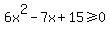
Find roots of the left side member. The x values to the left of the lesser root and the x values to the right of the greater root is the solution. I leave the algebra steps and the interval notation to you.
Question 1188325: Given  . Let a, b be any positive numbers where a is not equal to b, and . Let a, b be any positive numbers where a is not equal to b, and  , prove that , prove that 
Answer by CPhill(2189) (Show Source):
You can put this solution on YOUR website! Here's how to prove the given inequality:
**1. Analyze the given equation:**
We are given b\*log(a) - a\*log(b) = a - b. We can rewrite this as:
b\*log(a) - a = b - a\*log(b)
Dividing both sides by ab (since a and b are positive, we can safely do this):
log(a)/a - 1/b = 1/a - log(b)/b
log(a)/a + log(b)/b = 1/a + 1/b
**2. Relate to the function f(x):**
Notice that the left side of the equation above looks very similar to f(x) = x(1 - log(x)) if we divide by x. Let g(x) = log(x)/x. Then the equation can be written as:
g(a) + g(b) = 1/a + 1/b
We want to show that 2 < 1/a + 1/b < e. Substituting our expression, this is equivalent to:
2 < g(a) + g(b) < e
**3. Analyze g(x):**
Consider the function g(x) = log(x)/x. Let's find its derivative:
g'(x) = (1 - log(x))/x²
Notice that g'(x) = 0 when 1 - log(x) = 0, which means log(x) = 1, or x = e.
* If 0 < x < e, then log(x) < 1, so g'(x) > 0, meaning g(x) is increasing.
* If x > e, then log(x) > 1, so g'(x) < 0, meaning g(x) is decreasing.
Thus, g(x) reaches a maximum at x = e. The maximum value is g(e) = log(e)/e = 1/e.
**4. Consider the limits:**
As x approaches 0 from the right, g(x) approaches negative infinity. As x approaches infinity, g(x) approaches 0.
**5. Apply the information to the inequality:**
Since g(x) has a maximum value of 1/e at x = e, and it's increasing for 0 < x < e and decreasing for x > e, and we know that g(a) + g(b) = 1/a + 1/b, let's consider the function h(x) = g(x) + g(1/x).
h(x) = log(x)/x + log(1/x)/(1/x) = log(x)/x - xlog(x) = log(x)(1/x - x).
h(1) = 0.
We want to analyze h(x) when x is close to 1.
We know g(a) + g(b) = 1/a + 1/b. Since a ≠ b, let's assume, without loss of generality, that a < b.
If a and b are close to 1, g(a) and g(b) will be close to 0, and g(a) + g(b) will be close to 0, which is not greater than 2.
If a and b are on opposite sides of e, and g(a) + g(b) is close to 2/e, and a and b are close to e.
Since g(x) is maximized at x = e with g(e) = 1/e, and we have g(a) + g(b) = 1/a + 1/b, and we know that a and b are not equal, it implies that both *a* and *b* must be less than *e*.
Since g(x) is increasing for 0 < x < e, if a and b are close to 1, g(a) + g(b) will be close to 0. If a and b are close to e, g(a) + g(b) will be close to 2/e. Therefore, 2 < 1/a + 1/b < e.
**Final Answer:**
Therefore, 2 < 1/a + 1/b < e.
Question 1191311: Part A: Fernando is a student at Walt Disney High School and needs 220 credits to earn his high school diploma. He currently has 124 credits completed. There are 10 learning periods in one school year.
1. How many learning periods would it take for fernando to graduate if he completes three modules per learning period? (Remember that each module is worth one credit.)
2. How many school years would it take for fernando to finish at this rate? (Remember: there are 10 learning periods per school year)
3.How many learning periods would it take Fernando to graduate if he completes five modules per learning period?
4. How many school years would it take for Fernando to finish at this rate?
Answer by CPhill(2189) (Show Source):
You can put this solution on YOUR website! Here's how we can solve this problem:
**1. Learning periods to graduate with 3 modules per period:**
* **Credits needed:** Fernando needs 220 credits and has 124, so he needs 220 - 124 = 96 more credits.
* **Credits per learning period:** He completes 3 modules per learning period, and each module is worth 1 credit, so he earns 3 credits per learning period.
* **Learning periods needed:** To find the number of learning periods, divide the total credits needed by the credits earned per learning period: 96 credits / 3 credits/learning period = 32 learning periods.
**2. School years to graduate with 3 modules per period:**
* **Learning periods per school year:** There are 10 learning periods in a school year.
* **School years needed:** Divide the total learning periods needed by the number of learning periods per school year: 32 learning periods / 10 learning periods/school year = 3.2 school years. Since school years are typically counted in whole numbers, it would take Fernando 4 school years to graduate at this rate.
**3. Learning periods to graduate with 5 modules per period:**
* **Credits needed:** He still needs 96 credits.
* **Credits per learning period:** He now completes 5 modules per learning period, earning 5 credits per learning period.
* **Learning periods needed:** Divide the total credits needed by the credits earned per learning period: 96 credits / 5 credits/learning period = 19.2 learning periods. Since learning periods are typically counted in whole numbers, it will take Fernando 20 learning periods to graduate at this rate.
**4. School years to graduate with 5 modules per period:**
* **Learning periods per school year:** There are 10 learning periods per school year.
* **School years needed:** Divide the total learning periods needed by the number of learning periods per school year: 20 learning periods / 10 learning periods/school year = 2 school years.
Question 1197418: Florence is preparing cookies for a charity event and has to ensure that she earns profit to contribute to the charity. Each packet she sells consists of 10 cookies. Her fixed cost is €60 and the material cost for her cookies is €4.1/ with a packaging cost of €0.5N, in which N is the number of packs for every 10 cookies. Find N if Florence sells each packet for €6.50.
Answer by proyaop(69) (Show Source):
You can put this solution on YOUR website! **1. Define Variables**
* Let 'N' be the number of packs for every 10 cookies.
**2. Calculate Cost per Packet**
* Material Cost per Packet: €4.10
* Packaging Cost per Packet: €0.50 * N = €0.50N
* Total Cost per Packet: €4.10 + €0.50N
**3. Calculate Revenue per Packet**
* Selling Price per Packet: €6.50
**4. Calculate Profit per Packet**
* Profit per Packet = Revenue per Packet - Total Cost per Packet
* Profit per Packet = €6.50 - (€4.10 + €0.50N)
* Profit per Packet = €2.40 - €0.50N
**5. Determine the Condition for Profit**
* To earn a profit, Profit per Packet must be greater than 0.
* €2.40 - €0.50N > 0
**6. Solve for N**
* -€0.50N > -€2.40
* N < 2.40 / 0.50
* N < 4.8
**Therefore, Florence must produce less than 4.8 packs for every 10 cookies to ensure she earns a profit.**
**Since N represents the number of packs, it must be a whole number.**
* **To guarantee profit, Florence should produce 4 or fewer packs for every 10 cookies.**
Question 1209307: Let x and y be nonnegative real numbers. If x^2 + 5y^2 = 30, then find the maximum value of x^2 + y^2.
Found 2 solutions by math_tutor2020, ikleyn:
Answer by math_tutor2020(3835) (Show Source):
You can put this solution on YOUR website!
I'll refer to the two nonnegative numbers as m and n.
m^2 + 5n^2 = 30 rearranges to m^2 = 30 - 5n^2
Plug that into the expression we want to max out.
m^2 + n^2
= 30-5n^2 + n^2
= 30-4n^2
We want to make 30-4n^2 as large as possible.
This is equivalent to looking for the highest point on the upside down parabola y = 30-4x^2 aka y = -4x^2+30.
The smallest that x^2 can get is 0.
The negative out front will flip things to show that -4x^2 maxes out when x = 0
Therefore y = -4x^2+30 maxes out when x = 0 and its paired value is y = 30.
The vertex of y = -4x^2+30 is (0,30) which is the highest point on this parabola.
You can use a graphing tool such as Desmos and GeoGebra to confirm.
Or you can go old-school with something like a TI83.
The y coordinate of this vertex is the max value of 30-4n^2 aka m^2 + n^2 when m^2+5n^2 = 30.
A somewhat similar question is found here
Answer: 30
Answer by ikleyn(53748) (Show Source):
You can put this solution on YOUR website! .
Let x and y be nonnegative real numbers.
If x^2 + 5y^2 = 30, then find the maximum value of x^2 + y^2.
~~~~~~~~~~~~~~~~~~~~~~~~~~~
From the given equation

    x^2 + 5y^2 = 30,

express

    x^2 = 30 - 5y^2

and substitute it into another expression.  You will get

    x^2 + y^2 = (30-5y^2) + y^2 = 30 - 4y^2.


It has the maximum value of 30 when y = 0  (which is a non-negative real number).


ANSWER.  The requested maximum value of  x^2+y^2  is  30.
Solved.
Question 1209291: Solve the inequality 4t^2 \le -9t + 12. Write your answer in interval notation.
Found 2 solutions by ikleyn, textot:
Answer by ikleyn(53748) (Show Source):
Answer by textot(100) (Show Source):
You can put this solution on YOUR website! **1. Rewrite the inequality**
* 4t² ≤ -9t + 12
* 4t² + 9t - 12 ≤ 0
**2. Find the roots of the quadratic equation**
* 4t² + 9t - 12 = 0
* (4t - 3)(t + 4) = 0
* t = 3/4 or t = -4
**3. Determine the intervals**
* The roots divide the number line into three intervals:
* Interval 1: t ≤ -4
* Interval 2: -4 ≤ t ≤ 3/4
* Interval 3: t ≥ 3/4
**4. Test points in each interval**
* **Interval 1 (t ≤ -4):** Choose t = -5.
* 4(-5)² + 9(-5) - 12 = 100 - 45 - 12 = 43 > 0
* **Interval 2 (-4 ≤ t ≤ 3/4):** Choose t = 0.
* 4(0)² + 9(0) - 12 = -12 ≤ 0
* **Interval 3 (t ≥ 3/4):** Choose t = 1.
* 4(1)² + 9(1) - 12 = 1 > 0
**5. Determine the solution**
* The inequality 4t² + 9t - 12 ≤ 0 is satisfied in **Interval 2**.
**6. Write the solution in interval notation**
* **Solution: [-4, 3/4]**
**Therefore, the solution to the inequality 4t² ≤ -9t + 12 in interval notation is [-4, 3/4].**
Question 1209290: Solve the inequality x(x + 6) > 16 - x^2 + 14x. Write your answer in interval notation.
Found 2 solutions by math_tutor2020, mccravyedwin:
Answer by math_tutor2020(3835) (Show Source):
You can put this solution on YOUR website!
Consider the equation 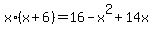
Let's get everything to one side.
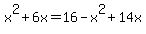
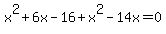
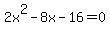
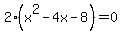

That last equation is of the format 
where,
a = 1, b = -4, c = -8
Plug those into the quadratic formula.


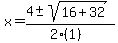

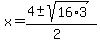
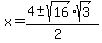


 or or 
 or or  both of which are approximate. both of which are approximate.
--------------------------------------------------------------------------
Draw a number line with regions A, B, C
region A = stuff to the left of -1.464
region B = stuff between -1.464 and 5.464
region C = stuff to the right of 5.464
Possible test values for regions A,B,C could be: x = -2, x = 0, x = 6 in that order
You plug each test value back into the original inequality 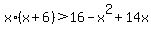 to see if we get a true statement or not. to see if we get a true statement or not.
If we tried x = -2, then,


which is true.
Any x value in region A is in the solution set for
Region A is  aka aka 
Yielding the interval notation 
Use curved parenthesis to indicate we do not include the endpoints in the solution set.
If we tried x = 0 then
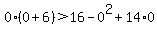

which is false.
Any x value in region B, ie the region between  and and  will make the original inequality false. will make the original inequality false.
The last region to test is region C.
Let's plug in x = 6
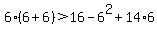

which is true
Therefore  aka aka 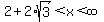 translates to the interval notation translates to the interval notation 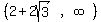
We found these two interval notation regions
or
Glue them together with a set union symbol to end up with this final answer

You can use a graphing calculator like Desmos and GeoGebra to confirm.
Answer by mccravyedwin(421) (Show Source):
Question 1209300: Solve the inequality x^3 + 4x > 5x^2 - 20x + 8. Write your answer in interval notation.
Answer by greenestamps(13327) (Show Source):
You can put this solution on YOUR website!
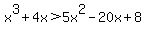
Rewrite the inequality with all non-zero terms on the left:
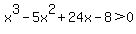
Use a graphing utility to find the equation has a single real root at approximately 0.35814. Since the leading coefficient is positive, the inequality is true for all x greater than that root.
ANSWER (approximately): (0.35814,infinity)
If the polynomial had three rational roots, finding the exact solution to the inequality would be good exercise in formal algebra. But since the polynomial has only one real root, which is irrational, finding the approximate answer using a graphing utility is the sensible way to go.
Question 1209289: Solve the inequality (x - 2)(x + 6) \le -x^2 + 5x - 15. Write your answer in interval notation.
Answer by ikleyn(53748) (Show Source):
You can put this solution on YOUR website! .
Solve the inequality (x - 2)(x + 6) \le -x^2 + 5x - 15. Write your answer in interval notation.
~~~~~~~~~~~~~~~~~~~~~~~~~~
Starting inequality is

    (x - 2)(x + 6) <= -x^2 + 5x - 15.


Simplify and reduce to the standard form quadratic equation

    x^2 + 4x - 12 <= -x^2 + 5x - 15,

    2x^2 - x + 3 <= 0.


Calculate the discriminant

    d = b^2 - 4ac = (-1)^2 - 4*2*3 = 1 - 24 = -23.


The discriminant is negative.


It means that the quadratic function  y = 2x^2 - x + 3  has no zeroes and is positive
everywhere on the number line for all real numbers.


Therefore, the set of solutions is EMPTY.
It can not be presented in the interval notation.
Solved.
Question 1209292: Solve the inequality
(3 - z)/(z + 1) \ge 2 + 1/(z - 7).
Write your answer in interval notation.
Answer by greenestamps(13327) (Show Source):
|
Older solutions: 1..45, 46..90, 91..135, 136..180, 181..225, 226..270, 271..315, 316..360, 361..405, 406..450, 451..495, 496..540, 541..585, 586..630, 631..675, 676..720, 721..765, 766..810, 811..855, 856..900, 901..945, 946..990, 991..1035, 1036..1080, 1081..1125, 1126..1170, 1171..1215, 1216..1260, 1261..1305, 1306..1350, 1351..1395, 1396..1440, 1441..1485, 1486..1530, 1531..1575, 1576..1620, 1621..1665, 1666..1710, 1711..1755, 1756..1800, 1801..1845, 1846..1890, 1891..1935, 1936..1980, 1981..2025, 2026..2070, 2071..2115, 2116..2160, 2161..2205, 2206..2250, 2251..2295, 2296..2340, 2341..2385, 2386..2430, 2431..2475, 2476..2520, 2521..2565, 2566..2610, 2611..2655, 2656..2700, 2701..2745, 2746..2790, 2791..2835, 2836..2880, 2881..2925, 2926..2970, 2971..3015, 3016..3060, 3061..3105, 3106..3150, 3151..3195, 3196..3240, 3241..3285, 3286..3330, 3331..3375, 3376..3420, 3421..3465, 3466..3510, 3511..3555, 3556..3600, 3601..3645, 3646..3690, 3691..3735, 3736..3780, 3781..3825, 3826..3870, 3871..3915, 3916..3960, 3961..4005, 4006..4050, 4051..4095, 4096..4140, 4141..4185, 4186..4230, 4231..4275, 4276..4320, 4321..4365, 4366..4410, 4411..4455, 4456..4500, 4501..4545, 4546..4590, 4591..4635, 4636..4680, 4681..4725, 4726..4770, 4771..4815, 4816..4860, 4861..4905, 4906..4950, 4951..4995, 4996..5040, 5041..5085, 5086..5130, 5131..5175, 5176..5220, 5221..5265, 5266..5310, 5311..5355, 5356..5400, 5401..5445, 5446..5490, 5491..5535, 5536..5580, 5581..5625, 5626..5670, 5671..5715, 5716..5760, 5761..5805, 5806..5850, 5851..5895, 5896..5940, 5941..5985, 5986..6030, 6031..6075, 6076..6120, 6121..6165, 6166..6210, 6211..6255, 6256..6300, 6301..6345, 6346..6390, 6391..6435, 6436..6480, 6481..6525, 6526..6570, 6571..6615, 6616..6660, 6661..6705, 6706..6750, 6751..6795, 6796..6840, 6841..6885, 6886..6930, 6931..6975, 6976..7020, 7021..7065, 7066..7110, 7111..7155, 7156..7200, 7201..7245, 7246..7290, 7291..7335, 7336..7380, 7381..7425, 7426..7470, 7471..7515, 7516..7560, 7561..7605, 7606..7650, 7651..7695, 7696..7740, 7741..7785, 7786..7830, 7831..7875, 7876..7920, 7921..7965, 7966..8010, 8011..8055, 8056..8100, 8101..8145, 8146..8190, 8191..8235, 8236..8280, 8281..8325, 8326..8370, 8371..8415, 8416..8460, 8461..8505, 8506..8550, 8551..8595, 8596..8640, 8641..8685, 8686..8730, 8731..8775, 8776..8820, 8821..8865, 8866..8910, 8911..8955, 8956..9000, 9001..9045, 9046..9090, 9091..9135, 9136..9180, 9181..9225, 9226..9270, 9271..9315, 9316..9360, 9361..9405, 9406..9450, 9451..9495, 9496..9540, 9541..9585, 9586..9630, 9631..9675, 9676..9720, 9721..9765, 9766..9810, 9811..9855, 9856..9900, 9901..9945, 9946..9990, 9991..10035, 10036..10080, 10081..10125, 10126..10170, 10171..10215, 10216..10260, 10261..10305, 10306..10350, 10351..10395, 10396..10440, 10441..10485, 10486..10530, 10531..10575, 10576..10620, 10621..10665, 10666..10710, 10711..10755, 10756..10800, 10801..10845, 10846..10890, 10891..10935, 10936..10980, 10981..11025, 11026..11070, 11071..11115, 11116..11160, 11161..11205
|
| |
