Question 282422: Solve using the five-step problem-solving process. Show all steps necessary to arrive at your solution.
The product of two consecutive positive integers is 272. Find the integers.
Found 2 solutions by richwmiller, solver91311:
Answer by richwmiller(17219)   (Show Source): (Show Source):
You can put this solution on YOUR website! x*(x+1)=272
x^2+x-272=0
16 and 17
| Solved by pluggable solver: Factoring using the AC method (Factor by Grouping) |
Looking at the expression  , we can see that the first coefficient is , we can see that the first coefficient is  , the second coefficient is , and the last term is , the second coefficient is , and the last term is  . .
Now multiply the first coefficient by the last term to get  . .
Now the question is: what two whole numbers multiply to (the previous product) and add to the second coefficient ?
To find these two numbers, we need to list all of the factors of (the previous product).
Factors of :
1,2,4,8,16,17,34,68,136,272
-1,-2,-4,-8,-16,-17,-34,-68,-136,-272
Note: list the negative of each factor. This will allow us to find all possible combinations.
These factors pair up and multiply to .
1*(-272) = -272
2*(-136) = -272
4*(-68) = -272
8*(-34) = -272
16*(-17) = -272
(-1)*(272) = -272
(-2)*(136) = -272
(-4)*(68) = -272
(-8)*(34) = -272
(-16)*(17) = -272
Now let's add up each pair of factors to see if one pair adds to the middle coefficient :
| First Number | Second Number | Sum | | 1 | -272 | 1+(-272)=-271 | | 2 | -136 | 2+(-136)=-134 | | 4 | -68 | 4+(-68)=-64 | | 8 | -34 | 8+(-34)=-26 | | 16 | -17 | 16+(-17)=-1 | | -1 | 272 | -1+272=271 | | -2 | 136 | -2+136=134 | | -4 | 68 | -4+68=64 | | -8 | 34 | -8+34=26 | | -16 | 17 | -16+17=1 |
From the table, we can see that the two numbers  and and  add to (the middle coefficient). add to (the middle coefficient).
So the two numbers and both multiply to and add to
Now replace the middle term  with with  . Remember, and add to . So this shows us that . Remember, and add to . So this shows us that  . .
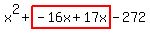 Replace the second term with . Replace the second term with .
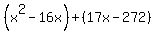 Group the terms into two pairs. Group the terms into two pairs.
 Factor out the GCF Factor out the GCF  from the first group. from the first group.
 Factor out from the second group. The goal of this step is to make the terms in the second parenthesis equal to the terms in the first parenthesis. Factor out from the second group. The goal of this step is to make the terms in the second parenthesis equal to the terms in the first parenthesis.
 Combine like terms. Or factor out the common term Combine like terms. Or factor out the common term 
===============================================================
Answer:
So factors to .
In other words,  . .
Note: you can check the answer by expanding to get or by graphing the original expression and the answer (the two graphs should be identical).
|
| Solved by pluggable solver: SOLVE quadratic equation with variable |
Quadratic equation  (in our case (in our case  ) has the following solutons: ) has the following solutons:

For these solutions to exist, the discriminant  should not be a negative number. should not be a negative number.
First, we need to compute the discriminant :  . .
Discriminant d=1089 is greater than zero. That means that there are two solutions:  . .


Quadratic expression 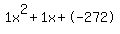 can be factored: can be factored:

Again, the answer is: 16, -17.
Here's your graph:
 |
Answer by solver91311(24713)  (Show Source): (Show Source):
| |
|
