|
Tutors Answer Your Questions about Rate-of-work-word-problems (FREE)
Question 955974: Person A can paint the neighbor's house 5 times as fast as Person B. The year A and B worked together, it took them 7 days. How long would it take each to paint the house?
Found 2 solutions by josgarithmetic, ikleyn:
Answer by josgarithmetic(39825)  (Show Source): (Show Source):
Answer by ikleyn(53889)  (Show Source): (Show Source):
You can put this solution on YOUR website! .
Person A can paint the neighbor's house 5 times as fast as Person B.
The year A and B worked together, it took them 7 days. How long would it take each to paint the house?
~~~~~~~~~~~~~~~~~~~~~~~~~~
In his post, @lwsshar3 solved the problem, using equations.
Actually, this problem is very simple and is arithmetical in its nature.
In other words, it can be solved MENTALLY, using arithmetic and common sense only, without involving equations.
Such mental solutions develop the childs' minds very much, making them more flexible and stronger.
It is why I can not resist to provide this mental solution here.
Person A works as 5 copies of person B.
So, the team "A+B' works as productive as 6 copies of B.
So, from the problem, 6 copies of B can make the job in 7 days.
Hence, one single B will complete the whole job in 6*7 = 42 days.
From it, one single A will complete the job 5 time faster, in 42/5 = 8  = 8.4 days. = 8.4 days.
At this point, the problem is solved completely: mentally and without using equations.
Question 547951: 1/2 sqrt(18) - 3/sqrt(2) - 9 sqrt(50)
Answer by MathTherapy(10839)  (Show Source): (Show Source):
Question 976287: One person left at 9:00am and drove north at 60 miles per hr. Another person left the same rest stop and an hour later and headed south at 50 mph. What time were they 335 miles apart ?
Found 2 solutions by greenestamps, ikleyn:
Answer by greenestamps(13358)  (Show Source): (Show Source):
Answer by ikleyn(53889) (Show Source):
You can put this solution on YOUR website! .
One person left at 9:00am and drove north at 60 miles per hr.
Another person left the same rest stop an hour later and headed south at 50 mph.
What time were they 335 miles apart ?
~~~~~~~~~~~~~~~~~~~~~~~~~~
The answer "11:30 am" in the post by @lwsshak3 is incorrect.
The correct answer is "12:30 am".
Question 975770: A and B can do a piece of work in 6 days,B and c together in 10 days,c and A together in 7 1/2 days.in how many days can c individually completes the work?
Found 3 solutions by greenestamps, n2, ikleyn:
Answer by greenestamps(13358) (Show Source):
You can put this solution on YOUR website!
Tutor @ikleyn has provided a solution using the standard formal method, using the rates of each worker.
Here is a solution by a different method that can usually be used to solve these "working together" problems.
Consider the least common multiple of the three given times needed for the three different pairs of workers to complete the job. That least common multiple is 30 days.
In 30 days...
(1) A and B together can do the job 30/6 = 5 times;
(2) B and C together can do the job 30/10 = 3 times; and
(3) A and C together can do the job 30/7.5 = 4 times
(4) From (2) and (3), A in 30 days can do the job 1 more time than B.
(5) Then, from (1) and (4), in 30 days A can do the job 3 times and B can do it 2 times.
Finally, from (5) and either (2) or (3), in 30 hours C can do the job 1 time.
ANSWER: 30 hours
Answer by n2(89) (Show Source): (Show Source):
You can put this solution on YOUR website! .
A and B can do a piece of work in 6 days, B and C together in 10 days, C and A together in 7 1/2 days.
in how many days can C individually completes the work?
~~~~~~~~~~~~~~~~~~~~~~~~~~~~
Let 'a' be the rate of work for A;
'b' be the rate of work for B;
'c' be the rate of work for C.
From the problem, we have this system of equations
a + b =  , (1)
b + c = , (1)
b + c =  , (2)
a + c = , (2)
a + c =  . (3)
Add equations (1), (2) and (3). You will get
2(a + b + c) = + + . (4)
Multiply both sides of (5) by 60. Notice that . (3)
Add equations (1), (2) and (3). You will get
2(a + b + c) = + + . (4)
Multiply both sides of (5) by 60. Notice that  = 8. You will get
120*(a + b + c) = 12 + 6 + 8 = 24,
which implies
a + b + c = = 8. You will get
120*(a + b + c) = 12 + 6 + 8 = 24,
which implies
a + b + c =  ,
or
a + b + c = . (5)
Now, to find 'c', subtract equation (1) from equation (5). You will get
c = - ,
or
a + b + c = . (5)
Now, to find 'c', subtract equation (1) from equation (5). You will get
c = -  = =  = =  .
Hence, the C's rate of work is 1/30 of the job per day,
which means that C can complete the entire job in 30 days working alone.
ANSWER. C can complete the entire job in 30 days working alone. .
Hence, the C's rate of work is 1/30 of the job per day,
which means that C can complete the entire job in 30 days working alone.
ANSWER. C can complete the entire job in 30 days working alone.
Solved.
Answer by ikleyn(53889) (Show Source):
You can put this solution on YOUR website! .
A and B can do a piece of work in 6 days, B and C together in 10 days, C and A together in 7 1/2 days.
in how many days can C individually completes the work?
~~~~~~~~~~~~~~~~~~~~~~~~~~~~
The "solution" provided by @lwsshar3 is incorrect substantially and atrocious in form.
It is incorrect substantially because, in the course of solving the problem,
@lwsshar3 uses wrong number 7 instead of the given value of 7.5.
It is atrocious in form because nothing useful can be learned from his presentation.
Meanwhile, the problem itself is fantastically beautiful substantially
and admits an upper class solution, giving a food for a student's mind.
Let  'a'  be the rate of work for A;
     'b'  be the rate of work for B;
     'c'  be the rate of work for C.


From the problem, we have this system of equations

    a + b = ,      (1)

    b + c = ,     (2)

    a + c = .    (3)


Add equations (1), (2) and (3).  You will get

    2(a + b + c) =  +  + .    (4)


Multiply both sides of (5) by 60.  Notice that   = 8.  You will get

    120*(a + b + c) = 12 + 6 + 8 = 24,

which implies

    a + b + c = ,

or

    a + b + c = .    (5)


Now, to find 'c', subtract equation (1) from equation (5).  You will get

    c =  -  =  = .


Hence, the C's rate of work is 1/30 of the job per day,
which means that C can complete the entire job in 30 days working alone.


ANSWER.  C can complete the entire job in 30 days working alone.
Solved correctly as it should be done and presented in a way as it is expected to be done
to teach you in a way how it should be done.
////////////////////////////////////
Returning to the post by @lwsshar3, I only can say that it is a blatant gibberish,
inappropriate neither as a solution to the problem nor as a tool for teaching.
Question 850681: A machine P can print one math book in 8 hours, machine Q can print the same number of books in 10 hours while machine R can print them in 12 hours. All the machines are started at 9 A.M. while machine P is closed at 11 A.M. and the remaining two machines complete work. Approximately at what time will the work (to print one math book) be finished ?
Answer by MathTherapy(10839) (Show Source):
You can put this solution on YOUR website!
A machine P can print one math book in 8 hours, machine Q can print the same number of
books (this author believes this should be PAGES) in 10 hours while machine R can print them in
12 hours. All the machines are started at 9 A.M. while machine P is closed at 11 A.M. and the
remaining two machines complete work. Approximately at what time will the work (to print one
math book) be finished ?
***************************************************************
The other person's answer, "approximately" 12:03 PM....", is WRONG!!
Machine P does the job (prints book) in 8 hrs, or does  of entire job in 1 hr
Machines P and Q do the job (print book) in 10 and 12 hrs, respectively
Then each does of entire job in 1 hr
Machines P and Q do the job (print book) in 10 and 12 hrs, respectively
Then each does  and and  of entire job in 1 hr, respectively
In 2 hours, the 3 machines complete of entire job in 1 hr, respectively
In 2 hours, the 3 machines complete 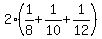 = =  = =  = =  = =  Let the time it takes Q and R to complete the job, be T
Then working together, Q and R completes
Let the time it takes Q and R to complete the job, be T
Then working together, Q and R completes  of the job
We then get the following COMPLETE-JOB equation: T1(rates) + T2(rates) = 1 (entire job), OR
Fraction completed + Remaining Fraction = 1 (entire job). This produces: of the job
We then get the following COMPLETE-JOB equation: T1(rates) + T2(rates) = 1 (entire job), OR
Fraction completed + Remaining Fraction = 1 (entire job). This produces:
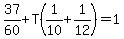
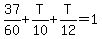 37 + 6T + 5T = 60 ---- Multiplying by LCD, 60
37 + 11T = 60
11T = 60 - 37
11T = 23
Time it takes Q and R to complete the job, after P, Q, and R worked together for 2 hrs, or
37 + 6T + 5T = 60 ---- Multiplying by LCD, 60
37 + 11T = 60
11T = 60 - 37
11T = 23
Time it takes Q and R to complete the job, after P, Q, and R worked together for 2 hrs, or 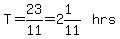 or 2 hrs, 5.5 minutes, approximately.
Finally, 2 hrs, 5.5 minutes after 11:00 a.m. takes us to 1:05.5, or approximately 1:06 p.m.
ANECDOTE
As seen above, the other person's approximated 1-hr claim is INVALID. The 3 machines completed of job in 2
hours, which leaves
or 2 hrs, 5.5 minutes, approximately.
Finally, 2 hrs, 5.5 minutes after 11:00 a.m. takes us to 1:05.5, or approximately 1:06 p.m.
ANECDOTE
As seen above, the other person's approximated 1-hr claim is INVALID. The 3 machines completed of job in 2
hours, which leaves  of the job, incomplete. Does it make sense that 3 machines take 2 hours to complete ,
or > of the job, incomplete. Does it make sense that 3 machines take 2 hours to complete ,
or >  of the job, but 2 of the 3 machines take just 1 hour to complete the remaining of the job, but 2 of the 3 machines take just 1 hour to complete the remaining  (approximation),
especially when the FASTEST of the 3, P, is no longer working? (approximation),
especially when the FASTEST of the 3, P, is no longer working?
Question 1002869: The Department ot Education is holding their annual Brigada Eskwela to prepare and clean up the classrooms.Kimberly can paint a chair in 45 minutes.Arthur can paint the same chairs in 30 minutes. If they work together, how long will it take them to paint six chairs.
Found 5 solutions by math_tutor2020, greenestamps, josgarithmetic, n2, ikleyn:
Answer by math_tutor2020(3837) (Show Source):
You can put this solution on YOUR website!
Let's say for a hypothetical argument that each chair's surface area is 900 square inches.
As it turns out, this figure 900 doesn't matter since you can change it to any positive real number you want. The final answer at the end will remain the same.
Kimberly can paint one chair (900 square inches) in 45 minutes, so her unit rate is 20 square inches per minute because:
rate = amountDone/time = 900/45 = 20 square inches per minute
Meanwhile,
Arthur's unit rate = 900/30 = 30 square inches per minute
When the two work together, the combined unit rate would be 20+30 = 50 square inches per minute.
This assumes neither person slows the other down.
1 chair has 900 square inches of material.
6 chairs cover 6*900 = 5400 square inches
rate*time = amountDone
time = amountDone/rate
time = 5400/50
time = 108 minutes
time = 60 min + 48 min
time = 1 hr + 48 min
Answer: 108 minutes (i.e. 1 hour & 48 minutes)
Side note: The answer by mananth applies to 1 chair. You have to multiply 18 by 6 to get the time duration for 6 chairs.
Answer by greenestamps(13358) (Show Source):
You can put this solution on YOUR website!
All of the responses you have received so far use the same formal algebraic method that is found in most textbooks, using fractions of the job performed by each worker each minute.
Here is a less formal way of solving this kind of problem; this method can be a lot faster than the formal algebraic method, especially if the numbers are "nice".
Consider the least common multiple of the two given times, which is 90 minutes. In 90 minutes...
the number of chairs Kimberly can paint is 90/45 = 2
the number of chairs Arthur can paint is 90/3 = 3
the number of chairs they can paint together is 2+3 = 5
They can paint 5 chairs in 90 minutes, so the number of minutes it takes them to paint each chair is 90/5 = 18.
So the time required for them to paint 6 chairs is 18*5 = 108 minutes
ANSWER: 108 minutes
Answer by josgarithmetic(39825) (Show Source):
Answer by n2(89) (Show Source):
Answer by ikleyn(53889) (Show Source):
Question 1027961: A takes 10 days less than the time taken by B to finish an embroidery work. If both A and B together can finish the work in 12 days. Find the time taken by B alone to finish the work.
Found 2 solutions by josgarithmetic, ikleyn:
Answer by josgarithmetic(39825) (Show Source):
Answer by ikleyn(53889) (Show Source):
You can put this solution on YOUR website! .
In the post by @mananth, the solution to the problem is correct,
but the answer presented in his post is wrong.
The correct answer is
A takes 20 days
B takes 30 days to do the job alone
Question 1029990: A container 80cm/60cm/70cm needs to be filled up completely with water. Tube A supplies 24l of water per minute and Tube B supplies 18l of water per minute. Mr Tan fills up the container by taking turns to use both Tubes for 17minutes. How long does he use each of the Tubes?
Found 2 solutions by n2, ikleyn:
Answer by n2(89) (Show Source):
You can put this solution on YOUR website! .
A container 80cm/60cm/70cm needs to be filled up completely with water.
Tube A supplies 24l of water per minute and Tube B supplies 18l of water per minute.
Mr Tan fills up the container by taking turns to use both Tubes for 17minutes.
How long does he use each of the Tubes?
~~~~~~~~~~~~~~~~~~~~~~~~~~~
The volume of the tank is 80*60*70 = 336000 cm^3,  or 336 liters.

Let x be the time for tube A working, in minutes;

then (17-x) is the time for the tube B working.


Write an equation for the total volume

    24*x + 18*(17-x) = 336.


Simplify and find x

    24x + 306 - 18x = 336

    24x - 18x = 336 - 306

        6x    =    30

         x    =    30/6 = 5.


So, tube A worked 5 minutes;  tube B worked 17-5 = 12 minutes.    <<<---===  ANSWER


CHECK.  The total volume is  24*5 + 18*12 = 336 liters,  which is precisely correct.
Solved.
Answer by ikleyn(53889) (Show Source):
You can put this solution on YOUR website! .
A container 80cm/60cm/70cm needs to be filled up completely with water.
Tube A supplies 24l of water per minute and Tube B supplies 18l of water per minute.
Mr Tan fills up the container by taking turns to use both Tubes for 17minutes.
How long does he use each of the Tubes?
~~~~~~~~~~~~~~~~~~~~~~~~~~~
The solution in the post by @mananth is FATALLY INCORRECT.
It is incorrect, because his setup equations are irrelevant to the problem.
I came to bring a correct solution.
The volume of the tank is 80*60*70 = 336000 cm^3,  or 336 liters.

Let x be the time for tube A working, in minutes;

then (17-x) is the time for the tube B working.


Write an equation for the total volume

    24*x + 18*(17-x) = 336.


Simplify and find x

    24x + 306 - 18x = 336

    24x - 18x = 336 - 306

        6x    =    30

         x    =    30/6 = 5.


So, tube A worked 5 minutes;  tube B worked 17-5 = 12 minutes.    <<<---===  ANSWER


CHECK.  The total volume is  24*5 + 18*12 = 336 liters,  which is precisely correct.
Solved correctly.
This situation is 100% typical.
@mananth uses a computer code, which generates solutions for his problems.
If a problem is one step from a standard, the code produces gibberish,
but @mananth's reaction is zero - he NEVER reads what his code does produce:
he submits it to the forum without reading it, without checking and without looking at it.
It is why every his post should be checked by others and it is why I check as many of them as I can.
Question 1038207: Paul can do a certain job in half the time that Jim requires to do it. Jim worked alone for an hour and stopped; then Paul completed the job in 10 hours. What length of time, in hours, would Paul, working alone, take to do the whole job?
Found 4 solutions by KMST, josgarithmetic, n2, ikleyn:
Answer by KMST(5381)  (Show Source): (Show Source):
Answer by josgarithmetic(39825) (Show Source):
Answer by n2(89) (Show Source):
You can put this solution on YOUR website! .
Paul can do a certain job in half the time that Jim requires to do it.
Jim worked alone for an hour and stopped; then Paul completed the job in 10 hours.
What length of time, in hours, would Paul, working alone, take to do the whole job?
~~~~~~~~~~~~~~~~~~~~~~~~~~~~~~~
Let 'a' be the Jim's rate of work, i.e. part of work, which Jim makes in 1 hour.

Then the Paul's rate of work is 2a, according to the problem.


Jim worked alone for an hour and stopped; then Paul completed the job in 10 hours.


It means that

    a + 10*(2a) = 1,    where '1' represents the whole job.


From this equation, we find

    a + 20a = 1  --->  21a = 1  --->  a = 1/21.


It means that Jim makes 1/21 of the Job per hour.
In other words, Jim needs 21 hours to make the whole job alone.

Hence, according to the problem, Paul needs half of 21 hours to make the whole job alone.

In other words, Paul needs 21/2 = 10.5 hours to make the whole job alone.    ANSWER
Answer by ikleyn(53889) (Show Source):
You can put this solution on YOUR website! .
Paul can do a certain job in half the time that Jim requires to do it.
Jim worked alone for an hour and stopped; then Paul completed the job in 10 hours.
What length of time, in hours, would Paul, working alone, take to do the whole job?
~~~~~~~~~~~~~~~~~~~~~~~~~~~~~~~
The solution by @mananth to this problem is INCORRECT.
It is obvious if to compare his answer with the given data in the problem.
I came to bring a correct solution.
Let 'a' be the Jim's rate of work, i.e. part of work, which Jim makes in 1 hour.

Then the Paul's rate of work is 2a, according to the problem.


Jim worked alone for an hour and stopped; then Paul completed the job in 10 hours.


It means that

    a + 10*(2a) = 1,    where '1' represents the whole job.


From this equation, we find

    a + 20a = 1  --->  21a = 1  --->  a = 1/21.


It means that Jim makes 1/21 of the Job per hour.
In other words, Jim needs 21 hours to make the whole job alone.

Hence, according to the problem, Paul needs half of 21 hours to make the whole job alone.

In other words, Paul needs 21/2 = 10.5 hours to make the whole job alone.    ANSWER
At this point, the problem is solved completely and correctly.
-------------------------
What we observe in this case, is very typical situation.
The solution by @mananth was created by a computer code - which was a prototype of an Artificial Intelligence in its current state.
As soon as this code met a non-standard formulation, it produced wrong solution (= kind of gibberish).
Not only it produced wrong solution - it even did not check it, even did not notice it and even did not react
on wrong solution.
It shows, that the AI is in its infantile state and can work properly only if real persons and experts
accompany its work, checking every step.
Question 394478: A piece of work can be done in 48 days by 40 men. After 15 days, 16 men were transferred. In how many days can the remaining men finish the work?
Found 2 solutions by ikleyn, MathTherapy:
Answer by ikleyn(53889) (Show Source):
You can put this solution on YOUR website! .
A piece of work can be done in 48 days by 40 men. After 15 days, 16 men were transferred.
In how many days can the remaining men finish the work?
~~~~~~~~~~~~~~~~~~~~~~~~~~~~~~~~~
Below is simple arithmetic solution, without using Algebra.
The entire job is 40 men * 48 days = 1920 man-days.

40 men, working 15 days, used 40*15 = 600 man-days.


The remaining job is 1920-600 = 1320 man-days.


Now only 40-16 = 24 men work.


They will complete the remaining job in  1320/24 = 55 days.    <<<---===  ANSWER
Solved.
Answer by MathTherapy(10839) (Show Source):
You can put this solution on YOUR website!
A piece of work can be done in 48 days by 40 men. After 15 days, 16 men were transferred. In how many days
can the remaining men finish the work?
**************************************
79.375 days, by one of the persons who responded, is WRONG!! The other person's answer is correct, but for 55 days, not
the 55 hours he posted!
Question 1154714: Howard and Edward, working together, can complete a job in 12 hours. Edward requires 18 hours to do this job alone. Howard and Edward start the job. After they worked for 4 hours, Howard left the job. How many hours will Edward require to finish the job working alone?
Found 2 solutions by josgarithmetic, ikleyn:
Answer by josgarithmetic(39825) (Show Source):
Answer by ikleyn(53889) (Show Source):
Question 1081944: 80 men can finish the job in 60 days. At the 16th day, 5 men were laid off and at the 45th day, 10 men were hired. How many days were they delayed finishing the job.
Found 3 solutions by ikleyn, math_tutor2020, MathTherapy:
Answer by ikleyn(53889) (Show Source):
You can put this solution on YOUR website! .
80 men can finish the job in 60 days. At the 16th day, 5 men were laid off and at the 45th day,
10 men were hired. How many days were they delayed finishing the job.
~~~~~~~~~~~~~~~~~~~~~~~~~~~
I will show you the method, which you (i hope) will remember for all your life.
(1)  The entire job is 80 men * 60 days = 4800 man-days.


(2)  80 men worked first 15 day and used 80 * 15 = 1200 man-days.

     The remaining job is 4800 - 1200 = 3600  man days.


(3)  Then (80-5) = 75 men worked from the day 16th till the day 44th inclusively, i.e. 44-15 = 29 days.

     They used 75 * 29 = 2175 man-days, and 3600 - 2175 = 1425 man-days work remained.


(4)  Starting from the 45th day, 75+10 = 85 men work.

     They complete the remaining job in  1425/85 = 16.7647 days, approximately.


(5)  So, the number of days they worked to complete the job is  15 + 29 + 16.7647 = 60.7647.    ANSWER


You can round it in a way you want.
Solved and explained.
Counting man-days (or man-hours, or man-minutes)
is a powerful method solving rate-of-work problems.
Answer by math_tutor2020(3837) (Show Source):
You can put this solution on YOUR website!
Let's say hypothetically that the job is to move 9600 stones.
I got this value by multiplying the numbers in the first sentence, then doubling the result.
It turns out that this value can be changed to any thing else you want; the final answer at the end will be the same. I picked 9600 so that I would get an integer when dividing in the next paragraph.
9600 stones
80 men
9600/80 = 120 stones per person
Each person is responsible for moving 120 stones. Each person can do it in 60 days, so the rate is 120/60 = 2 stones per day.
At the end of the 15th day, each person has moved 15*2 = 30 stones.
So that is 80*30 = 2400 stones that have been moved so far.
There are 9600-2400 = 7200 stones remaining.
5 men are laid off, so there are 80-5 = 75 men remaining.
The time gap from day 16 to day 44 is 44-16+1 = 29 days.
In those 29 days, 75 men move 75*2*29 = 4350 stones
7200-4350 = 2850 stones remain at the end of day 44.
On day 45, there are 10 new workers to bring the count to 75+10 = 85 workers.
x = number of days to move the remaining stones
85*2*x = 170x = number of stones to move
170x = 2850
x = 2850/170
x = 285/17
x = 16.765 approximately
44+x = 44+16.765 = 60.765 days (roughly) is the time it takes for the entire job to be completed.
This rounds to roughly 61 days.
This is in contrast to the estimated 60 day window.
61-60 = 1 is the amount they go over.
Answer: Approximately 1 day late
Answer by MathTherapy(10839) (Show Source):
You can put this solution on YOUR website!
80 men can finish the job in 60 days. At the 16th day, 5 men were laid off and at the 45th day, 10 men were hired.
How many days were they delayed finishing the job.
**************************************************
7+-day delay, from the other person is WRONG!!
80-MAN rate:  1-MAN rate:
 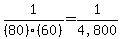 75-MAN rate:
 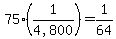 85-MAN rate:
 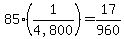 Number of days the full crew (80 men) worked: 15 (day 1 to day 15)
Number of days 5 less, or 75 (80 - 5) men worked: 29 (day 16 to day 44)
Number of days 10 more, or 85 (75 + 10) men worked: Unknown, or T
We then get: T1(rate) + T2(rate) + T3(rate) = 1
Number of days the full crew (80 men) worked: 15 (day 1 to day 15)
Number of days 5 less, or 75 (80 - 5) men worked: 29 (day 16 to day 44)
Number of days 10 more, or 85 (75 + 10) men worked: Unknown, or T
We then get: T1(rate) + T2(rate) + T3(rate) = 1

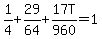 1(240) + 29(15) + 17T = 960 -- Multiplying by LCD, 960
240 + 435 + 17T = 960
675 + 17T = 960
17T = 960 - 675
17T = 285
Time taken by the final 85-man crew, to complete remaining fraction of job, or T =
1(240) + 29(15) + 17T = 960 -- Multiplying by LCD, 960
240 + 435 + 17T = 960
675 + 17T = 960
17T = 960 - 675
17T = 285
Time taken by the final 85-man crew, to complete remaining fraction of job, or T =  = =  , or about 17 days
So, entire job took 15 + 29 + 17 = 61 days, which was 1 day over the 60-day deadline. , or about 17 days
So, entire job took 15 + 29 + 17 = 61 days, which was 1 day over the 60-day deadline.
Question 773494: A piece of work can be done by 5 men in 10 days. After 4 days, 3 men were transferred to another job. how many more days will the remaining men finish the job?
Found 3 solutions by ikleyn, josgarithmetic, MathTherapy:
Answer by ikleyn(53889) (Show Source):
You can put this solution on YOUR website! .
A piece of work can be done by 5 men in 10 days. After 4 days, 3 men were transferred to another job.
how many more days will the remaining men finish the job?
~~~~~~~~~~~~~~~~~~~~~~~~~~~
I will show another way to solve, using different method.
Its advantage is that the fractions or equations are not used.
The total job is 5 men * 10 days = 50 man-days.


In the first 4 days, 5 men used 5*4 = 20 man-days;  50 - 20 = 30 man-days work remained.


Now only 5 - 3 = 2 men work.  They need 30/2 = 15 days to complete the remaining job.


So, the remaining 2 men will finish the rest of the job in 15 days.    <<<---===  ANSWER
Solved completely, using mental reasoning instead equations and/or fractions.
Answer by josgarithmetic(39825) (Show Source):
Answer by MathTherapy(10839) (Show Source):
Question 1179401: . Peter and Steven take 5 1/3 hours to do a job. Steven alone takes 16 hours to
do the same job. How long would it take Peter to do the same job alone?
Answer by n2(89) (Show Source):
Question 1179655: The bird capable of the fastest flying speed is the swift. A swift flying with the wind to a favorite feeding spot traveled 42 mi in 0.3 h. On returning, now against the wind, the swift was able to travel only 27 mi in the same amount of time. What is the rate of the swift in calm air, and what was the rate of the wind?
Found 2 solutions by n2, ikleyn:
Answer by n2(89) (Show Source):
You can put this solution on YOUR website! .
The bird capable of the fastest flying speed is the swift. A swift flying with the wind to a favorite feeding spot
traveled 42 mi in 0.3 h. On returning, now against the wind, the swift was able to travel only 27 mi
in the same amount of time. What is the rate of the swift in calm air, and what was the rate of the wind?
~~~~~~~~~~~~~~~~~~~~~~~~~~~~~~~~~~~
Let x be the rate of the swift in calm air, in miles per hour.
Let y be the rate of the wind.
Then the effective speed of the swift with the wind is (x+y) mph,
while the effective speed of the swift against the wind is (x-y) mph,
From the problem, the effective rate of the swift with the wind is the distance divided by the travel time
 = 140 miles per hour,
and the effective rate of the plane against the wind is the distance divided by the travel time = 140 miles per hour,
and the effective rate of the plane against the wind is the distance divided by the travel time
 = 90 miles per hour.
So, we have these two equations
x + y = 140 (1)
x - y = 90 (2)
To find x, add the equation. You will get
2x = 140 + 90 = 230, x = 230/2 = 115.
Now express y from equation (1) and calculate
y = 140 - x = 140 - 115 = 25.
At this point the problem is solved completely.
ANSWER. The speed of the swift in calm air is 115 mph. The rate of the wind is 25 mph. = 90 miles per hour.
So, we have these two equations
x + y = 140 (1)
x - y = 90 (2)
To find x, add the equation. You will get
2x = 140 + 90 = 230, x = 230/2 = 115.
Now express y from equation (1) and calculate
y = 140 - x = 140 - 115 = 25.
At this point the problem is solved completely.
ANSWER. The speed of the swift in calm air is 115 mph. The rate of the wind is 25 mph.
Solved correctly.
Answer by ikleyn(53889) (Show Source):
You can put this solution on YOUR website! .
The bird capable of the fastest flying speed is the swift. A swift flying with the wind to a favorite feeding spot
traveled 42 mi in 0.3 h. On returning, now against the wind, the swift was able to travel only 27 mi
in the same amount of time. What is the rate of the swift in calm air, and what was the rate of the wind?
~~~~~~~~~~~~~~~~~~~~~~~~~~~~~~~~~~~
The solution to this problem in the post by @mananth is INCORRECT.
It is incorrect due to arithmetic error in his calculations.
In this my post, I provide short, correct and straightforward solution to the given problem.
Let x be the rate of the swift in calm air, in miles per hour.

Let y be the rate of the wind.


Then  the effective speed of the swift with    the wind is (x+y) mph,

while the effective speed of the swift against the wind is (x-y) mph,


From the problem, the effective rate of the swift with the wind is  the distance divided by the travel time

     = 140 miles per hour,


and the effective rate of the plane against the wind is  the distance divided by the travel time

     = 90 miles per hour.


So, we have these two equations

    x + y = 140     (1)

    x - y =  90     (2)


To find x, add the equation.  You will get

    2x = 140 + 90 = 230,  x = 230/2 = 115.


Now express y from equation (1) and calculate

    y = 140 - x = 140 - 115 = 25.


At this point the problem is solved completely.


ANSWER.  The speed of the swift in calm air is  115 mph.  The rate of the wind is 25 mph.
Solved correctly.
-------------------------------
The solution by @mananth is defective, since it contains arithmetic errors.
It is also defective methodically, since it contain excessive unnecessary calculations.
We, the tutors, write here our solutions not only to get certain numerical answer.
We write to teach - and, in particular, to teach solving in right style.
This style solving presented in my post, is straightforward with no logical loops.
The solution presented in the post by @mananth has two logical loops.
One loop in the @mananth post is writing

    d/r = t  --->  42/(x+y) = 0.3   --->   0.3x + 0.3y = 42  --->  /0.3  --->  x+y = 42/0.3 = 140,

while in my solution I simply write for the effective rate

    u + v = 42/0.3 = 140.


Second loop in the @mananth post is writing

                   27/(x-y) = 0.3   --->   0.3x - 0.3y = 27  --->  /4  --->  x-y = 27/0.3 = 60  (error: must be 90),

while in my solution I simply write for the effective rate upstream

    u - v = 27/0.3 = 90.
It is why I presented my solution here and why I think it is better than the solution by @mananth:
- because it teaches students to present their arguments in a straightforward way, without logical zigzags.
@mananth repeats his construction of solution with no change for all similar problems on flies
with and against the wind simply because his COMPUTER CODE is written this way.
But this way is not pedagogically optimal - in opposite, it is pedagogically imperfect.
Question 1181303: Carlo can type a manuscript for 10 hours. he started working then bobby joined him 2 hours later. they worked together for 4 hrs until carlo decided to stop and then bobby had to finish the manuscript alone. if bobby finished the remaining portion in 6 more hours, how long can he type the whole manuscript working alone?
Found 4 solutions by CPhill, greenestamps, MathTherapy, ikleyn:
Answer by CPhill(2264)  (Show Source): (Show Source):
You can put this solution on YOUR website! Consider typing a manuscript is 1 job
Carlo takes 10 hours to do the job alone
So he does 1/10 of the job in 1 hour
in the first two hours he does 2/10 of the job ------------A
let bobby take x hours to do the job alpne
so he does 1/x of the job in 1 hour
together they do (1/10 +1/x ) of the job in 1 hour
they work together for4 hours.
so they do 4 (1/10 + 1/x ) job = 4(10+x)/10x = 2(10+x)/5x of the job-----B
Booby works for 6 hours
so he does 6/x of the job -------------C
A+B+c = 1 job
2/10 + 2(10+x)/5x + 6/x =1
Solve for x
Answer by greenestamps(13358) (Show Source):
You can put this solution on YOUR website!
Carlo worked for 2 hours alone and then 4 hours with Bobby, for a total of 6 hours. Since he can do the whole job in 10 hours, the fraction of the job that he did is 6/10 = 3/5.
So Bobby did 2/5 of the job. He worked for 4 hours with Carlo and then 6 more hours alone, for a total of 10 hours.
Since he did 2/5 of the job in 10 hours, the amount of time it would take him to do the job alone is 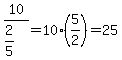
ANSWER: 25 hours
Answer by MathTherapy(10839) (Show Source):
You can put this solution on YOUR website!
Carlo can type a manuscript for 10 hours. he started working then bobby joined him 2 hours later. they worked together for 4 hrs
until carlo decided to stop and then bobby had to finish the manuscript alone. if bobby finished the remaining portion in 6 more
hours, how long can he type the whole manuscript working alone?
Carlo can complete the job in 10 hours, or of job in 1 hr
Let time Bobby takes, to do entire job, by himself, be B
Then, Bobby can complete  of job in 1 hr
Since Bobby started 2 hours after Carlo, then Carlo worked alone for 2 hours. So, fraction of job completed by Carlo,
before Bobby joined him = of job in 1 hr
Since Bobby started 2 hours after Carlo, then Carlo worked alone for 2 hours. So, fraction of job completed by Carlo,
before Bobby joined him =  With both working together for 4 hrs, fraction of job both completed, working together =
  Finally, given that Bobby completed the remaining portion in 6 hours, fraction of entire job done by Bobby, alone, =
  .
We then get the following ENTIRE JOB-equation: .
We then get the following ENTIRE JOB-equation: 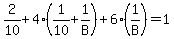
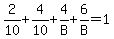
 6B + 100 = 10B ----- Multiplying by LCD, 10B
100 = 10B - 6B
100 = 4B
Time taken by Bobby to do the ENTIRE job, working ALONE, or
6B + 100 = 10B ----- Multiplying by LCD, 10B
100 = 10B - 6B
100 = 4B
Time taken by Bobby to do the ENTIRE job, working ALONE, or 
Answer by ikleyn(53889) (Show Source):
You can put this solution on YOUR website! .
Carlo can type a manuscript for 10 hours. He started working then Bobby joined him 2 hours later.
they worked together for 4 hrs until Carlo decided to stop and then Bobby had to finish the manuscript alone.
if Bobby finished the remaining portion in 6 more hours, how long can he type the whole manuscript working alone?
~~~~~~~~~~~~~~~~~~~~~~~~
To this problem, I will give two solutions: first Arithmetic and the second Algebra.
Arithmetic solution
Carlo's rate of work is 1/10 of the job per hour.
Carlo typed 2 hours + 4 hours = 6 hours and made  + + = =  of the job in 6 hours.
So, the remaining job, which was 1 - = = , was done by Bobby.
Bobby worked 4 hours + 6 hours = 10 hours and completed of the job.
Hence, Bob's rate of work was of the job in 6 hours.
So, the remaining job, which was 1 - = = , was done by Bobby.
Bobby worked 4 hours + 6 hours = 10 hours and completed of the job.
Hence, Bob's rate of work was  = =  = =  = =  .
It means that Bobby takes 25 hours to print the entire manuscript alone. ANSWER
Algebra solution
Carlo's rate of work is 1/10 of the job per hour.
Let 'b' be the Bobby's rate of work. It is unknown value now, for which we should set uo an equation and find it.
In 2 hours, Carlo made = of the job.
In the next 4 hours, Carlo made = of the job.
During these 4 hours, Bobby made 4b parts of the job.
In next 6 hours, Bobby completed the job.
So, we write an equation for the whole job by summing these parts
+ + 4b + 6b = 1.
Simplify and find 'b' .
It means that Bobby takes 25 hours to print the entire manuscript alone. ANSWER
Algebra solution
Carlo's rate of work is 1/10 of the job per hour.
Let 'b' be the Bobby's rate of work. It is unknown value now, for which we should set uo an equation and find it.
In 2 hours, Carlo made = of the job.
In the next 4 hours, Carlo made = of the job.
During these 4 hours, Bobby made 4b parts of the job.
In next 6 hours, Bobby completed the job.
So, we write an equation for the whole job by summing these parts
+ + 4b + 6b = 1.
Simplify and find 'b'
 + 10b = 1,
10b = 1 - = ,
b = = = .
Hence, Bobby needs 25 hours to make the whole job working alone.
We get the same answer. + 10b = 1,
10b = 1 - = ,
b = = = .
Hence, Bobby needs 25 hours to make the whole job working alone.
We get the same answer.
Solved in simple manner in two different ways, for your better understanding.
This my solution teaches you on how to solve joint work problems using a conception of the rate of job.
It is MUCH SIMPLER than to follow the @mananth's approach.
Question 453010: can someone help me by tuesday plss :(?
solve the problem.
joanne mows the front yard in 40 min, while hope can mow the same yard in 50 min. how long would it take them, working together with two mowers, to mow the yard?
Answer by ikleyn(53889) (Show Source):
Question 446848: a new machine can make 10,000 aluminum cans three times faster than an older machine. with both machines working, 10,000 cans be made in 9h. how long would it take the new machine, working alone, to make the 10,000 cans?
Found 3 solutions by MathTherapy, josgarithmetic, ikleyn:
Answer by MathTherapy(10839) (Show Source):
You can put this solution on YOUR website!
a new machine can make 10,000 aluminum cans three times faster than an older machine. with both machines working,
10,000 cans be made in 9h. how long would it take the new machine, working alone, to make the 10,000 cans?
More LIKELY/Chances are, "three times faster......." should actually read,"three times as fast......"
If this is so, then:
Let time new machine takes to complete the job (make 10,000 aluminum cans), be T
Then, time old machine takes to complete the job (make 10,000 aluminum cans), is 3T
In 1 hour then, and working ALONE, new and old machines can do  , and , and  of job, respectively
Since both, working together, can do the job in 9 hours, we then get: of job, respectively
Since both, working together, can do the job in 9 hours, we then get:  9 + 3 = T -- Multiplying by LCD, 9T
Time both take, working together, to complete the job (make 10,000 aluminum cans) = 12 hours
9 + 3 = T -- Multiplying by LCD, 9T
Time both take, working together, to complete the job (make 10,000 aluminum cans) = 12 hours
Answer by josgarithmetic(39825) (Show Source):
Answer by ikleyn(53889) (Show Source):
You can put this solution on YOUR website! .
a new machine can make 10,000 aluminum cans three times faster than an older machine.
with both machines working, 10,000 cans be made in 9h. how long would it take the new machine,
working alone, to make the 10,000 cans?
~~~~~~~~~~~~~~~~~~~~~~
First, I want to say to the writer/(creator of this problem) and to the readers,
that this problem is good, interesting and educative. But it is formulated unprofessionally
in the post. As presented, its meaning is dark, and wording does not correspond to the rules
of using words in English. (Words sound anti-harmonic). So, I will re-formulate it in the right way:
    A new machine can make 3 aluminum cans in the same time as an older machine
    makes 1 can. With both machines working together, 10,000 cans be made in 9h.
    How long would it take the new machine, working alone, to make the 10,000 cans?
With this modified formulation, it is a standard classic entertainment problem,
which can be solved mentally, using reasoning and common sense.
See my solution below.
During this time interval of 9 hours, of 10,000 cans total, 7500 are made by the new machine
and 2500 cans are made by the old machine. (it is because 7500 cans is three times 2500 cans).


So, we need to determine, how much time the new machine needs to produce 2500 cans.


But it is obvious: since the new machine produces 7500 cans in 9 hours, it will produce
one third, or 2500 cans in one third time of 9 hours, i.e. in 3 hours.


Thus, in all, the new machine needs 9 + 3 = 12 hours to produce 10,000 cans working alone.
Solved completely in this modified formulation.
--------------------
After this my solution, you can ignore the post by @mananth,
since it goes out the target.
/\/\/\/\/\/\/\/\/\/\/\/
Keep in mind that the "solution" in the post by @josgarithmetic is incorrect and irrelevant.
The best what you can do regarding the post by @josgarithmetic is to ignore it.
Question 446358: One person can do a certain job in six days, a second person can do the same job in two days, and a third person can do this job in three days. How many days will they take to do the job together?
Answer by ikleyn(53889) (Show Source):
Question 730604: two taps take 8 hours to fill a tank. one tap takes 12 hours to do the same work. How long will the other tap take to fill the same tank?
Answer by ikleyn(53889) (Show Source):
|
Older solutions: 1..45, 46..90, 91..135, 136..180, 181..225, 226..270, 271..315, 316..360, 361..405, 406..450, 451..495, 496..540, 541..585, 586..630, 631..675, 676..720, 721..765, 766..810, 811..855, 856..900, 901..945, 946..990, 991..1035, 1036..1080, 1081..1125, 1126..1170, 1171..1215, 1216..1260, 1261..1305, 1306..1350, 1351..1395, 1396..1440, 1441..1485, 1486..1530, 1531..1575, 1576..1620, 1621..1665, 1666..1710, 1711..1755, 1756..1800, 1801..1845, 1846..1890, 1891..1935, 1936..1980, 1981..2025, 2026..2070, 2071..2115, 2116..2160, 2161..2205, 2206..2250, 2251..2295, 2296..2340, 2341..2385, 2386..2430, 2431..2475, 2476..2520, 2521..2565, 2566..2610, 2611..2655, 2656..2700, 2701..2745, 2746..2790, 2791..2835, 2836..2880, 2881..2925, 2926..2970, 2971..3015, 3016..3060, 3061..3105, 3106..3150, 3151..3195, 3196..3240, 3241..3285, 3286..3330, 3331..3375, 3376..3420, 3421..3465, 3466..3510, 3511..3555, 3556..3600, 3601..3645, 3646..3690, 3691..3735, 3736..3780, 3781..3825, 3826..3870, 3871..3915, 3916..3960, 3961..4005, 4006..4050, 4051..4095, 4096..4140, 4141..4185, 4186..4230, 4231..4275, 4276..4320, 4321..4365, 4366..4410, 4411..4455, 4456..4500, 4501..4545, 4546..4590, 4591..4635, 4636..4680, 4681..4725, 4726..4770, 4771..4815, 4816..4860, 4861..4905, 4906..4950, 4951..4995, 4996..5040, 5041..5085, 5086..5130, 5131..5175, 5176..5220, 5221..5265, 5266..5310, 5311..5355, 5356..5400, 5401..5445, 5446..5490, 5491..5535, 5536..5580, 5581..5625, 5626..5670, 5671..5715, 5716..5760, 5761..5805, 5806..5850, 5851..5895, 5896..5940, 5941..5985, 5986..6030, 6031..6075, 6076..6120, 6121..6165, 6166..6210, 6211..6255, 6256..6300, 6301..6345, 6346..6390, 6391..6435, 6436..6480, 6481..6525, 6526..6570, 6571..6615, 6616..6660, 6661..6705, 6706..6750, 6751..6795, 6796..6840, 6841..6885, 6886..6930, 6931..6975, 6976..7020, 7021..7065, 7066..7110, 7111..7155, 7156..7200, 7201..7245, 7246..7290, 7291..7335, 7336..7380, 7381..7425, 7426..7470, 7471..7515, 7516..7560, 7561..7605, 7606..7650, 7651..7695, 7696..7740, 7741..7785, 7786..7830, 7831..7875, 7876..7920, 7921..7965, 7966..8010, 8011..8055, 8056..8100, 8101..8145, 8146..8190, 8191..8235, 8236..8280, 8281..8325, 8326..8370, 8371..8415, 8416..8460, 8461..8505, 8506..8550, 8551..8595, 8596..8640, 8641..8685, 8686..8730, 8731..8775, 8776..8820, 8821..8865, 8866..8910, 8911..8955
|
| |
