Question 372348: log base 3 (x+1) - log base 3 (x-3)=2
Answer by jsmallt9(3759)   (Show Source): (Show Source):
You can put this solution on YOUR website! 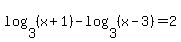
To solve equations like this, where the variable is in the argument of a logarithm, you often want to start by transforming the equation into one of the following forms:
log(expression) = other-expression
or
log(expression) = log(other-expression)
With your "non-log" term of 2 on the right side, the second form will be a little more difficult to reach. So we'll aim for the first form. For this we need a single logarithm. Fortunately we have a property of logarithms, 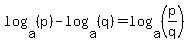 , which allows us to combine two logarithms (of the same base with coefficients of 1) like yours. Using this property on your logarithms we get: , which allows us to combine two logarithms (of the same base with coefficients of 1) like yours. Using this property on your logarithms we get:
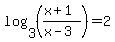
We now have the first form. With this form the next step is to rewrite the equation in exponential form. (This is how we get the variable out of the argument). In general  is equivalent to is equivalent to  . Using this on your equation we get: . Using this on your equation we get:

which simplifies to:

The variables are now where we can "get at them" so we can now solve for x. We'll start by eliminating the fraction (by multiplying both sides by (x-3):
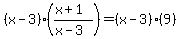
On the left side the (x-3)'s cancel:
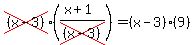
leaving
x + 1 = 9x - 27
Subtracting x from each side:
1 = 8x + 27
Subtracting 27 from each side:
-26 = 8x
Dividing both sides by 8:

which reduces to:

When solving logarithmic equations like this, it is important, not just a good idea, to check you answers. You must ensure that no argument (or base) of a logarithm becomes negative. Any "solution" that makes an argument (or base) of any logarithm must be rejected. And when checking, use the original equation:
Checking  : :

We should be able to tell already that the argument of the second logarithm will be negative. (The first logarithm's argument also turns out negative but this is less obvious.) So we must reject as a solution. Since this was the only solution we found, your equation has no solutions!
The fact that we rejected our solution does not mean we made a mistake. This is always a possibility with these equations and this is why it is important to check.
|
|
|
