|
Tutors Answer Your Questions about decimal-numbers (FREE)
Question 1210354: The monthly salary of Mr. Johnson was ₦320,000 for each of the first three years. He then got an annual increment of ₦40,000 per month for each of the following successive 12 years. His salary remained stationary till retirement when he found that his average monthly salary during the service period was ₦698,000.
Required:
(a) Prove that there is an Arithmetic Progression (AP) in the first 3 years of service.
(b) Compute the total salary in the first 3 years of service.
(c) Calculate the monthly and annual salary for the fourth year of service.
(d) Determine the monthly and annual salary for the ninth year of service.
(e) Find the total salary up to the 12th year of service.
(f) Obtain the total salary up to the 15th year of service.
(g) Find the monthly salary at the end of the 15th year of service.
(h) Compute the period of service.
Found 2 solutions by ikleyn, Edwin McCravy:
Answer by ikleyn(53748)   (Show Source): (Show Source):
You can put this solution on YOUR website! .
When I read this post, my impression and feeling are the same as if
I were driving a car whose wheels are shaped like squares or triangles.
I shudder at every word.
Absolutely anti-pedagogic way of writing Math problem in English.
Answer by Edwin McCravy(20077)  (Show Source): (Show Source):
You can put this solution on YOUR website!
The problem is botched.

 year           salary       average
  1            ₦320000       ₦320000
  2            ₦320000       ₦320000
  3            ₦320000       ₦320000
  4            ₦360000       ₦330000
  5            ₦440000       ₦352000
  6            ₦560000       ₦386666.667
  7            ₦720000       ₦434285.714
  8            ₦920000       ₦495000
  9           ₦1160000       ₦568888.889
 10           ₦1440000       ₦656000
 11           ₦1760000       ₦756363.636

As you see, he could not have worked 11 years because if he had, he would
have already averaged more than ₦698,000 per month.

Sorry, but we cannot help you.  Get the right numbers and post the correct
problem.  Then we can help you.

Edwin
Question 1210284: The sum of three numbers in a geometric progression GP is 13 and there products is -64. Find the numbers.
Found 2 solutions by greenestamps, ikleyn:
Answer by greenestamps(13327)  (Show Source): (Show Source):
You can put this solution on YOUR website!
The product of three consecutive terms of a geometric sequence is equal to the cube of the middle term. Since the product of the three terms in this problem is -64 = (-4)^3, the middle term is -4.
Let r be the common ratio in the geometric sequence. Then since the middle term is -4, the three terms are -4/r, -4, and -4r.
The sum of the three terms is 13:
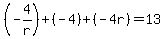
Multiply everything by r to get a quadratic equation in r:
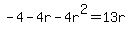
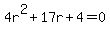

 or or 
(1) If r = -1/4, the terms are
-4/r = -4/(-1/4) = 16
-4
-4r = (-4)(-1/4) = 1
The sequence is 16, -4, 1
(2) If r = -4, then the terms are
-4/r = -4/-4 = 1
-4
-4r = (-4)(-4) = 16
The sequence is 1, -4, 16
ANSWER: The three numbers are (in either order) 1, -4, and 16. (Note that there are two different SEQUENCES that satisfy the conditions of the problem, but there is only one ANSWER to the problem, because it only asks for the three numbers.)
Note we could have solved the problem informally (and quickly) by trial and error, once we determined that the middle term is -4.
Since the sum of the three terms is positive and the product is negative, the common ratio must be negative; and since the sum and product are both integers, the common ratio is almost certain to be an integer.
Trying r=-2 with middle term -4 gives us 2, -4, and 8, and the sum of those is not 13.
Trying r=-4 with middle term -4 gives us 1, -4, and 16, and the sum of those IS 13.
And then of course those three terms can be in the opposite order, giving us two different sequences.
Answer by ikleyn(53748) (Show Source):
You can put this solution on YOUR website! .
The sum of three  numbers in a geometric progression numbers in a geometric progression  is 13 and is 13 and  their their  product is -64. product is -64.
Find the numbers.
~~~~~~~~~~~~~~~~~~~~~~~~~~
So, in standard designations, the terms are a, ar and ar^2.
From the problem, we have two equations
a + ar + ar^2 = 13, (1) (the sum)
a*(ar)*(ar^2) = -64. (2) (the product).
Equation (2) is the same as
(ar)^3 = -64,
which gives us
ar = -4. (3)
We substitute ar = -4 into equation (1). We get then
a - 4 + ar^2 = 13,
a + ar^2 = 13 + 4 = 17. (4)
We also represent ar^2 as (ar)*r = -4r.
Then equation (4) takes the form
a - 4r = 17. (5)
Now we have a system of two equations (3) and (5)
ar = -4, (3)
a - 4r = 17. (5)
From (3), express r =  and substitute it into (5). You will get and substitute it into (5). You will get
 = 17,
a^2 + 16 = 17a,
a^2 - 17a + 16 = 0,
(a-16)*(a-1) = 0.
It gives two possible solutions for 'a', 16 and 1.
If a = 16, then r = = = 17,
a^2 + 16 = 17a,
a^2 - 17a + 16 = 0,
(a-16)*(a-1) = 0.
It gives two possible solutions for 'a', 16 and 1.
If a = 16, then r = =  = =  .
If a = 1, then r = = .
If a = 1, then r = =  = -4.
Thus, two progressions are possible.
One progression is 16, -4, 1. (*)
The other progression is 1, -4, 16 (the same as (*), but reversed)
Both progressions satisfy the imposed conditions. = -4.
Thus, two progressions are possible.
One progression is 16, -4, 1. (*)
The other progression is 1, -4, 16 (the same as (*), but reversed)
Both progressions satisfy the imposed conditions.
Solved.
Enjoy !
Question 1210268: A sum of money amounts to ₦5,280 in 4 years at a certain rate of simple interest. If the same amount is invested at a 2% higher interest rate, it amounts to ₦5,520 in the same time.
Find:
- The principal
- The original rate of interest
Found 2 solutions by ikleyn, Edwin McCravy:
Answer by ikleyn(53748) (Show Source):
Answer by Edwin McCravy(20077) (Show Source):
Question 1210236: 2^2x-3 — 2^2x-2 — 1 = 0
Found 4 solutions by Edwin McCravy, ikleyn, mccravyedwin, greenestamps:
Answer by Edwin McCravy(20077) (Show Source):
Answer by ikleyn(53748) (Show Source):
Answer by mccravyedwin(421)  (Show Source): (Show Source):
Answer by greenestamps(13327) (Show Source):
Question 1210237: In a basket u have balls numbered 1-47. Odd numbers are 15 even numbers are 22
What's the probability of picking 5 even numbers at random and 5 odd numbers
Answer by greenestamps(13327) (Show Source):
You can put this solution on YOUR website!
????!!!!!!
Balls numbered 1 to 47, and 15 are even and 24 are odd?
Makes no sense!
Balls numbered 1 to 47 means 24 odd and 23 even....
Re-post, with numbers that make sense.
Question 1210225: Consider the sequence
1, 3, 4, 9, 10, 12, 13, ...
which consists of every positive integer that can be expressed as a sum of distinct powers of 3.
What is the first term that is greater than 20?
Found 2 solutions by greenestamps, CPhill:
Answer by greenestamps(13327) (Show Source):
You can put this solution on YOUR website!
The last given number in the sequence is 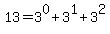 . .
Since that number is the sum of all the distinct powers of 3 up to the second power, the next number in the sequence must involve the third power of 3.
3 to the third power is 27, which is greater than 20, so it is the next number in the sequence.
ANSWER: 27
Answer by CPhill(2189)  (Show Source): (Show Source):
You can put this solution on YOUR website! Let's analyze how the numbers in the sequence are formed by sums of distinct powers of 3:
Powers of 3 are:
$3^0 = 1$
$3^1 = 3$
$3^2 = 9$
$3^3 = 27$
$3^4 = 81$
and so on.
The sequence consists of numbers that can be written in the form $c_0 \cdot 3^0 + c_1 \cdot 3^1 + c_2 \cdot 3^2 + c_3 \cdot 3^3 + \dots$, where each $c_i$ is either 0 or 1 (because the powers of 3 must be distinct).
Let's generate the terms of the sequence in increasing order:
Using only $3^0 = 1$:
$1 \cdot 3^0 = 1$
Using $3^0 = 1$ and $3^1 = 3$:
$1 \cdot 3^0 = 1$ (already listed)
$1 \cdot 3^1 = 3$
$1 \cdot 3^0 + 1 \cdot 3^1 = 1 + 3 = 4$
Using $3^0 = 1$, $3^1 = 3$, and $3^2 = 9$:
$1 \cdot 3^0 = 1$
$1 \cdot 3^1 = 3$
$1 \cdot 3^2 = 9$
$1 \cdot 3^0 + 1 \cdot 3^1 = 1 + 3 = 4$
$1 \cdot 3^0 + 1 \cdot 3^2 = 1 + 9 = 10$
$1 \cdot 3^1 + 1 \cdot 3^2 = 3 + 9 = 12$
$1 \cdot 3^0 + 1 \cdot 3^1 + 1 \cdot 3^2 = 1 + 3 + 9 = 13$
The sequence generated so far in increasing order is: 1, 3, 4, 9, 10, 12, 13, ...
We are looking for the first term that is greater than 20. Let's continue generating terms by including the next power of 3, which is $3^3 = 27$.
The terms formed using $3^0, 3^1, 3^2$ are all less than $1 + 3 + 9 = 13$. Now, let's consider sums that include $3^3 = 27$:
$1 \cdot 3^3 = 27$
$1 \cdot 3^0 + 1 \cdot 3^3 = 1 + 27 = 28$
$1 \cdot 3^1 + 1 \cdot 3^3 = 3 + 27 = 30$
$1 \cdot 3^2 + 1 \cdot 3^3 = 9 + 27 = 36$
$1 \cdot 3^0 + 1 \cdot 3^1 + 1 \cdot 3^3 = 1 + 3 + 27 = 31$
$1 \cdot 3^0 + 1 \cdot 3^2 + 1 \cdot 3^3 = 1 + 9 + 27 = 37$
$1 \cdot 3^1 + 1 \cdot 3^2 + 1 \cdot 3^3 = 3 + 9 + 27 = 39$
$1 \cdot 3^0 + 1 \cdot 3^1 + 1 \cdot 3^2 + 1 \cdot 3^3 = 1 + 3 + 9 + 27 = 40$
Looking at the sequence 1, 3, 4, 9, 10, 12, 13, ..., the next terms will be formed by sums of distinct powers of 3 greater than 13. The next power of 3 is 27. The smallest positive integer that can be expressed as a sum of distinct powers of 3 and is greater than 13 will involve the smallest power of 3 that is greater than 13, which is 27.
The smallest term in the sequence that includes $3^3 = 27$ is $1 \cdot 3^3 = 27$.
Since 27 is greater than 20, and all previous terms in the sequence (formed by sums of 1, 3, and 9) are less than or equal to $1+3+9=13$, the first term in the sequence that is greater than 20 is 27.
Final Answer: The final answer is $\boxed{27}$
Question 1210226: Consider the sequence
1, 5, 6, 25, 26, 30, 31, ...
which consists of every positive integer that can be expressed as a sum of distinct powers of 5.
What is the first term that is greater than 50?
Found 2 solutions by greenestamps, CPhill:
Answer by greenestamps(13327) (Show Source):
You can put this solution on YOUR website!
The last number shown in the sequence is 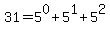
That is the sum of all the distinct powers of 5 up to the second power, so the next number in the sequence must involve the third power of 5, which is 125.
And since 125 is greater than 50, it is the next number in the sequence.
ANSWER: 125
Answer by CPhill(2189) (Show Source):
You can put this solution on YOUR website! Let's analyze how the numbers in the sequence are formed by sums of distinct powers of 5:
Powers of 5 are:
$5^0 = 1$
$5^1 = 5$
$5^2 = 25$
$5^3 = 125$
and so on.
The sequence consists of numbers that can be written in the form $c_0 \cdot 5^0 + c_1 \cdot 5^1 + c_2 \cdot 5^2 + c_3 \cdot 5^3 + \dots$, where each $c_i$ is either 0 or 1 (because the powers of 5 must be distinct).
Let's generate the terms of the sequence in increasing order:
Using only $5^0 = 1$:
$1 \cdot 5^0 = 1$
Using $5^0 = 1$ and $5^1 = 5$:
$1 \cdot 5^0 = 1$ (already listed)
$1 \cdot 5^1 = 5$
$1 \cdot 5^0 + 1 \cdot 5^1 = 1 + 5 = 6$
Using $5^0 = 1$, $5^1 = 5$, and $5^2 = 25$:
$1 \cdot 5^0 = 1$
$1 \cdot 5^1 = 5$
$1 \cdot 5^2 = 25$
$1 \cdot 5^0 + 1 \cdot 5^1 = 1 + 5 = 6$
$1 \cdot 5^0 + 1 \cdot 5^2 = 1 + 25 = 26$
$1 \cdot 5^1 + 1 \cdot 5^2 = 5 + 25 = 30$
$1 \cdot 5^0 + 1 \cdot 5^1 + 1 \cdot 5^2 = 1 + 5 + 25 = 31$
The sequence generated so far in increasing order is: 1, 5, 6, 25, 26, 30, 31, ...
We are looking for the first term that is greater than 50. Let's continue generating terms by including the next power of 5, which is $5^3 = 125$.
The terms formed using $5^0, 5^1, 5^2$ are all less than or equal to $1 + 5 + 25 = 31$. Now, let's consider sums that include $5^3 = 125$:
$1 \cdot 5^3 = 125$
$1 \cdot 5^0 + 1 \cdot 5^3 = 1 + 125 = 126$
$1 \cdot 5^1 + 1 \cdot 5^3 = 5 + 125 = 130$
$1 \cdot 5^2 + 1 \cdot 5^3 = 25 + 125 = 150$
$1 \cdot 5^0 + 1 \cdot 5^1 + 1 \cdot 5^3 = 1 + 5 + 125 = 131$
$1 \cdot 5^0 + 1 \cdot 5^2 + 1 \cdot 5^3 = 1 + 25 + 125 = 151$
$1 \cdot 5^1 + 1 \cdot 5^2 + 1 \cdot 5^3 = 5 + 25 + 125 = 155$
$1 \cdot 5^0 + 1 \cdot 5^1 + 1 \cdot 5^2 + 1 \cdot 5^3 = 1 + 5 + 25 + 125 = 156$
Looking at the sequence 1, 5, 6, 25, 26, 30, 31, ..., the next terms will be formed by sums of distinct powers of 5 greater than 31. The next power of 5 is 125. The smallest positive integer that can be expressed as a sum of distinct powers of 5 and is greater than 31 will involve the smallest power of 5 that is greater than 31, which is 125.
The smallest term in the sequence that includes $5^3 = 125$ is $1 \cdot 5^3 = 125$.
Since 125 is greater than 50, and all previous terms in the sequence (formed by sums of 1, 5, and 25) are less than or equal to $1+5+25=31$, the first term in the sequence that is greater than 50 is 125.
Final Answer: The final answer is $\boxed{125}$
Question 1210180: Find the three digit number such that the sum of its digits is equal to 12, the product of its digit is equal to 48 and the number is divisible by 6.
Answer by CPhill(2189) (Show Source):
You can put this solution on YOUR website! Let the three-digit number be $abc$, where $a$, $b$, and $c$ are digits. We are given the following conditions:
1. **Sum of digits is 12:** $a + b + c = 12$
2. **Product of digits is 48:** $a \cdot b \cdot c = 48$
3. **The number is divisible by 6:** This means the number is divisible by both 2 and 3.
From condition 3, for a number to be divisible by 2, the last digit $c$ must be even. For a number to be divisible by 3, the sum of its digits must be divisible by 3. Since $a + b + c = 12$, and 12 is divisible by 3, this condition is already satisfied.
Now, we need to find three digits whose sum is 12 and product is 48.
Let's find the possible sets of three digits whose product is 48.
The prime factorization of 48 is $2^4 \cdot 3$.
Possible sets of three digits:
* $1 \cdot 6 \cdot 8$
* $2 \cdot 4 \cdot 6$
* $3 \cdot 4 \cdot 4$
* $2 \cdot 3 \cdot 8$
Now, let's check which sets also satisfy the sum condition:
* $1 + 6 + 8 = 15$ (doesn't equal 12)
* $2 + 4 + 6 = 12$ (satisfies)
* $3 + 4 + 4 = 11$ (doesn't equal 12)
* $2 + 3 + 8 = 13$ (does not equal 12)
So the only set of digits that works is 2, 4, 6.
Now, we need to find the arrangements of 2, 4, 6 such that the number is divisible by 6 (i.e., the last digit is even).
Possible numbers:
* 246
* 264
* 426
* 462
* 624
* 642
All of these numbers satisfy the conditions:
* $2 + 4 + 6 = 12$
* $2 \cdot 4 \cdot 6 = 48$
* All numbers are even, so they are divisible by 2.
* All numbers have a digit sum of 12, so they are divisible by 3.
* Therefore, all numbers are divisible by 6.
So the possible numbers are 246, 264, 426, 462, 624, 642.
Question 1209801: Compute
1.11111 + 0.11111 + 0.01111 + 0.00111 + 0.00011 + 0.00001
Found 2 solutions by Edwin McCravy, CPhill:
Answer by Edwin McCravy(20077) (Show Source):
Answer by CPhill(2189) (Show Source):
Question 1209410: Let S be the set of all real numbers of the form
(a_1)/(3) + (a_2)/(3^2) + (a_3)/(3^3) + ...
where (a_i) is equal to either 0, 1, or 2 for each i.
(a) Is the number 1/4 in the set S?
(b) Is the number 1/7 in the set S?
Answer by ikleyn(53748) (Show Source):
You can put this solution on YOUR website! .
See the explicit solution, found/produced by artificial intelligence (AI)
as the response to my request under this link
https://www.google.com/search?q=Let+S+be+the+set+of+all+real+numbers+of+the+form+(a_1)%2F(3)+%2B+(a_2)%2F(3%5E2)+%2B+(a_3)%2F(3%5E3)+%2B+...+where+(a_i)+is+equal+to+either+0%2C+1%2C+or+2+for+each+i.+(a)+Is+the+number+1%2F4+in+the+set+S%3F+(b)+Is+the+number+1%2F7+in+the+set+S%3F&rlz=1C1CHBF_enUS1071US1071&oq=Let+S+be+the+set+of+all+real+numbers+of+the+form++(a_1)%2F(3)+%2B+(a_2)%2F(3%5E2)+%2B+(a_3)%2F(3%5E3)+%2B+...++where+(a_i)+is+equal+to+either+0%2C+1%2C+or+2+for+each+i.++(a)+Is+the+number+1%2F4+in+the+set+S%3F+++(b)+Is+the+number+1%2F7+in+the+set+S%3F&gs_lcrp=EgZjaHJvbWUyBggAEEUYOdIBCTE5MjhqMGoxNagCCLACAQ&sourceid=chrome&ie=UTF-8
Question 1209409: Estimate 247^9 without using a calculator. I asked my teacher and she said a hint was 200 < 247 < 300. I'm still really stuck. Please help?
Answer by math_tutor2020(3835) (Show Source):
You can put this solution on YOUR website!
200 < 247 < 300
2009 < 2479 < 3009
Raising each part to the 9th power will not flip the inequality signs.
To estimate 2479, we need to compute 2009 and 3009
Which in turn means we need 29 = 512 and 39 = 19683
Both of which can be computed without a calculator when given enough time.
2009 = (2*102)9
2009 = 29*(102)9
2009 = 512*102*9
2009 = 512*1018
2009 = 5.12*102*1018
2009 = 5.12*102+18
2009 = 5.12*1020
This massive number is 512 followed by 18 zeros.
3009 = (3*102)9
3009 = 39*(102)9
3009 = 19683*1018
3009 = 1.9683*104*1018
3009 = 1.9683*104+18
3009 = 1.9683*1022
This massive number is 19683 followed by 18 zeros.
We go from this
2009 < 2479 < 3009
to this
5.12*1020 < 2479 < 1.9683*1022
Since the numbers involved are so large, I recommend to keep things in scientific notation.
Question 1209369: A sum of money doubles itself in 10 years. The number of years it would triple itself is?
Answer by greenestamps(13327) (Show Source):
Question 1209352: Please help me solve this equation: 
Answer by ikleyn(53748) (Show Source):
Question 1209349: Find the number of bases n \ge 2$ such that 100_n + 1_n is prime.
Found 2 solutions by ikleyn, math_tutor2020:
Answer by ikleyn(53748) (Show Source):
You can put this solution on YOUR website! .
Find the number of bases n \ge 2$ such that 100_n + 1_n is prime.
~~~~~~~~~~~~~
This problem, inadvertently, offers to solve a world class mathematical problem
from Number theory (of the Fields prize level) here, passing by.
Perhaps, a great thinker is behind this post, who wishes that somebody will solve it for him soon . . .
Bravo ! Plus an elementary proof of Fermat's last theorem, too.
So as not to get up twice.
To do this, we need to revive Euler, Dirichlet, Riemann and five more world class level mathematicians,
to provide them all conditions for work of the Google corporation level for 20 - 40 years,
with quantum super-computers and free food, publishing special journals/magazines
and by holding annual conferences on the subject.
And, perhaps, establish contact with extraterrestrial civilizations in other galaxies.
. . . . . . . . . . . .
In some countries, in collections of preparatory problems for high-level Math Olympiads,
it is customary to print one or two unsolved mathematical problems - simply to inspire young readers.
Naturally, nobody of publishers does not expect that such problems will be solved,
but the tradition is the tradition.
Answer by math_tutor2020(3835) (Show Source):
You can put this solution on YOUR website!
100n+1n = 101n where n is an integer such that 
101n = 101 base n
To convert 101n to base 10 we will use this quadratic polynomial.
1*n^2 + 0*n^1 + 1*n^0
The coefficients 1,0,1 are from 101n
The exponents 2,1,0 count down by 1
The expression
1*n^2 + 0*n^1 + 1*n^0
simplifies to
n^2 + 1
So 101n converts to n^2+1 base 10.
A few examples are
1012 = 2^2 + 1 = 510
1013 = 3^2 + 1 = 1010
1014 = 4^2 + 1 = 1710
1015 = 5^2 + 1 = 2610
1016 = 6^2 + 1 = 3710
1017 = 7^2 + 1 = 5010
1018 = 8^2 + 1 = 6510
1019 = 9^2 + 1 = 8210
10110 = 10^2 + 1 = 10110
You can confirm each claim with a calculator such as this one
Of that list of examples we see the following primes in base ten: 5, 17, 37, 101
Any prime in base 10 converts to a prime back in base n.
For instance, 1014 is prime (since 1710 is prime). We cannot multiply smaller integer values in base 4 to arrive at 1014
So the original problem is equivalent to asking: "What integer values of n will make n^2+1 prime?"
As far as I know, the problem is unsolved in the mathematics community. Many topics about primes are also unsolved.
Refer to this page and this page for further discussion.
The last link mentions "It is conjectured that this sequence is infinite, but this has never been proved."
It's quite possible that there might be a proof out there somewhere that I haven't found; or a proof could come along later in the future. I'll let another tutor chime in.
Question 1209351: A bank offers 5% compound interest calculated on half yearly basi. A customer deposit 1600 each on 1st January and 1st July of a year. Find the interest it would have gained at the end of the year
Answer by ikleyn(53748) (Show Source):
You can put this solution on YOUR website! .
A bank offers 5% compound interest calculated on half yearly basis.
A customer  deposits 1600 each on 1st January and 1st July of a year. deposits 1600 each on 1st January and 1st July of a year.
Find the interest it would have gained at the end of the year
~~~~~~~~~~~~~~~~~~~~~~~~
Formulation of the problem is a bit strange, since it does not concretizes
at the end of which year it wants to get the interest/answer.
So, I will assume that it wants the interest at the end of the first year.
It is an Annuity Due saving plan. The general formula is
FV = 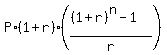 , (1)
where FV is the future value of the account; P is the semi-annual payment (deposit);
r is the semi-annual effective rate presented as a decimal;
n is the number of deposits (= the number of years multiplied by 2, in this case).
Under the given conditions, P = 1600; r = 0.05/2 = 0.025; n = 1*2 = 2.
So, according to the formula (1), Future Value of the account at the end of the first year
FV = , (1)
where FV is the future value of the account; P is the semi-annual payment (deposit);
r is the semi-annual effective rate presented as a decimal;
n is the number of deposits (= the number of years multiplied by 2, in this case).
Under the given conditions, P = 1600; r = 0.05/2 = 0.025; n = 1*2 = 2.
So, according to the formula (1), Future Value of the account at the end of the first year
FV = 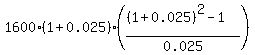 = 3321.
Note that the customer will deposit only 2*1600 = 3200 in two semi-annual payments.
So, the interest at the end of the first year is 3321 - 3200 = 121. ANSWER = 3321.
Note that the customer will deposit only 2*1600 = 3200 in two semi-annual payments.
So, the interest at the end of the first year is 3321 - 3200 = 121. ANSWER
-----------------
On Annuity Due saving plans, see the lessons
- Annuity Due saving plans and geometric progressions
- Find future value for an Annuity Due saving plan
in this site.
The lessons contain EVERYTHING you need to know about this subject, in clear and compact form.
When you learn from these lessons, you will be able to do similar calculations in semi-automatic mode.
Question 1209277: A man makes a deposit of $50,000 into an account that pays an annual interest of 5%. How much money will be in the account after 10 years if:
I. The interest is compounded continuously
II. How long will it take for the money to triple itself if interest is compounded continuously?
Answer by math_tutor2020(3835) (Show Source):
You can put this solution on YOUR website!
Part I
P = 50000 = deposit amount
e = special constant 2.718 approximately
r = 0.05 = decimal form of the interest rate
t = 10 years
A = P*e^(r*t)
A = 50000*e^(0.05*10)
A = 82436.06353501
A = 82436.06
--------------------------------------------------------------------------
Part II
The man deposits P dollars and wants it to triple to 3P dollars.
You could use P = 50,000 from earlier, but this also works for any positive real number.
The r value is the same as before.
The goal is to solve for variable t.
A = P*e^(r*t)
3P = P*e^(0.05*t)
3 = e^(0.05*t)
Ln(3) = Ln( e^(0.05*t) )
Ln(3) = 0.05*t*Ln( e )
Ln(3) = 0.05*t*1
Ln(3) = 0.05*t
t = Ln(3)/0.05
t = 21.972246
--------------------------------------------------------------------------
Answers:
I. $82,436.06
II. 21.972246 years approximately
Question 1209273: Please who could help solve this simple addition and multiplication
Explain 2(1-5(3+5))
Answer by josgarithmetic(39792) (Show Source):
Question 1208614: brad is currently $18 overdrawn in his account his knows that he needs to pay a $61.61 bill from his account tomorrow How much does he need to add to his account so he can pay his bill tomorrow?
Answer by timofer(155) (Show Source): (Show Source):
You can put this solution on YOUR website! So brad ran out of money and he expects to take care of a charge of $18, and another of $61.61. He needs to have at least 18+61.61 or $79.61 in his account.
Question 1208275: Lee buys two buckets of paint, each containing 3.25 gallons of paint.
He uses 4.75 gallons of paint. How many gallons of paint were not
used?
Answer by ikleyn(53748) (Show Source):
Question 1208250: The total distance of a family road trip is 668.25 miles. After traveling 50.75 miles, a kid asked how much longer it would take to get there. If the car travels 65 miles every hour, how many hours will it take to finish the trip, if they do not stop?
Found 3 solutions by josgarithmetic, math_tutor2020, ikleyn:
Answer by josgarithmetic(39792) (Show Source):
Answer by math_tutor2020(3835) (Show Source):
You can put this solution on YOUR website!
When the kid asks, the car has already traveled 50.75 miles.
They need to travel another 65x miles (due to the formula distance = rate*time) where x is the extra number of hours needed to travel this distance.
The total distance is 65x+50.75
Set this equal to 668.25 and solve for x.
65x+50.75 = 668.25
65x = 668.25-50.75
65x = 617.5
x = 617.5/65
x = 9.5 hours is the answer.
Check:
65*x+50.75 = 65*9.5+50.75 = 668.25
This confirms the answer.
Answer by ikleyn(53748) (Show Source):
You can put this solution on YOUR website! .
The remaining time to travel is 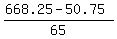 = 9.5 hours. = 9.5 hours.
Solved.
The formula is SELF-EXPLANATORY.
It is as simple, as a cucumber, or as 3 - 1 = 2.
Question 1208054: When expanded as a decimal, the fraction  has a repetend (the repeating part of the decimal) that begins right after the decimal point, and is 976 digits long. If the last three digits of the repetend are ABC, compute the digits A, B, and C. has a repetend (the repeating part of the decimal) that begins right after the decimal point, and is 976 digits long. If the last three digits of the repetend are ABC, compute the digits A, B, and C.
A=
B=
C=
Found 2 solutions by Edwin McCravy, ikleyn:
Answer by Edwin McCravy(20077) (Show Source):
You can put this solution on YOUR website!
To get some insight as to what is going on here, I took
the long division out a few places, without skipping any
steps because of 0's, as we usually do in long division:

      0.0 0 1 0 2
9 7 7)1.0 0 0 0 0
      0
      1 0
        0
      1 0 0
          0
      1 0 0 0
        9 7 7
          2 3 0
              0
          2 3 0 0
          1 9 5 4
            3 4 6

The very first remainder above is 1. The decimal will start repeating
when the remainder is 1 again, and the subtractions we perform to get a
remainder are always from a remainder that is annexed on the right with
a 0.  So to get a 1 remainder, we must be subtracting a digit multiple
of 977 that ends in a 9.

The only digit multiple of 977 that ends with a 9 is 7x977 or
6839, so 1 more, or 6840 must have been the number we would be
subtracting 6839 from, which means the remainder just before the
remainder of 1 was 684. So the last digit before the digits started
repeating must have been a 7.

To have gotten the remainder 684 from a number that ended with 0, we
must have subtracted a digit multiple of 977 that ended with a 6.

The only digit multiple of 977 that ends with a 6 is 8x977 or
7816, so 684 more, or 8500 must have been the number we would be
subtracting 6839 from, which means the remainder just before the
remainder of 684 was 850. And the digit before the 7 must have
been an 8.

To have gotten the remainder 850 from a number that ended with 0, we
must have subtracted a digit multiple of 977 that ended with a 0,
which could only have been 0x977 or 0.

So the last three digits before we got a 1 remainder must have been 087

That's the answer 087.  A=0, B=8, C=7

Edwin
Answer by ikleyn(53748) (Show Source):
You can put this solution on YOUR website! .
When expanded as a decimal, the fraction has a repetend (the repeating part of the decimal)
that begins right after the decimal point, and is 976 digits long.
If the last three digits of the repetend are ABC, compute the digits A, B, and C.
A=
B=
C=
~~~~~~~~~~~~~~~~~
Let = x. Since the repetend is 977 digits long, we see that  has the same decimal
expansion as x. Hence, the number n = has the same decimal
expansion as x. Hence, the number n =  is an integer number and it is (it represents) the "repetend".
But, from the other side, this number n is
9999...999999
n = is an integer number and it is (it represents) the "repetend".
But, from the other side, this number n is
9999...999999
n =  = --------------- .
977
+---------------------------------------------------------------+
| The numerator is the integer formed by 976 digits of "9". |
+---------------------------------------------------------------+
So, we can write 9999...999999 = 977*n, where n is some integer number. (1)
This number "n" is the "repetend part", and our goal is to find three last digits of n.
+-------------------------------------------------------------------+
| From this writing (1), it is clear that the last digit of n is 7, |
| providing 7*7 = 49 with the last digit 9; |
| so, we can write n = 10m+7 for some integer m. |
+-------------------------------------------------------------------+
Substitute it into (1). You will get
9999...999999 = 977*(10m+7) = 977*10m + 6839.
Hence, 9999...999999 = 977*10m + 6839. (2)
Subtract 6839 from both sides of (2). You will get
9999...9993160 = 977*10m (3)
In (3), divide both sides by 10. You will get
9999...999316 = 977*m, (4)
where the number in the left side has the last 3 digits 316 and all other preceding digits are "9", and "m" is some integer.
+-------------------------------------------------------------------+
| From this writing (4), it is clear that the last digit of m is 8, |
| providing 7*8 = 56 with the last digit 6; |
| so, we can write m = 10k+8 for some integer k. |
+-------------------------------------------------------------------+
Substitute it into (4). You will get
9999...999316 = 977*(10k+8) = 977*10k + 7816.
Hence, 9999...999316 = 977*10k + 7816. (5)
Subtract 7816 from both sides of (5). You will get
9999...991500 = 977*10k (6)
In (6), divide both sides by 10. You will get
9999...999150 = 977*k, (7)
where the number in the left side has the last 3 digits 134 and all other preceding digits are "9", and "k" is some integer.
+-------------------------------------------------------------------+
| From this writing (7), it is clear that the last digit of k is 0, |
| providing 7*0 = 0 with the last digit 0. |
+-------------------------------------------------------------------+
Thus the last three digits in repetend part are 087.
ANSWER. The last three digits in repetend part are 087.
So, A = 0, B = 8, C = 7. = --------------- .
977
+---------------------------------------------------------------+
| The numerator is the integer formed by 976 digits of "9". |
+---------------------------------------------------------------+
So, we can write 9999...999999 = 977*n, where n is some integer number. (1)
This number "n" is the "repetend part", and our goal is to find three last digits of n.
+-------------------------------------------------------------------+
| From this writing (1), it is clear that the last digit of n is 7, |
| providing 7*7 = 49 with the last digit 9; |
| so, we can write n = 10m+7 for some integer m. |
+-------------------------------------------------------------------+
Substitute it into (1). You will get
9999...999999 = 977*(10m+7) = 977*10m + 6839.
Hence, 9999...999999 = 977*10m + 6839. (2)
Subtract 6839 from both sides of (2). You will get
9999...9993160 = 977*10m (3)
In (3), divide both sides by 10. You will get
9999...999316 = 977*m, (4)
where the number in the left side has the last 3 digits 316 and all other preceding digits are "9", and "m" is some integer.
+-------------------------------------------------------------------+
| From this writing (4), it is clear that the last digit of m is 8, |
| providing 7*8 = 56 with the last digit 6; |
| so, we can write m = 10k+8 for some integer k. |
+-------------------------------------------------------------------+
Substitute it into (4). You will get
9999...999316 = 977*(10k+8) = 977*10k + 7816.
Hence, 9999...999316 = 977*10k + 7816. (5)
Subtract 7816 from both sides of (5). You will get
9999...991500 = 977*10k (6)
In (6), divide both sides by 10. You will get
9999...999150 = 977*k, (7)
where the number in the left side has the last 3 digits 134 and all other preceding digits are "9", and "k" is some integer.
+-------------------------------------------------------------------+
| From this writing (7), it is clear that the last digit of k is 0, |
| providing 7*0 = 0 with the last digit 0. |
+-------------------------------------------------------------------+
Thus the last three digits in repetend part are 087.
ANSWER. The last three digits in repetend part are 087.
So, A = 0, B = 8, C = 7.
Solved.
Question 1208055: Compute Last Three Digits of Repetend for
Answer by ikleyn(53748) (Show Source):
You can put this solution on YOUR website! .
Was just solved today at this forum under this link
https://www.algebra.com/algebra/homework/decimal-numbers/decimal-numbers.faq.question.1208054.html
Question 1207782: 1. Suppose that you have entered an 87-mile biathlon that consists of a run and a bicycle race. During Explaining Concepts:Discussion and Writing your run, your average speed is 6 miles per hour, and during your bicycle race, your average speed is 25 miles per hour. You finish the race in 5 hours. What is the distance of the run? What is the distance of the bicycle race?
2. In the 1984 Olympics, C.Lewis of the United States won the gold medal in the 100-meter race with a time of 9.99 seconds. In the 1896 Olympics,Thomas Burke,also of the United States, won the gold medal in the 100-meter race in 12.0 seconds. If they ran in the same race repeating their respective times, by how many meters would Lewis beat Burke?
Found 3 solutions by MathTherapy, ikleyn, josgarithmetic:
Answer by MathTherapy(10806)  (Show Source): (Show Source):
You can put this solution on YOUR website!
1. Suppose that you have entered an 87-mile biathlon that consists of a run and a bicycle race. During Explaining Concepts:Discussion and Writing your run, your average speed is 6 miles per hour, and during your bicycle race, your average speed is 25 miles per hour. You finish the race in 5 hours. What is the distance of the run? What is the distance of the bicycle race?
2. In the 1984 Olympics, C.Lewis of the United States won the gold medal in the 100-meter race with a time of 9.99 seconds. In the 1896 Olympics,Thomas Burke,also of the United States, won the gold medal in the 100-meter race in 12.0 seconds. If they ran in the same race repeating their respective times, by how many meters would Lewis beat Burke?
I'll do no. 1, ONLY!
Let distance of run, be D
Then, distance of bicycle race = 87 - D (Total distance of the biathlon is 87 miles)
As  , it follows that the: , it follows that the: 
 This gives us the following TIME equation:

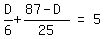 ----- Substituting D for RUN-DISTANCE, 6 for RUN-SPEED, "87 - D" for
RACE-DISTANCE, 25 for RACE-SPEED, and 5 for BIATHLON-TIME
25D + 6(87 - D) = 5(150) ----- Multiplying by LCD, 150
25D + 522 - 6D = 750
25D - 6D = 750 - 522
19D = 228
RUN-DISTANCE, or ----- Substituting D for RUN-DISTANCE, 6 for RUN-SPEED, "87 - D" for
RACE-DISTANCE, 25 for RACE-SPEED, and 5 for BIATHLON-TIME
25D + 6(87 - D) = 5(150) ----- Multiplying by LCD, 150
25D + 522 - 6D = 750
25D - 6D = 750 - 522
19D = 228
RUN-DISTANCE, or  RACE-DISTANCE = 87 - D = 87 - 12 = 75 miles
Answer by ikleyn(53748) (Show Source):
You can put this solution on YOUR website! .
1. Suppose that you have entered an 87-mile biathlon that consists of a run and a bicycle race.
During your run, your average speed is 6 miles per hour, and during your bicycle race,
your average speed is 25 miles per hour. You finish the race in 5 hours.
What is the distance of the run? What is the distance of the bicycle race?
~~~~~~~~~~~~~~~~~~~~
Let "t" be the time running, in hours.

Then the time cycling is (5-t) hours.


The total distance equation is

    6t + 25(5-t) = 87  miles.


Simplify and find "t"

    6t + 125 - 25t = 87,

     125 - 87 = 25t - 6t

         38   =    19t

          t    =    38/19 = 2 hours.


So, you run 2 hours and cycle 5-2 = 3 hours.


The distance running is  6*2 = 12 miles.  The distance cycling is 25*3 = 75 miles.    ANSWER
Solved.
////////////////////////////////
2. In the 1984 Olympics, C.Lewis of the United States won the gold medal in the 100-meter race
with a time of 9.99 seconds. In the 1896 Olympics,Thomas Burke,also of the United States,
won the gold medal in the 100-meter race in 12.0 seconds.
If they ran in the same race repeating their respective times, by how many meters would Lewis beat Burke?
~~~~~~~~~~~~~~~~~~~~~
C.Lewis finished 12 - 9.99 = 2.01 seconds ahead of Thomas Burke.
Hence, C.Lewis beat Burke by  = 16.75 meters. ANSWER
Here the ratio = 16.75 meters. ANSWER
Here the ratio  is the Burke' average speed in meters per second. is the Burke' average speed in meters per second.
Solved.
Answer by josgarithmetic(39792) (Show Source):
Question 1207842: Find an equation for the line that is described. Write the answer in the two forms y = mx + b and Ax + By + C = 0.
A. Is parallel to 2x - 5y = 10 and passes through ( 1, 2)
B. Is parallel to 4x + 5y = 20 and passes through (0, 0)
Found 2 solutions by greenestamps, josgarithmetic:
Answer by greenestamps(13327) (Show Source):
You can put this solution on YOUR website!
The equations are both in Ax+By=C form. It's very slow and inefficient to start solving the problem by converting the given equations to slope-intercept form, as the other tutor suggested.
Given an equation in Ax+By=C form, any line parallel to it will have an equation of the form Ax+By=N for some N. Then, given a point (x,y) on the line, the value of N is determined by using those x and y values in the general form.
A. parallel to 2x-5y=10 passing through (1,2)
The equation is 2x-5y=N, where N is determined by substituting x=1 and y=2:
N = 2(1)-5(2) = 2-10 = -8
ANSWER: 2x-5y = -8
Put in slope-intercept form by solving for y:
2x-5y = -8
-5y = -2x-8
5y = 2x+8
y = (2/5)x+8/5
Solve the other one in exactly the same way.
Answer by josgarithmetic(39792) (Show Source):
Question 1207837: Brittany needed new tires for her truck. She went to the auto shop and bought 4 tires on sale for $85.95 each. The salesman told her that she saved a total of $96.16. If Brittany saved the same amount on each tire, what was the original price of each tire?
Found 2 solutions by ikleyn, josgarithmetic:
Answer by ikleyn(53748) (Show Source):
You can put this solution on YOUR website! .
Brittany needed new tires for her truck. She went to the auto shop and bought 4 tires on sale for $85.95 each.
The salesman told her that she saved a total of $96.16. If Brittany saved the same amount on each tire,
what was the original price of each tire?
~~~~~~~~~~~~~~~~~~~~
Brittany saved $96.16 on 4 tires, in total.
Hence, she saved  = 24.04 dollars on each tire.
So, the original price per tire was 85.95 + 24.04 = 109.99 dollars. ANSWER = 24.04 dollars on each tire.
So, the original price per tire was 85.95 + 24.04 = 109.99 dollars. ANSWER
Solved.
-----------------
I wrote this solution here to show you that 3 short lines is enough, if do not make unnecessary excessive work.
In this problem, two arithmetic operations are needed: to divide $96.24 by 4 and to add the quotient to $85.95.
Answer by josgarithmetic(39792) (Show Source):
Question 1207835: Show that for all real numbers a and b, we have
|a| - |b| <= |a - b|
Hint:
Beginning with the identity a = (a - b) + b, take the absolute value of each side and then use the triangle inequality.
Answer by ikleyn(53748) (Show Source):
You can put this solution on YOUR website! .
Show that for all real numbers a and b, we have
|a| - |b| <= |a - b|
Hint:
Beginning with the identity a = (a - b) + b, take the absolute value of each side
and then use the triangle inequality.
~~~~~~~~~~~~~~~~~~~~~~~
I will strictly follow the given instructions.
             Step by step


(1)  Start with the identity a = (a - b) + b.


(2)  Take absolute values

         |a| = |(a-b) + b|.


(3)  Apply the triangle inequality

          |a| = |(a-b) + b| <= |a-b| + |b|.


     So, you have

          |a| <= |a-b| + |b|.


(4)  In the last equality, subtract |b| from both sides

     (it is the same as transfer term |b| from right to left).  You will get

          |a| - |b| <= |a-b|.


     It is precisely what they want you prove.


At this point, the proof is complete.
Solved.
Question 1207761: A sugar molecule has twice as many atoms of hydrogen as it does oxygen and one more atom of carbon than oxygen. If a sugar molecule has a total of 45 atoms, how many are oxygen? How many are hydrogen?
Let me see.
Atoms = 2x
Hydrogen = x
2x + x = 45
Is this equation correct?
Found 2 solutions by josgarithmetic, ikleyn:
Answer by josgarithmetic(39792) (Show Source):
Answer by ikleyn(53748) (Show Source):
You can put this solution on YOUR website! .
The equation in your post is WRONG.
Is my understanding correct that your job at this forum
is posting wittingly wrong problems, of the type 2 + 2 = 5,
and then, with blue eyes, asking/requesting, if it is correct or not, preferably with detailed explanations ?
\\\\\\\\\\\\\\\\\\\\\\\\\\\
I got this comment from you
comment from student:
1. No
2. I read the problem
3. I try setting up an equation(s)
4. I ask tutors if my set up is correct.
5. If my set up I'd correct, I can then take it from there.
Below is my response :
As I see, you like to work having a list of step-by-step instructions.


But as I look on your activity here at the forum, this list, which you
compiled for yourself in your comment, is not enough for you.


More precisely, if you are going to "solve" problems due to the intelligence and skills
of the tutors, then it is enough.


But if you want to learn solving Math problems on your own,
then you need to EXTEND your list, adding there


    - read and re-read the problem until you get a complete understanding;


    - Make set up checking and re-checking your job at every step,
          check, then double check, then re-check, then cross check.


    - At every step, apply full attention and be concentrated/focused on the problem.


      It is very and absolutely normal process: these are no excessive demands here.
      It is assumed (by default) that every student, wishing to learn Math,
      works and does it this way with full diligence.
And take this my last instruction very seriously:
- when I recommend you my lessons to read, do not leave it without your attention.
For many people, it is necessary to see a large massive of solved problems on a subject
to get full/complete understanding the method / (methods), the terminology, and standards of presentations.
You may add this my last instruction to your list: read what is recommended to you.
|
Older solutions: 1..45, 46..90, 91..135, 136..180, 181..225, 226..270, 271..315, 316..360, 361..405, 406..450, 451..495, 496..540, 541..585, 586..630, 631..675, 676..720, 721..765, 766..810, 811..855, 856..900, 901..945, 946..990, 991..1035, 1036..1080, 1081..1125, 1126..1170, 1171..1215, 1216..1260, 1261..1305, 1306..1350, 1351..1395, 1396..1440, 1441..1485, 1486..1530, 1531..1575, 1576..1620, 1621..1665, 1666..1710, 1711..1755, 1756..1800, 1801..1845, 1846..1890, 1891..1935, 1936..1980, 1981..2025, 2026..2070, 2071..2115, 2116..2160
|
| |
