Question 99620: How do I solve for t (time ) in the following equation. This is from a college physics book
y = initial velocity x time + 1/2 (acceleration) time ^2
-1.69 m = (1094 m/s )t + 1/2 ( -9.8 m/s^2 ) t ^2
Answer by Adam(64)   (Show Source): (Show Source):
You can put this solution on YOUR website! Is is a standard quadratic eaquation of  , and can be solved with formula with coefficients: , and can be solved with formula with coefficients:  I'll use my favourite notation :-),let's denote s for distance, t - time,a - acceleration,v0-initial velocity. then we have I'll use my favourite notation :-),let's denote s for distance, t - time,a - acceleration,v0-initial velocity. then we have 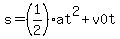
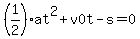 substituting into formula we get substituting into formula we get 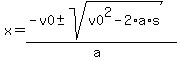 with values we get - getting two answers - -0.0015 and 223.2669 we can forget the negative one because it is phsically imposibble (time can never be negative) - btw those numbers in your equation seem really suspicious to me negative distance....that's either new theory of spacetime or.... with values we get - getting two answers - -0.0015 and 223.2669 we can forget the negative one because it is phsically imposibble (time can never be negative) - btw those numbers in your equation seem really suspicious to me negative distance....that's either new theory of spacetime or....
anyway quick rememberance:
s...distance[m],distance you travelled
v...velocity[m/s],change of s during infinitesimal change of t ds/dt to be precise
a...acceleration[m/s^2],dv/dt
How to have something from nothing...
now, what I want to show is not fully rigorous, but it is a lot of fun :-),
let's start with a = a with help of our formulae we can state that v=S[t]dt (primitive function) thus v = a*t+c now after deep thought we may state that constant will probably be v0, so v = a*t+v0, followed by s= V[t]dt
s = 1/2a*t^2+v0*t+s0 (thought), now you try to make similiar conclusions, starting with a = 0. Good luck :-D
|
|
|
