|
Question 850681: A machine P can print one math book in 8 hours, machine Q can print the same number of books in 10 hours while machine R can print them in 12 hours. All the machines are started at 9 A.M. while machine P is closed at 11 A.M. and the remaining two machines complete work. Approximately at what time will the work (to print one math book) be finished ?
Found 2 solutions by JulietG, MathTherapy:
Answer by JulietG(1812)   (Show Source): (Show Source):
You can put this solution on YOUR website! We're assuming that the book can be made up of pieces.
P * 8 = 1
Q * 10 = 1
R * 12 = 1
.
or the inverse:
P = 1/8
Q = 1/10
R = 1/12
.
P prints 1/8 * 2 hours; 2/8 of a book.
In the same time, Q prints 2/10
In the same time, R prints 2/12
.
After 2 hours, 2/8 + 2/10 + 2/12 of a book is printed. (1/4 + 1/5 + 1/6)
Let's use a common denominator for 4,5,6 --> 60
After 2 hours, 15/60 + 12/60 + 10/60 is finished, or 37/60.
.
Each following hour,
Q prints 2/10 (or 12/60)
R prints 2/12 (or 10/60)
.
After 3 hours, 37/60 + 22/60 is finished. That is 59/60.
.
Since Q and R print 22/60 per hour (or at the rate of 2.728 minutes), the remaining 1/60 is printed at 12:02.728, or "approximately" 12:03 PM.
.
*sigh* This sounds like one of those horrible Common Core messes.
Answer by MathTherapy(10803)  (Show Source): (Show Source):
You can put this solution on YOUR website!
A machine P can print one math book in 8 hours, machine Q can print the same number of
books (this author believes this should be PAGES) in 10 hours while machine R can print them in
12 hours. All the machines are started at 9 A.M. while machine P is closed at 11 A.M. and the
remaining two machines complete work. Approximately at what time will the work (to print one
math book) be finished ?
***************************************************************
The other person's answer, "approximately" 12:03 PM....", is WRONG!!
Machine P does the job (prints book) in 8 hrs, or does  of entire job in 1 hr
Machines P and Q do the job (print book) in 10 and 12 hrs, respectively
Then each does of entire job in 1 hr
Machines P and Q do the job (print book) in 10 and 12 hrs, respectively
Then each does  and and  of entire job in 1 hr, respectively
In 2 hours, the 3 machines complete of entire job in 1 hr, respectively
In 2 hours, the 3 machines complete 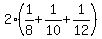 = =  = =  = =  = =  Let the time it takes Q and R to complete the job, be T
Then working together, Q and R completes
Let the time it takes Q and R to complete the job, be T
Then working together, Q and R completes  of the job
We then get the following COMPLETE-JOB equation: T1(rates) + T2(rates) = 1 (entire job), OR
Fraction completed + Remaining Fraction = 1 (entire job). This produces: of the job
We then get the following COMPLETE-JOB equation: T1(rates) + T2(rates) = 1 (entire job), OR
Fraction completed + Remaining Fraction = 1 (entire job). This produces:
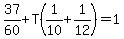
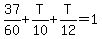 37 + 6T + 5T = 60 ---- Multiplying by LCD, 60
37 + 11T = 60
11T = 60 - 37
11T = 23
Time it takes Q and R to complete the job, after P, Q, and R worked together for 2 hrs, or
37 + 6T + 5T = 60 ---- Multiplying by LCD, 60
37 + 11T = 60
11T = 60 - 37
11T = 23
Time it takes Q and R to complete the job, after P, Q, and R worked together for 2 hrs, or 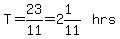 or 2 hrs, 5.5 minutes, approximately.
Finally, 2 hrs, 5.5 minutes after 11:00 a.m. takes us to 1:05.5, or approximately 1:06 p.m.
ANECDOTE
As seen above, the other person's approximated 1-hr claim is INVALID. The 3 machines completed of job in 2
hours, which leaves
or 2 hrs, 5.5 minutes, approximately.
Finally, 2 hrs, 5.5 minutes after 11:00 a.m. takes us to 1:05.5, or approximately 1:06 p.m.
ANECDOTE
As seen above, the other person's approximated 1-hr claim is INVALID. The 3 machines completed of job in 2
hours, which leaves  of the job, incomplete. Does it make sense that 3 machines take 2 hours to complete ,
or > of the job, incomplete. Does it make sense that 3 machines take 2 hours to complete ,
or >  of the job, but 2 of the 3 machines take just 1 hour to complete the remaining of the job, but 2 of the 3 machines take just 1 hour to complete the remaining  (approximation),
especially when the FASTEST of the 3, P, is no longer working? (approximation),
especially when the FASTEST of the 3, P, is no longer working?
|
|
|
| |
