|
Question 846331: Two thirds of a cake is left from a birthday party. Ginny decides to give 3/4 of the remaining cake to joe. What part of the entire cake will joe receive?
Answer by KMST(5347)   (Show Source): (Show Source):
You can put this solution on YOUR website! Joe will get  of of  of the cake. of the cake.
When you want to find of something (like of 48 apples),
you multiply times ,
and the same goes if you are trying to find of of a cake.

Joe will get 1/2 of the cake.
ANOTHER WAY:
Since we have thirds and fourths,
 could be a common denominator, could be a common denominator,
so let's think of twelfths.
Supposed that the cake came conveniently cut into equal slices.
Each slice is  of the cake. of the cake.
If you have of the cake left, you have  slices left, slices left,
because  slices would be slices would be  of the cake, of the cake,
and slices is twice slices.
To figure those slices, out of the original ,
you divided by  to get , to get ,
and then multiplied times  to get of the original slices. to get of the original slices.
That is 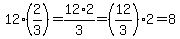 . .
You are multiplying times when you
first divide by and then multiply times , or
when you multiply times and then divide by .
It's all the same.
Now,  of those slices left would be slices, of those slices left would be slices,
and of those slices left would be  slices that you give to Joe. slices that you give to Joe.
Since the whole cake was slices, those slices are half of the cake.
|
|
|
| |
