Question 823877: ABCD IS A PARALLELOGRAM.TRIANGLE DEC IS DRAWN SUCH THAT BE=1/3 AE.SUM OF THE AREAS OF TRIANGLES ADE AND BEC IS?
Answer by KMST(5345)   (Show Source): (Show Source):
You can put this solution on YOUR website! Since the problem does not state any side measurements (just a ratio), the most that we could do is calculate that sum of areas relative to the area of the parallelogram.
Without a picture, I am not quite sure I can interpret the situation intended, but I will try.
We could calculate that sum of areas as    for the situation below. for the situation below.

In that case,  , ,
 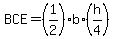
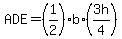

area of ADE + area of BCE =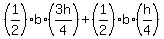
area of ADE + area of BCE =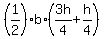
area of ADE + area of BCE =
It really does not matter what fraction of AE is BE,
because the heights of ADE and BCE would add up to  anyway. anyway.
It really does not matter where E is located, as long as it is between the lines AD and BC,
 because we could still calculate the areas of ADE and BCE because we could still calculate the areas of ADE and BCE
based on  (the length of AD and BC) as the base for both, (the length of AD and BC) as the base for both,
and the distances from E to AB and to BC as the heights.
And those heights would add up to anyway.
The ratio of AE is BE, does not matter either,
because the heights of ADE and BCE would add up to anyway.
|
|
|
