Question 720317: Here is my problem.
[SQRT(x + 7)] - 2[SQRT(x)] =-2
OR
√(x + 7) - 2√(x) = -2
-------
Now, the steps I took to solve this problem are to first square both sides:
[√(x + 7) - 2√(x)] * [√(x + 7) - 2√(x)] = 4
so then I FOIL the left side, resulting in:
(x+7) - [√(x + 7) * - 2√(x)] - [ - 2√(x) * √(x + 7)] + 4x
So then I thought to subtract (x+7) and (4x) to both sides
- [√(x + 7) * - 2√(x)] - [ - 2√(x) * √(x + 7)] = 4 - 4x - x - 7 (I think I'm supposed to switch the sign, because I've subtracted it and moved it to the opposite side, right?)
I think I'm correct up to this point, but now I have to square both sides again.
I think this left hand side could be re-written as:
-2[√(x + 7) * - 2√(x)]
Is this right? I'm subtracting it from itself, a negative, which could simply multiplied by -2. Anyway, now I need to square this again, so I assume the -2 becomes a 4 and I FOIL them separately?
FOILING the left side will get:
[√(x + 7) * - 2√(x)] * [√(x + 7) * - 2√(x)]
Which, when FOILed, looks like
(x+7) - [√(x+7) * -2√(x)] - [ - 2√(x) * √(x + 7)] + 4x
It looks exactly the same as before!! I'm just really confused by this problem, and I have a couple more like it, so I want to know if figuring this one out could help me solve the other ones.
I'm confused about FOILing the different sides, whether or not I can combine two square roots, and quite frankly, a lot of other things.
One of the options on the test is 9, and I think this is the answer, because I've inserted it into the original equation and it works, but I'm just confused about how to actually get 9 out of this..
Sorry for the long question. I hope it's not hard to understand. I'm just hoping someone can walk me through all the steps of solving a problem like this so I can do it easily in the future.
Found 3 solutions by lwsshak3, MathTherapy, greenestamps:
Answer by lwsshak3(11628)   (Show Source): (Show Source):
You can put this solution on YOUR website! √(x + 7) - 2√(x) = -2
√(x+7)=2√x-2
square both sides
x+7=4x-8√x+4
-3x+3=-8√x
-3(x-1)=-8√x
square both sides again
9(x-1)^2=64x
9(x^2-2x+1)=64x
9x^2-18x+9-64x=0
9x^2-82x+9=0
solve for x using quadratic formula:
x≈0.1111..(reject, extraneous root)
x=9
Answer by MathTherapy(10858)  (Show Source): (Show Source):
You can put this solution on YOUR website!
Here is my problem.
[SQRT(x + 7)] - 2[SQRT(x)] =-2 OR √(x + 7) - 2√(x) = -2
-------
Now, the steps I took to solve this problem are to first square both sides:
[√(x + 7) - 2√(x)] * [√(x + 7) - 2√(x)] = 4
so then I FOIL the left side, resulting in:
(x+7) - [√(x + 7) * - 2√(x)] - [ - 2√(x) * √(x + 7)] + 4x
So then I thought to subtract (x+7) and (4x) to both sides
- [√(x + 7) * - 2√(x)] - [ - 2√(x) * √(x + 7)] = 4 - 4x - x - 7 (I think I'm supposed to switch the sign, because I've
subtracted it and moved it to the opposite side, right?)
I think I'm correct up to this point, but now I have to square both sides again.
I think this left hand side could be re-written as:
-2[√(x + 7) * - 2√(x)]
Is this right? I'm subtracting it from itself, a negative, which could simply multiplied by -2. Anyway, now I need to
square this again, so I assume the -2 becomes a 4 and I FOIL them separately?
FOILING the left side will get:
[√(x + 7) * - 2√(x)] * [√(x + 7) * - 2√(x)]
Which, when FOILed, looks like
(x+7) - [√(x+7) * -2√(x)] - [ - 2√(x) * √(x + 7)] + 4x
It looks exactly the same as before!! I'm just really confused by this problem, and I have a couple more like it, so I
want to know if figuring this one out could help me solve the other ones.
I'm confused about FOILing the different sides, whether or not I can combine two square roots, and quite frankly, a lot
of other things.
One of the options on the test is 9, and I think this is the answer, because I've inserted it into the original
equation and it works, but I'm just confused about how to actually get 9 out of this..
Sorry for the long question. I hope it's not hard to understand. I'm just hoping someone can walk me through all
the steps of solving a problem like this so I can do it easily in the future.
*******************************
Here is my problem.
[SQRT(x + 7)] - 2[SQRT(x)] =-2 OR √(x + 7) - 2√(x) = -2
-------
Now, the steps I took to solve this problem are to first square both sides:
[√(x + 7) - 2√(x)] * [√(x + 7) - 2√(x)] = 4
so then I FOIL the left side, resulting in:
(x+7) - [√(x + 7) * - 2√(x)] - [ - 2√(x) * √(x + 7)] + 4x <=== This is where you went WRONG! When FOILed, this's
actually:  , which results in: , which results in:
 . See? . See?

 So then I thought to subtract (x+7) and (4x) to both sides So then I thought to subtract (x+7) and (4x) to both sides
 - [√(x + 7) * - 2√(x)] - [ - 2√(x) * √(x + 7)] = 4 - 4x - x - 7
(I think I'm supposed to switch the sign, because I've
subtracted it and moved it to the opposite side, right?) - [√(x + 7) * - 2√(x)] - [ - 2√(x) * √(x + 7)] = 4 - 4x - x - 7
(I think I'm supposed to switch the sign, because I've
subtracted it and moved it to the opposite side, right?)
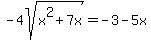 <=== This is exactly how you need to proceed! <=== This is exactly how you need to proceed!
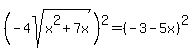 ---- Squaring both sides ---- Squaring both sides



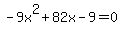 OR OR 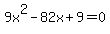
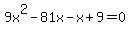 9x(x - 9) - 1(x - 9) = 0
(x - 9)(9x - 1) = 0
x - 9 = 0 OR 9x - 1 = 0
x = 0 + 9 OR 9x = 1
x = 9 OR x =
9x(x - 9) - 1(x - 9) = 0
(x - 9)(9x - 1) = 0
x - 9 = 0 OR 9x - 1 = 0
x = 0 + 9 OR 9x = 1
x = 9 OR x =  (IGNORE)
proves to be EXTRANEOUS, so sole solution is: x = 9
To some though, it's easier to solve, if one of the left-side RADICALS is MOVED to the right, 1st. But then, this's subjective.
It looks exactly the same as before!! I'm just really confused by this problem, and I have a couple more like it, so I want
to know if figuring this one out could help me solve the other ones. Hopefully, the above will clear up SOME/ALL confusion!
I'm confused about FOILing the different sides, whether or not I can combine two square roots, and quite frankly, a lot of
other things. Hopefully, the above will clear up SOME/ALL confusion!
One of the options on the test is 9, and I think this is the answer, because I've inserted it into the original equation
and it works, but I'm just confused about how to actually get 9 out of this. Yes, the solution is indeed 9, as seen above!
Sorry for the long question. I hope it's not hard to understand. I'm just hoping someone can walk me through all the steps
of solving a problem like this so I can do it easily in the future. Hopefully, this author has assisted you in understanding this
problem, so you can understand and obtain SOLUTIONS to similar problems, more easily, more efficiently, and without confusion! (IGNORE)
proves to be EXTRANEOUS, so sole solution is: x = 9
To some though, it's easier to solve, if one of the left-side RADICALS is MOVED to the right, 1st. But then, this's subjective.
It looks exactly the same as before!! I'm just really confused by this problem, and I have a couple more like it, so I want
to know if figuring this one out could help me solve the other ones. Hopefully, the above will clear up SOME/ALL confusion!
I'm confused about FOILing the different sides, whether or not I can combine two square roots, and quite frankly, a lot of
other things. Hopefully, the above will clear up SOME/ALL confusion!
One of the options on the test is 9, and I think this is the answer, because I've inserted it into the original equation
and it works, but I'm just confused about how to actually get 9 out of this. Yes, the solution is indeed 9, as seen above!
Sorry for the long question. I hope it's not hard to understand. I'm just hoping someone can walk me through all the steps
of solving a problem like this so I can do it easily in the future. Hopefully, this author has assisted you in understanding this
problem, so you can understand and obtain SOLUTIONS to similar problems, more easily, more efficiently, and without confusion!
Answer by greenestamps(13367)  (Show Source): (Show Source):
|
|
|
