Question 644822: Alfred, Mindy and Casey can mow their lawn in 60 minutes if they work together. If it takes Alfred twice as long as Mindy and Casey take 10 minutes more than Mindy, how long would it take each to mow the lawn alone?
Answer by nerdybill(7384)   (Show Source): (Show Source):
You can put this solution on YOUR website! Alfred, Mindy and Casey can mow their lawn in 60 minutes if they work together. If it takes Alfred twice as long as Mindy and Casey take 10 minutes more than Mindy, how long would it take each to mow the lawn alone?
.
Let m = time (mins) it takes Mindy to mow alone
then
2m = time (mins) it takes Alfred to mow alone
m+10 = time (mins) it takes Casey to mow alone
.
from:"Alfred, Mindy and Casey can mow their lawn in 60 minutes if they work together." we get our equation:
60(1/m + 1/(2m) + 1/(m+10)) = 1
multiplying both sides by m(2m)(m+10) we get:
60((2m)(m+10) + m(m+10) + m(2m)) = m(2m)(m+10)
60(2m^2+20m + m^2+10m + 2m^2) = (2m^2)(m+10)
60(5m^2+30m) = 2m^3+20m^2
30(5m^2+30m) = m^3+10m^2
150m^2+900m = m^3+10m^2
900m = m^3-140m^2
0 = m^3-140m^2-900m
0 = m(m^2-140m-900)
applying the quadratic formula, we get:
m = {0, 146.16, -6.16}
toss out 0 and the negative solution (extraneous) leaving:
m = 146 mins (Mindy)
.
Alfred:
2m = 2(146) = 292 mins
Casey:
m+10 = 146+10 = 156 mins
.
Details from quadratic formula:
| Solved by pluggable solver: SOLVE quadratic equation with variable |
Quadratic equation  (in our case (in our case  ) has the following solutons: ) has the following solutons:

For these solutions to exist, the discriminant  should not be a negative number. should not be a negative number.
First, we need to compute the discriminant :  . .
Discriminant d=23200 is greater than zero. That means that there are two solutions: 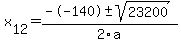 . .


Quadratic expression 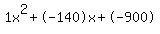 can be factored: can be factored:

Again, the answer is: 146.157731058639, -6.15773105863909.
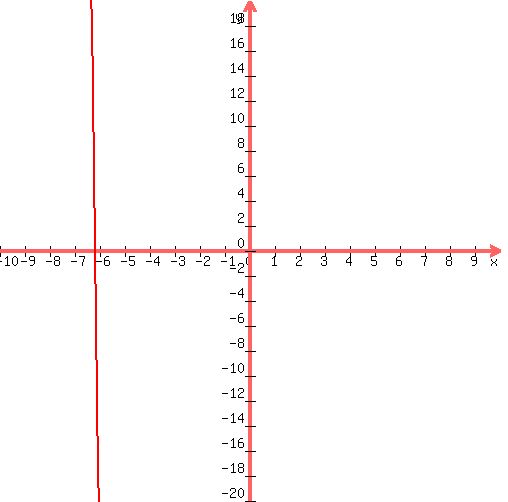
Here's your graph:
 |
|
|
|
