Question 63264: solve. x-2/x+1 greater or equal to 3
thank you
Found 3 solutions by jai_kos, ikleyn, n2:
Answer by jai_kos(139)   (Show Source): (Show Source):
You can put this solution on YOUR website! Solution:
x-2 /x+1 > = 3
Multiply both sides by (x+1), we have
x -2 > = 3 (x+ 1)
x - 2 >= 3x + 3
Group all the x terms to one side, we get
x -3x > = 3 + 2
-2x > =5
Divide the above equation by 2 we get,
-x>= 5/2
When we change the sign in inequalites ,we also change the symbols.
x < = 5/2
Answer by ikleyn(53751)  (Show Source): (Show Source):
You can put this solution on YOUR website! .
solve. x-2/x+1 greater or equal to 3
~~~~~~~~~~~~~~~~~~~~~~~~
The solution in the post by @jai_kos in incorrect.
It is incorrect methodologically and gives incorrect answer.
See my correct solution below.
They want you solve this inequality
 >= 3. (1)
Transform it equivalently this way
- 3 >= 0 <<<---=== moving 3 from right side to left side with changing the sign
- >= 3. (1)
Transform it equivalently this way
- 3 >= 0 <<<---=== moving 3 from right side to left side with changing the sign
-  >= 0 <<<---=== writing '3' with the common denominator >= 0 <<<---=== writing '3' with the common denominator
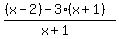 >= 0 <<<---=== simplifying >= 0 <<<---=== simplifying
 >= 0 <<<---=== simplifying further
Now, the left side rational function can be non-negative if and only if
EITHER the numerator is non-negative and denominator is positive
-2x - 5 >= 0 and x + 1 > 0 (2)
OR the numerator is non-positive and denominator is negative
-2x - 5 <= 0 and x + 1 < 0. (3)
In case (2), -2x >= 5 and x > -1, which is the same as
x <= -5/2 and x > -1.
These both inequalities, taken together, has no solution.
In case (3), -2x <= 5 and x < -1, which is the same as
x >= -5/2 and x < -1.
Thus the final solution to the given inequality is this set of real numbers -5/2 <= x < -1,
or, in the interval notation, the set [ >= 0 <<<---=== simplifying further
Now, the left side rational function can be non-negative if and only if
EITHER the numerator is non-negative and denominator is positive
-2x - 5 >= 0 and x + 1 > 0 (2)
OR the numerator is non-positive and denominator is negative
-2x - 5 <= 0 and x + 1 < 0. (3)
In case (2), -2x >= 5 and x > -1, which is the same as
x <= -5/2 and x > -1.
These both inequalities, taken together, has no solution.
In case (3), -2x <= 5 and x < -1, which is the same as
x >= -5/2 and x < -1.
Thus the final solution to the given inequality is this set of real numbers -5/2 <= x < -1,
or, in the interval notation, the set [ , , ). ).
Solved.
The error made by @jai_kos is that when he multiplies both sides of the original inequality by (x+1),
he misses the case when (x+1) is negative, which requires different treatment.
This error, which jai_kos makes solving the problem, is a typical error, which beginners make
when trying to solve such inequalities,
until the more experienced teachers/tutors will explain their error and will show a right way solving.
Answer by n2(79) (Show Source): (Show Source):
You can put this solution on YOUR website! .
.
solve the rational inequality (x-2)/(x+1) >= 3.
~~~~~~~~~~~~~~~~~~~~~~~~
They want you solve this inequality

     >= 3.    (1)


Transform it equivalently this way

     - 3 >= 0             <<<---===  moving 3 from right side to left side with changing the sign

     -  >= 0    <<<---=== writing '3' with the common denominator

     >= 0       <<<---===  simplifying

     >= 0               <<<---===  simplifying further


Now, the left side rational function can be non-negative if and only if

    EITHER the numerator is non-negative and denominator is positive

        -2x - 5 >= 0  and  x + 1 > 0    (2)

    OR     the numerator is non-positive and denominator is negative

        -2x - 5 <= 0  and  x + 1 < 0.   (3)


In case (2),  -2x >= 5  and  x > -1,  which is the same as

              x <= -5/2 and  x > -1.

              These both inequalities, taken together, has no solution.


In case (3),  -2x <= 5  and  x < -1,  which is the same as

              x >= -5/2 and  x < -1.


Thus the final solution to the given inequality is this set of real numbers  -5/2 <= x < -1,
or, in the interval notation, the set [,).
Solved.
|
|
|
