|
Question 503419: What is the slope of this tangent if given this point?
y=4/x (-2,8)
It reads: y equals four over x
The given point is: (-2, 8)
An explanation as to how the answer was reached would be wonderful! :)
Answer by oberobic(2304)   (Show Source): (Show Source):
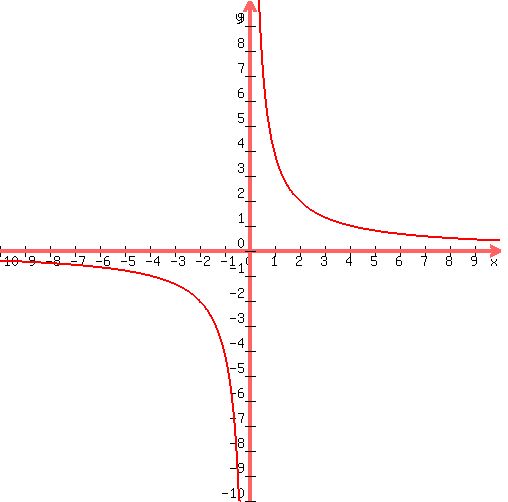
You can put this solution on YOUR website! Looking at the graph, you can see that y = 4/x is not truly a linear equation.
.
Actually

.
The point (-2,8) is not on the curve, which you see above. Or prove it by plugging the x value into the equation:
y = 4/x
x = -2
y = -2, not 8
That creates another problem for you.
.
In general the slope of a line tangent to a curve can be found using the first derivative.
But that is a calculus question, not algebra.
.
The first derivative of

.
That is the slope of the line tangent to the curve for any value of 'x'.
But you need a point on the curve, which you do not have.
So, there is something wrong with your problem statement.
.
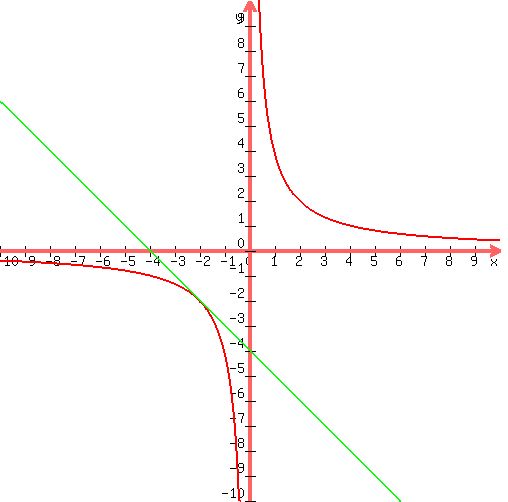
But assuming the point = (-2,-2)
The slope is:
-4/(-2^2) = -4/4 = -1 at that point.
.
Remember this is a curve, so the slope changes continuously.
(except there is a discontinuity at x=0 because 4/0 is undefined)
.
Substituting in the slope-intercept equation:
y = mx+b
-2 = -1*(-2) + b
b = -4
.
y = -x -4
which is a linear equation.
.
.
Of course, you could have picked another point.
Let's say x =4
The curve is y = x/4, so y=1.
(4,1)
.
m = -4/(4^2) = -4/16 = -1/4
.
1 = -1/4(4) + b
.
so
b=2
.
y = (-1/4)x+2
which is a linear equation tangent to the curve at (4,1)

|
|
|
| |
