Question 473012: Probability that an arrow hits second ring (second cirlce) if it hits target?
Problem consist of a circle, and in it are 2 smaller circles, they all have the same center...I'm guessing they're concentric. The radius of the smallest cirlce = 1, second circle=2, and 3rd = 3.
I confiugred 4/9, but, wouldn't the area of lagest circle minus the area of the smallest circle give me the area of the second circle? If this is true, then the area of the second circle would be 8 and the probability would be 8/9. Which is correct, i'm guessing 4/9, but why? Would the area of the largest - the smallest give the correct probability if and only if the readius of the second circle was not given?
Answer by ccs2011(207)   (Show Source): (Show Source):
You can put this solution on YOUR website! No the area of largest circle - area of smallest circle does NOT equal area of 2nd circle.
The largest circle represents the entire target, now if you take away the smallest circle you are left with the entire outer part of the target which includes part of the outer circle as well as part of the 2nd circle.
You are correct in thinking it is 4/9.
P(hitting 2nd circle) = Area of 2nd / Area of target
= 
**Note, I am assuming it includes the possibility of hitting the inner circle as well, since it is inside the 2nd circle**
Otherwise, if you only wanted to know the probability of hitting the inner ring (2nd circle but not the smallest circle) then subtract the smallest circle from 2nd circle
P = 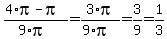
|
|
|
