|
Question 148962: I need some help with this problem. I have tried to work it and cannot seem to come up with the answer All the directions say is to complete the square to solve the following equations
x^2+6x=7 ( i know that you need to get every thing on 1 side but then what)
x^2+6x-7=0
and with this problem the same directions but would you us the quadratic formula to solve? 2x^2-5x-3=0 Thanks Leann
Found 4 solutions by ankor@dixie-net.com, mangopeeler07, MathTherapy, josgarithmetic:
Answer by ankor@dixie-net.com(22740)   (Show Source): (Show Source):
Answer by mangopeeler07(462)  (Show Source): (Show Source):
You can put this solution on YOUR website! x^2+6x-7=0
Factor:
start with
(x)(x)
insert a + and a -
(x+)(x-)
Find two factors of 7 whose difference is 6: 7 and 1. insert them:
(x+7)(x-1)
Set each expression equal to zero
x+7=0
x-1=0
Solve for x in each
x=-7
x=1
Answer by MathTherapy(10839)  (Show Source): (Show Source):
You can put this solution on YOUR website!
I need some help with this problem. I have tried to work it and cannot seem to come up with the answer All the directions say is to
complete the square to solve the following equations
x^2+6x=7 ( i know that you need to get every thing on 1 side but then what)
x^2+6x-7=0
and with this problem the same directions but would you us the quadratic formula to solve? 2x^2-5x-3=0 Thanks Leann
*************************************
While one of the other 2 "respondents" solved by factoring the trinomial, this is NOT the required method. However, this method, if the
trinomial is factorable, is oftentimes used by this author, as a way to determine the solutions/roots before COMPLETING the SQUARE.
You started out with  , and went on to SUBTRACT 7 from each side of the equation. But, when completing the square, the
CONSTANT (the number without an attached variable) should be on the right side of the equation, which it is! So, NO NEED to subtract 7,
in this case!
The answer to your question about whether or not the quadratic equation formula can be used, is YES!! But, why would you want to do
that when requested to solve, by COMPLETING the SQUARE? And also, both equations are indeed, factorable. , and went on to SUBTRACT 7 from each side of the equation. But, when completing the square, the
CONSTANT (the number without an attached variable) should be on the right side of the equation, which it is! So, NO NEED to subtract 7,
in this case!
The answer to your question about whether or not the quadratic equation formula can be used, is YES!! But, why would you want to do
that when requested to solve, by COMPLETING the SQUARE? And also, both equations are indeed, factorable.
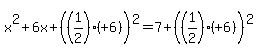 ---- Squaring ---- Squaring  of b, then adding result to both sides of b, then adding result to both sides
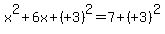


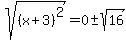 ---- Taking square root on both sides ---- Taking square root on both sides


 Now, follow the same concept for the 2nd equation!
Answer by josgarithmetic(39823) (Show Source):
|
|
|
| |
