|
Question 143431This question is from textbook Algebra
: Im not sure how to solve problems by rationalizing the denominator
This question is from textbook Algebra
Answer by solver91311(24713)   (Show Source): (Show Source):
You can put this solution on YOUR website! The process involves multiplying your fraction expression by 1 in a form such that when the denominators are multiplied, the denominator of the result becomes a rational number -- that is to say you have rid yourself of the radical. The process is also known as "Get that pesky radical OUT of my denominator"
Example 1:
 . .
The way to make the denominator rational is to multiply it by  , but we aren't allowed to change the value of the fraction. Fortunately, , but we aren't allowed to change the value of the fraction. Fortunately,  no matter what no matter what  is and is and  no matter what is (as long as it isn't zero), so multiplying by no matter what is (as long as it isn't zero), so multiplying by  (which is just another way to write 1) is allowed. (which is just another way to write 1) is allowed.
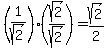
Example 2:

This one is a little tricker. Here we need to multiply the denominator by  . Again, we have to multiply by 1: . Again, we have to multiply by 1:
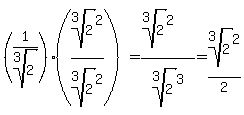
Example 3:

This one is a little trickier still. We need to take advantage of the 'difference of two squares' factorization, that is: 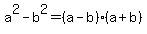
If we multiply the denominator by what is called its conjugate,  (notice the sign change), then the result will be the difference of the first term squared and the second term squared with no annoying center term containing a radical. Again, and as always, we have to multiply by 1. (notice the sign change), then the result will be the difference of the first term squared and the second term squared with no annoying center term containing a radical. Again, and as always, we have to multiply by 1.

Ewww! That's a mess, but at least the denominator is rational. You might want to rephrase the alternate definition I gave earlier for the process to: "Get that pesky radical OUT of my denominator and I don't care how big a mess you make in the numerator"
Write back if you have any questions.
| |
|
| |
