Question 134056: Graph (x+3) (x-2)^2=0 (use maxs, mins, x and y intercepts)
Answer by solver91311(24713)   (Show Source): (Show Source):
You can put this solution on YOUR website! 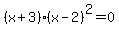 doesn't actually have a graph other than the three values (-3, 2, and 2) on the number line that satisfy the equation. You can, however, graph doesn't actually have a graph other than the three values (-3, 2, and 2) on the number line that satisfy the equation. You can, however, graph 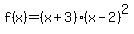 , and I suspect that is what you really meant. (I sincerely hope your instructor didn't pose the question that way. If s/he did, go get your money back) , and I suspect that is what you really meant. (I sincerely hope your instructor didn't pose the question that way. If s/he did, go get your money back)
Zeros, or x-intercepts at -3, 2, and 2 (we should have an extrema at 2)
Expand:
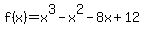
Extreme points where f'(x) = 0, so:
f'(x) =  . Set the first derivative equal to zero: . Set the first derivative equal to zero:
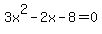
 , hence critical points are at ( , hence critical points are at ( , , ) and ( ) and ( , , ). ).
We know that  , so we have a critical point at (2,0). , so we have a critical point at (2,0).
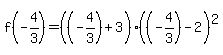
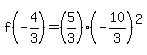
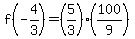
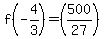
And we have an extreme point at , ) )
f"(x)=
f"(2)= => (2,f(2)) is a local minimum => (2,f(2)) is a local minimum
f"(-4/3)=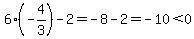 => (,) is a local maximum => (,) is a local maximum
The y-intercept is found by evaluating f(0):
 hence the y-intercept is (0,12) hence the y-intercept is (0,12)
Using this information, we can make a rough sketch of the graph:

| |
|
