Question 129143: Kindly help me with my assignment. I need solution and checking. Thank you!
1)A number increased by 2/5 of it becomes 210. What is the number?
2)The sum of 3 consecutive odd integers is 201. Find the largest of the 3 integers?
3)One number is twice another number when the larger number is diminished by 10, the result is 2 greater than the smaller number. Find the nos.?
4)There are 31 bills which total P1,830 in a cash box. This bills are either
P20.00 or P50.00. How many of each domination of bill are there in a box?
5)The sum of 3 consecutive even integers is 50 more than the smallest one. Find the integers?
Answer by Construe(3)   (Show Source): (Show Source):
You can put this solution on YOUR website! Question 1
Let the number be  . .
Then 2/5 of the number is 
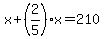
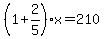


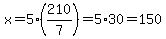
The number is  . .
Question 2
Since there are 3 consecutive odd integers, there is a smallest one, a largest one, and one in between. Let the integer in between be . Then the smallest integer will be  and the largest will be and the largest will be  . .
Their sum is equal to 201, so:



Since the largest integer is ,

The largest integer is  . .
Question 3
Let the smaller number be S and the larger number be L.
The larger number is twice the smaller number:

The larger number diminished by 10 is 2 more than the smaller number:

Substituting into this equation, we have:



Since ,

The smaller number is  and the larger number is and the larger number is  . .
Question 4
Let A be the number of 20-pound notes and B be the number of 50-pound notes.


Substituting  into the second equation, into the second equation,




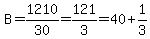
Then  . .
Since A and B must necessarily be non-negative integers, there are no valid solutions to this problem. Also, by observation, the total amount of money in the cash box can only range from  to to  , and , and  as given in the question is outside that range. as given in the question is outside that range.
Question 5
Let the smallest integer be . Then the middle-valued integer will be , and the largest integer will be {{[x+4}}}.






The integers are  , and , and  . .
|
|
|
