|
Question 1210613: Marek and Zaven had 900 coins altogether. Marek spent 25% fewer coins than Zaven. Zaven was left with 50% as many coins as the number he spent. Marek had 75% of the total number of coins the two friends had left in the end. How many coins did Marek have in the end?
Found 4 solutions by josgarithmetic, KMST, math_tutor2020, greenestamps:
Answer by josgarithmetic(39818)   (Show Source): (Show Source):
You can put this solution on YOUR website!
             Marek             Zaven          TOTAL

Start        900-z               z             900

AFTER
SPENT       900-z-0.75x         z-x=0.5x

            900-z-0.75x=(0.75)(900-z-0.75x+0.5x)
That does not go directly to the quanity asked in the question.
System is 
But a more efficient setup may be possible.
(*WARNING: possible fault in setup; algebraic steps produced faulty outcome)
Answer by KMST(5362)  (Show Source): (Show Source):
You can put this solution on YOUR website! DATA WE HAVE:
Marek and Zaven had 900 coins altogether.
That is what they had initially.
Zaven was left with 50% (half) as many coins as the number he spent.
He spent twice as many coins as he was left with.
For every 1 coin he had left, there were 2 he had spent, and 3 that he originally had.
That tells me that the number of coins Zaven initially had was a multiple of 3.
Marek spent 25% fewer coins than Zaven.
Marek spent 100%-25%=75% of what Zaven spent.
If I knew how much Zaven spent I can multiply times 0.75 to find what Marek spent.
For every 4 coins Zaven spent Marek spent 3. So I could instead divide by 4 and multiply times 3.
Marek had 75% of the total number of coins the two friends had left in the end.
Could Marek have initially had 75% of the total number of coins the two friends had left in the end? It does not seem possible.
I think what the "in the end" part applies to the whole sentence, and what was meant is:
In the end, Marek had 75% of the total number of coins the two friends had left.
AN EASY WAY TO SOLVE IT (guess and check):
Fist Guess:
What if Zaven initially had  . .
Then, Zaven must have spent  , ,
and must have had left with  in the end. in the end.
Then, Marek
must have started with 
must have spent  , ,
and have had left  in the end. in the end.
Then, Zaven and Marek then together had  in the end, in the end,
and that would mean that in the end,
the number of coins Marek had,
as a fraction and as a percentage of the number of coins Zaven and Marek had together, was
 
We need  as an answer, so we should try to have Marek start with a little less with respect to Zaven. as an answer, so we should try to have Marek start with a little less with respect to Zaven.
second Guess:
What if Zaven initially had  . .
Then, Zaven must have spent  , ,
and must have had left with  in the end. in the end.
Then, Marek
must have started with 
must have spent  , ,
and have had left  in the end. in the end.
Then, Zaven and Marek then together had  in the end, in the end,
and that would mean that in the end,
the number of coins Marek had,
as a fraction and as a percentage of the number of coins Zaven and Marek had together, was

A HYBRID OF THE SOLUTION ABOVE AND jogsarithmetic's solution:
Let's call the number of coins Zaven had at start, what he spent, and what he had left in the end 3x, 2x, and x, respectively.
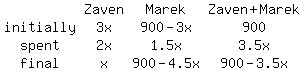
Then, we have just one variable, and the equation
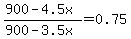 <--> <--> <--> <--> <--> <--> <--> <-->

In th e end, the number of coins Marek had was 
Some teachers want problems solved the way it was taught in class, and may not like alternative solutions.
Some teacher may want to give extra point f=if more that one way to solve the problem is shown.
Answer by math_tutor2020(3837) (Show Source):
You can put this solution on YOUR website!
I'd go with the last method tutor KMST mentioned.
| Zaven | Marek | Total | | Start | 3x | 900-3x | 900 | | Spent | 2x | 1.5x | 3.5x | | Final | x | 900-4.5x | 900-3.5x |
Refer to the given statement that "Marek had 75% of the total number of coins the two friends had left in the end" which means we'll use the last two entries of the bottom row to form this equation
900-4.5x = 0.75*(900-3.5x)
That equation solves to x = 120
Plugging that value of x back into the table above produces the following:
| Zaven | Marek | Total | | Start | 360 | 540 | 900 | | Spent | 240 | 180 | 420 | | Final | 120 | 360 | 480 |
Answer: 360 coins
Answer by greenestamps(13351)  (Show Source): (Show Source):
You can put this solution on YOUR website!
After working a short way through the problem, I chose to set the problem up like this, to make the work easier by avoiding having to work with fractions or decimals.
Marek spent 25% fewer coins than Zaven -- i.e., he spent three-fourths as many as Zaven. So
Let 4x = # Zaven spent
Then 3x = # Marek spent
The number Zaven left with was half the number he spent. So
2x = # Zaven was left with; and then
4x+2x = 6x = # Zaven started with
The total number of coins the two of them had is 900, so
900-6x = # Marek started with
Then
(90-6x)-3x = 900-9x = # Marek finished with
In the end, Marek had 3/4 of the total number of coins. Here we have two (at least) ways to continue; we could either say that the number Marek finished with is 3/4 of the total 900, or we could say Marek finished with 3 times as many as Zaven. For an unknown reason, I chose the second option when I first worked the problem all the way through.
900-9x = 3(2x)
900-9x = 6x
900 = 15x
x = 900/15 = 60
The problem asks for the number Marek finished with.
ANSWER: 900-9x = 900-540 = 360
|
|
|
| |
