Question 1207417: An investment fund that pays quarterly dividends for 10 years yields an annual return of 6.6%. If the initial price of the fund is $200, what is the amount of the dividend?
Found 2 solutions by Theo, ikleyn:
Answer by Theo(13342)   (Show Source): (Show Source):
You can put this solution on YOUR website! an annual return of 6.6% compounded quarterly is equal to 6.6 / 4 = 1.65% per quarter.
the initial price of the investment fund is 200.
the fund is for 10 years.
at the end of the 10 year investment period, the fund is fully depleted, i.e. there is nothing left in the fund.
under that assumption, the quarterly dividend will be 6.869883668 provided at the end of each quarter.
i'm not quite sure this is what you mean, but this is how i interpreted the problem.
i used excel to show the quarterly transactions.
here's a result of the first and last few calculations.


all calculations were not rounded.
results shown are rounded to the nearest penny.
Answer by ikleyn(53763)  (Show Source): (Show Source):
You can put this solution on YOUR website! .
An investment fund that pays quarterly dividends for 10 years yields an annual return of 6.6%.
If the initial price of the fund is $200, what is the amount of the dividend?
~~~~~~~~~~~~~~~~~~~~~~~~~~
This investment fund, in other terms, is a sinking fund, which provides regular payouts
quarterly and is compounded quarterly at the nominal compounding rate of 6.6% per year.
The fund works in this mode during 10 years. After 10 years, the fund is empty.
The problem's formulation is INCOMPLETE, since it does not say if the fund makes payments
at the end or at the beginning of each quarter. The formulas to calculate future values
of such sinking fund are DIFFERENT in these cases. In my solution below, I will assume
that the payments are at the end of each quarter.
For such sinking fund, the formula which connects the starting amount X and the quarterly
payment Q is
X = 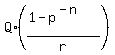 . (1)
In this formula, Q is the regular withdrawal per quarter; the factual quarterly compounding rate
is r = . (1)
In this formula, Q is the regular withdrawal per quarter; the factual quarterly compounding rate
is r =  , p = , p =  , and the number of payment periods is n = 10 years * 4 quarters = 40. So
200 = , and the number of payment periods is n = 10 years * 4 quarters = 40. So
200 = 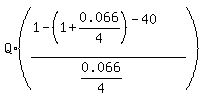 . (2)
The unknown is the value of quarterly payments Q.
In this formula, we can calculate the factor (multiplier) . (2)
The unknown is the value of quarterly payments Q.
In this formula, we can calculate the factor (multiplier)
 = 29.11257449.
Then from formula (2) Q = = 29.11257449.
Then from formula (2) Q =  = 6.869883668.
We round it to the closest cent and get the
ANSWER. The quarterly payment out is 6.87 dollars. = 6.869883668.
We round it to the closest cent and get the
ANSWER. The quarterly payment out is 6.87 dollars.
Solved.
-----------------
To see other similar (and different) solved problems on regular withdrawing from sinking fund
compounded periodically, look into the lesson
- Withdrawing a certain amount of money periodically from a compounded saving account
From this lesson, learn the subject once and for all.
|
|
|
