SOLUTION: what happens to sinθ as θ approaches 0 radians? Why?

Algebra ->  Trigonometry-basics -> SOLUTION: what happens to sinθ as θ approaches 0 radians? Why?      Log On


Question 1196692: what happens to sinθ as θ approaches 0 radians? Why?
Found 2 solutions by ikleyn, MathLover1:
Answer by ikleyn(53751) About Me  (Show Source):
You can put this solution on YOUR website!
.

Then  sin%28theta%29  approaches to zero.


Why ? - - - because   abs%28sin%28theta%29%29 < abs%28theta%29.


Answer by MathLover1(20855) About Me  (Show Source):
You can put this solution on YOUR website!
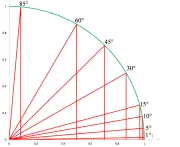
The way most people first encounter sine is as a ratio of two sides of a triangle.

graph

In this case:
1. the sloping lines are all radii of the circle and represent the hypotenuse
2. the vertical lines are the ‘opposite’ side of the various triangles
As you can clearly see, as the angle reduces from
85° → 60° → 45° → 30° →15° →10° →5° →1°

the height of the vertical line (’opposite’) shrinks while the sloping line (‘hypotenuse’) remains constant
So the fraction opposite hypotenuse will, does and indeed must+reduce to 0 as theta reduces to 0 .

The more modern way to define sine is with an infinite series:

sin%28x%29=x-x%5E3%2F3%21%2Bx%5E5%2F5%21-x%2A7%2F7%21+…....
sin%28x%29=x%281-x%5E2%2F3%21%2Bx%5E4%2F5%21-x%5E6%2F7%21%2Bx%5E8%2F9%21%29....
But you can see how that also goes to zero as theta goes to zero!