Question 1191369: A pair of 6 side dice is thrown. A wins if the sum is 5 and the game stops immediately. B wins if the sum is 7 and the game stops immediately. What is the probability of A winning?
I know that I'm supposed to solve this using geometric series but can't seem to find clear examples of this kind of question. I tried 1/(1+(1-(4/36)) and my answer was 9/17 which is aprox 0.52 but that seems off to me.
Answer by greenestamps(13334)   (Show Source): (Show Source):
You can put this solution on YOUR website!
(1) Since the probability of getting a 5 is less than the probability of getting a 7, in the long run the probability of A winning should be less than 0.5 -- so your answer should be off. Note the formula you are using to get your answer is not correct....
(2) The probability of A winning depends on whether A or B goes first. Your statement of the problem doesn't specify....
P(5 on any throw) = 4/36 = 1/9
P(not 5 on any throw) = 8/9
P(7 on any throw) = 6/36 = 1/6
P(not 7 on any throw) = 5/6
If A goes first....
A wins if the sequence of throws is
A 5, or
A not 5, B not 7, A 5, or
A not 5, B not 7, A not 5, B not 7, A 5, or
...
The probability of A winning if A goes first is then
(1/9)+(8/9)(5/6)(1/9)+(8/9)(5/6)(8/9)(5/6)(1/9)+...
Using the formula for the infinite sum of a geometric series (first term 1/9; common ratio (8/9)(5/6)=20/27)....
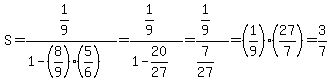
Then it should be true that if A goes first the probability of B winning is 4/7. Let's verify that using the same kind of calculations as above.
If A goes first....
B wins if the sequence of throws is
A not 5, B 7, or
A not 5, B not 7, A not 5, B 7, or
A not 5, B not 7, A not 5, B not 7, A not 5, B 7, or
...
The probability of A winning if A goes first is then
(8/9)(1/6)+(8/9)(5/6)(8/9)(1/6)+(8/9)(5/6)(8/9)(5/6)(8/9)(1/6)+...
Using the formula for the infinite sum of a geometric series....
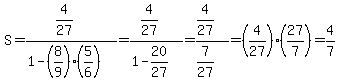
Now here is a somewhat advanced concept regarding this problem.
Since the common ratio in both sequences is the same -- representing each of A and B rolling the dice and NOT getting the number they want -- the ratio of A winning to B winning is the same as the ratio of A winning on his first throw to B winning on his first throw.
P(A wins on first throw) = 1/9
P(B wins on his first throw) = (8/9)(1/6) = 8/54 = 4/27
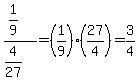
Then since the ratio of A winning to B winning is 3:4, the probability that A wins is 3/7 and the probability that B wins is 4/7.
If B goes first....
Again, the statement of the problem did not specify which player goes first, so let's look at the problem again if B goes first.
Using the same argument as in the preceding paragraph, the ratio of the probabilities of B or A winning is the ratio of the probabilities that each player wins on his first throw.
P(B goes first and rolls 7 on first throw) = 1/6
P(B goes first, does not roll 7, and A rolls 5 on first throw) = (5/6)(1/9) = 5/54
The ratio of B winning to A winning is
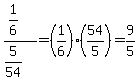
In this case (B rolling first), the ratio of B winning to A winning is 9:5, so the probability of B winning is 9/14 and the probability of A winning is 5/14.
You should find those probabilities if you analyze the case of B going first using infinite geometric series, as done in the first part of this response for the case of A going first.
|
|
|
