Question 1181193: Find the number in the interval [ - 2, 2 ] so that the difference of the
number from its square is maximized.
Found 2 solutions by Edwin McCravy, ikleyn:
Answer by Edwin McCravy(20077)   (Show Source): (Show Source):
Answer by ikleyn(53752)  (Show Source): (Show Source):
You can put this solution on YOUR website! .
Find the number in the interval [ - 2, 2 ] so that the difference of the
number from its square is maximized.
~~~~~~~~~~~~~~~~~~~~
The solution given by Edwin in his post is ONLY PART of the FULL solution, and being the part, only,
IT DOES NOT GIVE the full solution.
His solution for the local minimum/maximum should be supplemented by the end-behavior analysis
of the function f(x) = x^2 - x.
This end-behavior analysis gives the values


    (a)  at x = -2,  f(-2) = (-2)^2 - (-2) = 4 + 2 = 6;


    (a)  at x =  2,  f(2)  =   2^2  -   2  = 4 - 2 = 2.


So, the answer is:  in the interval [-2,2],  the number which provides the maximum of the function f(x) = x^2 - x, is the value of x= -2.
As you see, the correct answer is totally different from that by Edwin.
For better understanding, see the plot below.
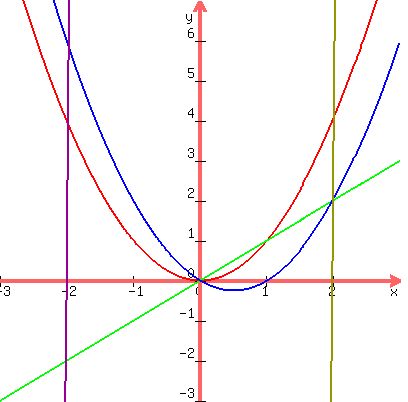 Plot y =
  (red), y = x (green) and the difference y = (red), y = x (green) and the difference y =  (blue) (blue)
|
|
|
