Question 1179660: A motorboat traveling with the current went 42 mi in 3.5 h. Traveling against the current, the boat went 18 mi in 3 h. Find the rate of the boat in calm water and the rate of the current.
Found 5 solutions by mananth, ikleyn, n2, greenestamps, josgarithmetic:
Answer by mananth(16949)   (Show Source): (Show Source):
You can put this solution on YOUR website! boat speed= x km/h
current speed= y km/h
with current speed= (x+y)
against current speed (x-y)
d= 42 with current
42 / (x+y) = 3.5
divide by 3.5
12 / (x+y) = 1
(x+y) = 12 ............1
d= = 18 against current
18/(x-y) = 3
divide by 3
6 /(x-y) = 1
x - y = 6 .............2
add up (1) & (2)
2 x = 18
/ 2
x= 9 mph speed of boat in still water
plug value of x in (1)
we get y= 3 mph speed of current
Answer by ikleyn(53619)  (Show Source): (Show Source):
You can put this solution on YOUR website! .
A motorboat traveling with the current went 42 mi in 3.5 h. Traveling against the current, the boat went 18 mi in 3 h.
Find the rate of the boat in calm water and the rate of the current.
~~~~~~~~~~~~~~~~~~~~~~~~~~~~~~
Let x be the rate of the motorboat in still water (in miles per hour)
and y be the rate of the current (in the same units).
Then the effective rate of the motorboat downstream is x + y
and the effective rate of the motorboat upstream is x - y.
From the problem, the effective rate of the motorboat downstream is the distance of 42 miles
divided by the time of 3.5 hours  = 12 mph.
The effective rate of the motorboat upstream is the distance of 18 miles
divided by the time of 3 hours = 12 mph.
The effective rate of the motorboat upstream is the distance of 18 miles
divided by the time of 3 hours  = 6 mph.
So, we have two equations to find 'k' and 'c'
x + y = 12, (1)
x - y = 6. (2)
To solve, add equations (1) and (2). The terms 'y' and '-y' will cancel each other, and you will get
2x = 12 + 6 = 18 ---> x = 18/2 = 9.
Now from equation (1)
v = 12 - u = 12 - 9 = 3.
ANSWER. The rate of the motorboat in still water is 9 mph. The rate of the current is 3 mph km/h. = 6 mph.
So, we have two equations to find 'k' and 'c'
x + y = 12, (1)
x - y = 6. (2)
To solve, add equations (1) and (2). The terms 'y' and '-y' will cancel each other, and you will get
2x = 12 + 6 = 18 ---> x = 18/2 = 9.
Now from equation (1)
v = 12 - u = 12 - 9 = 3.
ANSWER. The rate of the motorboat in still water is 9 mph. The rate of the current is 3 mph km/h.
Solved.
-------------------------------
This solution produces the same answer as in the post by @mananth, but has an advantage
that it does not contain excessive calculations that the solution by @mananth has.
We, the tutors, write here our solutions not only to get certain numerical answer.
We write to teach - and, in particular, to teach solving in a right style.
This style solving presented in my post, is straightforward with no logical loops.
The solution presented in the post by @mananth has two logical loops.
One loop in the @mananth post is writing
42/(x+y) = 3.5 ---> divide by 3.5 12/(x+y) = 1 ---> x+y = 12,
while in my solution I simply write for the effective rate
x + y = 42/3.5 = 12.
Second loop in the @mananth post is writing
18/(x-y) = 3 ---> divide by 3 6/(x-y) = 1 ---> x-y = 6,
while in my solution I simply write for the effective rate upstream
x - y = 18/3 = 6.
It is why I present my solution here and why I think it is better than the solution by @mananth:
- because it teaches students to present their arguments in a straightforward way, without logical zigzags.
@mananth repeats his construction of solution with no change for all similar problems on floating
with and against the current simply because his COMPUTER CODE is written this way.
But this way is not pedagogically optimal - in opposite, it is pedagogically imperfect.
Answer by n2(55)  (Show Source): (Show Source):
You can put this solution on YOUR website! .
A motorboat traveling with the current went 42 mi in 3.5 h. Traveling against the current, the boat went 18 mi in 3 h.
Find the rate of the boat in calm water and the rate of the current.
~~~~~~~~~~~~~~~~~~~~~~~~~~~~~~
Let x be the rate of the motorboat in still water (in miles per hour)
and y be the rate of the current (in the same units).


Then the effective rate of the motorboat downstream is x + y
and  the effective rate of the motorboat   upstream is x - y.


From the problem, the effective rate of the motorboat downstream is the distance of 42 miles
divided by the time of 3.5 hours   = 12 mph.

                  The effective rate of the motorboat upstream is the distance of 18 miles
divided by the time of 3 hours   = 6 mph.


So, we have two equations to find 'k' and 'c'

    x + y = 12,    (1)

    x - y =  6.    (2)


To solve, add equations (1) and (2).  The terms 'y' and '-y' will cancel each other, and you will get

    2x = 12 + 6 = 18  --->   x = 18/2 = 9.

Now from equation (1)

     v = 12 - u = 12 - 9 = 3.


ANSWER.  The rate of the motorboat in still water is 9 mph.  The rate of the current is 3 mph km/h.
Solved.
Answer by greenestamps(13296)  (Show Source): (Show Source):
You can put this solution on YOUR website!
After using the given information to find that the speed with the current is 12 mph and the speed against the current is 6 mph, the other tutors solved the problem with formal algebra by using a pair of equations involving the boat speed and the current speed.
Of course, a formal algebraic solution is possibly what was required.
However, this kind of problem is so common that, if formal algebra is not required, it can be solved informally with very little effort using logical reasoning.
If the current speed added to the boat speed is 12 mph and the current speed subtracted from the boat speed is 6 mph, then logical reasoning says that the boat speed is halfway between 12 mph and 6mph -- i.e., 9 mph -- and the current speed is then the difference between 9 mph and either 6 mph of 12 mph.
ANSWERS:
boat speed: 9 mph (halfway between 6 mph and 12 mph)
current speed: 12-9 = 3 mph; or 9-6 = 3 mph
Answer by josgarithmetic(39736) (Show Source):
You can put this solution on YOUR website! ust a different example of one of the frequent forms of travel-problems.
r, speed of boat if no current
c, speed of current
D, the large distance in T, the large time
d, the small distance in t, the small time
The unknown variables for this example are r and c.
The other variables are given.

add corresponding parts


subtract corresponding parts


Problem description gives D=42, T=3.5, d=18, and t=3.
Using these to evaluate r and c,
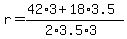

and
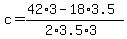

|
|
|
