Question 1164371: The ends X and Y of an inextensible string 27m long are fixed at two points on the same horizontal line which are 20m apart. A particle of mass 7.5kg is suspended from a point P on the string 12m from X.
a) illustrate this information in a diagram
b) calculate, correct to two decimal places angle YXP and angle XYP
c) find, correct to the nearest hundredth, the magnitudes of the tensions in the string. [Take g=10 m/s2]
Answer by KMST(5345)   (Show Source): (Show Source):
You can put this solution on YOUR website! The ends X and Y of an inextensible string 27m long are fixed at two points on the same horizontal line which are  apart. apart.
A particle of mass 7.5kg is suspended from a point P on the string 12m from X.
As it is an inextensible string, it will not stretch and its total length will always be  . If the point P is at . If the point P is at  from point X, point P will be at from point X, point P will be at  from point Y. from point Y.
a) illustrate this information in a diagram
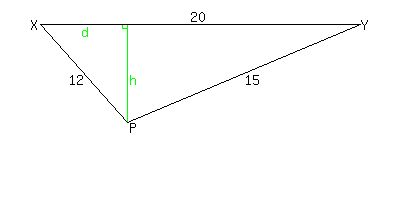
The diagram will show the triangle, XYZ with the length shown as numbers without the units,
as it is understood that they the lengths are in meters.
For easy reference, the height  with respect to base XY will be shown, as well as the length of with respect to base XY will be shown, as well as the length of  of the projection of segment XP onto XY. of the projection of segment XP onto XY.
b) calculate, correct to two decimal places angle YXP and angle XYP
The angles in question are those at X and Y. For short, those angles and their measures will be referred to as  and and  . .
The measuring units are not specified, but will be calculated in degrees.
A first step would be calculating trigonometric functions of the angles, such as  and and  , from the known lengths. , from the known lengths.
To calculate and a student who has been taught how to solve triangles that are not necessarily right triangles could use the law of cosines to calculate and ,
unless a different calculation is expected.
Law of cosines says that in a triangle ABC, with vertices A, B, and C opposite sides a, b, and c, respectively, the side and angle measures are related by
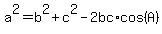 . .
Applied to angle , you get
 --> --> --> --> -> -> -> ->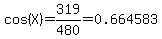 --> --> 
Applied to angle , you get
 --> --> --> --> --> --> -> ->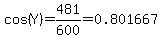 --> --> 
For students who know Heron's (or Hero's) formula, they can calculate the area  of triangle XYZ, and from that and the length of side XY, calculate , and from there calculate of triangle XYZ, and from that and the length of side XY, calculate , and from there calculate  and and  to find and . to find and .
Heron's (or Hero's) formula says that  where a, b, and c are the lengths of the triangle sides, and where a, b, and c are the lengths of the triangle sides, and  is the semiperimeter. is the semiperimeter.
In this case 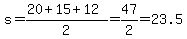

As the area of a triangle is  , ,
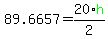 --> --> 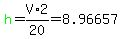 --> -->
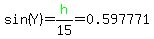 --> -->
Another option is to consider the two right triangles formed by splitting triangle XYZ along the altitude labeled as , using the Pythagorean theorem to calculate , and calculating and as trigonometric ratios.
The Pythagorean theorem only applies to right triangles. If A is the right angle opposite hypotenuse of length a, and the length of the legs of the right triangle are b and c,
then  . .
Applying it to the right triangle with side lengths (in meters)  , and , we get , and , we get
 --> -->
Applying it to the other right triangle, the one with side lengths (in meters)  , ,  and , we get and , we get
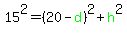 --> -->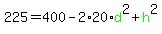 --> -->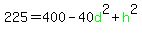 --> -->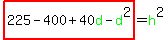
As the two highlighted expressions are equal to  , we can write , we can write
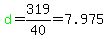
 --> --> --> --> --> --> --> -->


c) find, correct to the nearest hundredth, the magnitudes of the tensions in the string. [Take g=10 m/s2]
The weight of an object of mass  in a location with a gravitational acceleration in a location with a gravitational acceleration  is a force is a force  . .
With the mass in kg and the acceleration in   , the resulting product will be the force in newtons, abbreviated , the resulting product will be the force in newtons, abbreviated  . .
If we use  , the weight calculates as , the weight calculates as 
The tensions on both sides of the string are the forces pulling to balance the weight of
the 7.5kg particle. The three forces can be considered vectors that add up to zero force, meaning no net force on the particle, and no motion of the particle.
I’ll update the diagram from above with the proper angles, adding the three forces. I will call the tension to the left  and the tension to the right and the tension to the right  . .
I will use the same names to represent the numeric value of their magnitudes in newtons, without having to write the units at every step.
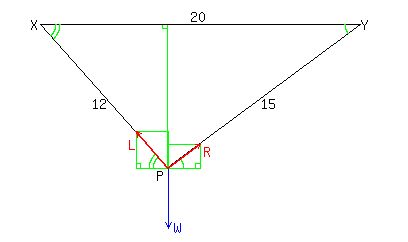
A trick that works for many vector problems in Physics class is decomposing some them into a horizontal component and a vertical component. It works in this case.
To visualize horizontal and vertical component I drew right triangles that form a rectangular "cages" around and >
The magnitude of the horizontal component of a vector is the magnitude of the vector times the cosine of the smaller angle it forms with the horizontal.
The magnitude of the vertical component of a vector is the magnitude of the vector times the sine of the smaller angle it forms with the vertical.
I marked those angles with little green arcs showing that their measures are and .
For the vectors , , and  to add to zero, to add to zero,
the vertical components of , must add to ,
and the horizontal components of and must add to zero.
Those horizontal components point left and right, so their magnitudes must be equal. That means  --> --> --> -->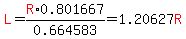
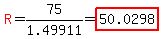
The magnitude of the vertical components adds to  , so , so



 --> --> --> -->

I carried more than enough decimal places through the calculations,
but as the values for the mass an for g are given with just 2 significant figures,
I would report as results that the magnitudes of the tensions are
 and and  , with just 2 significant figures. , with just 2 significant figures.
|
|
|
