Question 1161528: A boy throws a stone from the top of a building 46.0 m above ground. The
stone is thrown at an angle of 33.0° below the horizontal and strikes the
ground 55.6 m away from the building, find the following: (a) Time of flight.
(b) Initial speed. (c) The magnitude and the direction of the velocity of the
stone just before it strikes the ground.
Answer by KMST(5377)   (Show Source): (Show Source):
You can put this solution on YOUR website! EDITED for clarity and to correct multiple typos on April 28, 2026:
This is really a Physics class problem,
but from the math point of view it involves algebra, vectors, geometry and trigonometry.
Times will be in seconds from the time the stone left the boy's hand,
distances will be in meters,
speeds will be in m/s, and accelerations in m/s/s,
with the units understood, but not always stated.
  initial speed (magnitude of the velocity) of the stone as it leaves the boy's hand initial speed (magnitude of the velocity) of the stone as it leaves the boy's hand
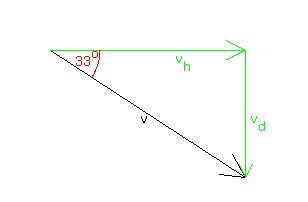
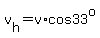 magnitude of the horizontal vector component of that initial velocity magnitude of the horizontal vector component of that initial velocity
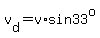 magnitude of the vertical, downward vector component of that initial velocity magnitude of the vertical, downward vector component of that initial velocity
 Time of flight of the stone, in seconds Time of flight of the stone, in seconds
We reasonably assume that the effects of air friction or wind do not cause a measurable difference in the motion of the stone,
so that the horizontal velocity is constant,
and the vertical velocity is only affected by gravity.
We know that latitude and altitude affect the acceleration of an object due to gravity,
but not having precise location data, we will use the value of 9.8m/s/s.
The downward velocity will increase linearly with  , ,
the time in seconds since the stone was thrown,
as 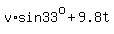
from  at at  to to 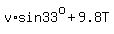 at at  . .
The average downward velocity during that time will be the average of initial and final velocities:

The horizontal and vertical distances traveled by the stone (in meters) will be
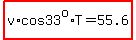 and and
 --> -->
Part (a) and part (b):
We can find and from the equations above.
From the first of the highlighted equations above, we get 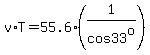 , ,
and substituting the expression found for  into the second equation, we get into the second equation, we get
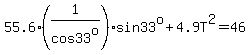 --> -->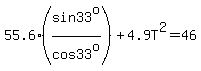 --> -->
Using  (rounded) , we substitute to get (rounded) , we substitute to get
 --> --> (rounded), and (rounded), and  --> -->  (rounded). (rounded).
Answer for part (a): The stone flies for  . .
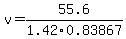
Then, substituting the value found above and  into , we get into , we get
 --> --> --> -->  (rounded). (rounded).
The initial speed (magnitude of the initial velocity) of the stone was  m/s. m/s.
Part(c):
For the stone, the time "just before it strikes the ground" is a minuscule fraction of a second before t=1.42 seconds, which rounds to 
We can calculate the magnitude and the direction of the velocity of the
stone at that time from the magnitude of its horizontal and downward components.
As stated early,
the horizontal component of the stone velocity is constant, with magnitude ,
while the vertical component is a function of the time , in seconds, since the stone was thrown.
It was also established that at time , the downwards velocity was 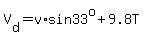 , ,
Substituting , 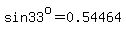 , ,
and the already found values  and and  , we get that , we get that
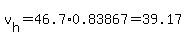 and and 
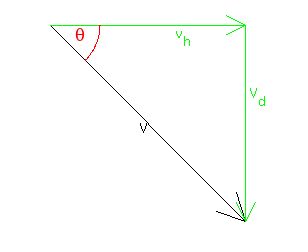
Adding those horizontal and vertical components vectors,
we calculate the magnitude of the velocity vector at 1.42 second as
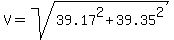 --> --> 
We can calculate its direction as the angle  below the horizontal from below the horizontal from
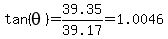 (rounded), which corresponds to (rounded), which corresponds to
 . .
The calculated magnitude and direction of the velocity of the
stone just before it strikes the ground is  m/s at an angle below the horizontal of m/s at an angle below the horizontal of  . .
|
|
|
