Question 1160048: To make decisions on the purchase of securities, a market analysis system was developed. From past data it is known that 5% of the market are “bad” securities - unsuitable objects for investment. The proposed system identifies 98% of “bad” securities as potentially “bad”, but also defines 15% of eligible investments as potentially “bad”. Given that a security has been identified as potentially “bad”, what is the likelihood that the security is actually “bad”? Comment on the suitability of the system for making investment decisions.
Answer by ikleyn(53937)   (Show Source): (Show Source):
You can put this solution on YOUR website! .
Let N be the total number of all securities.
Then 0.05N of them are "bad" securities. ( (!) actually "bad", using the terminology from the condition).
The proposed system identifies 98% of these 0.05N "bad" securities as potentially bad;
so, there are 0.98*0.05N potentially bad securities, from this pool.
The system also defines 15% of the rest, eligible securities as potentially bad.
So, there are addition 0.15*(1-0.05)N = 0.15*0.95N potentially bad securities, from the other pool.
In all, the number of potentially bad securities is the sum
0.098*0.05N + 0.15*0.95N.
Now, the probability under the question is
P = 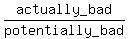 = = 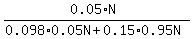 = = 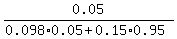 = 0.339213. ANSWER
It means that the "proposed system" recognizes actually bad securities among potentially bad securities with the probability about 0.34 only.
It is, actually, a very low level recognition system. ( It is enough to say, that it is WORST than tossing coin (!) )
At so low recognition level, it is better to vote AGAINST the system's predictions.
A good (or an ideal) system should recognize with the probability 0.9 - 0.95 - 0.98. = 0.339213. ANSWER
It means that the "proposed system" recognizes actually bad securities among potentially bad securities with the probability about 0.34 only.
It is, actually, a very low level recognition system. ( It is enough to say, that it is WORST than tossing coin (!) )
At so low recognition level, it is better to vote AGAINST the system's predictions.
A good (or an ideal) system should recognize with the probability 0.9 - 0.95 - 0.98.
Solved.
| |
|
