Question 1159221: If tan α = − 4/3 and cot β = 15/8
for a second-quadrant angle α and a third-quadrant angle β, find the following.
1. sin (a+b)
2. cos (a+b)
3. tan (a+b)
I got -5 for #1, 20 for #2, and 13/84 for #3. They are all wrong and I do not know why. Maybe because I just substituted the fractions I was given into the equations?
Found 3 solutions by math_helper, Edwin McCravy, MathTherapy:
Answer by math_helper(2461)   (Show Source): (Show Source):
Answer by Edwin McCravy(20086)  (Show Source): (Show Source):
You can put this solution on YOUR website! If tan α = − 4/3 and cot β = 15/8
for a second-quadrant angle α and a third-quadrant angle β, find the following.
1. sin (a+b)
2. cos (a+b)
3. tan (a+b)
I got -5 for #1, 20 for #2, and 13/84 for #3. They are all wrong and I do not know why. Maybe because I just substituted the fractions I was given into the equations?
We draw a picture of α in Quadrant II, and a picture of β in Quadrant III
  From the ends of the terminal sides we draw vertical lines to the x-axis,
in green, forming right triangles:
From the ends of the terminal sides we draw vertical lines to the x-axis,
in green, forming right triangles:
  We are given that tan α = − 4/3
Since we know that TANGENT = OPPOSITE/ADJACENT = y/x, we label the
opposite side (y) as the numerator of -4/3, which is -4, negative because
it goes left. We label the adjacent (x) as the denominator of -4/3,
which is +3 because it goes upward from the x-axis.
We are given that cot(β)= 15/8
Since we know that COTANGENT = ADJACENT/OPPOSITE = x/y, we label the
adjacent side (x) as the numerator of 15/8, thought of as (-15)/(-8) which is
-15, negative because
it goes downward. We label the opposite (y) as the denominator of (-15)/(-8),
which is -8 because it goes left.
We are given that tan α = − 4/3
Since we know that TANGENT = OPPOSITE/ADJACENT = y/x, we label the
opposite side (y) as the numerator of -4/3, which is -4, negative because
it goes left. We label the adjacent (x) as the denominator of -4/3,
which is +3 because it goes upward from the x-axis.
We are given that cot(β)= 15/8
Since we know that COTANGENT = ADJACENT/OPPOSITE = x/y, we label the
adjacent side (x) as the numerator of 15/8, thought of as (-15)/(-8) which is
-15, negative because
it goes downward. We label the opposite (y) as the denominator of (-15)/(-8),
which is -8 because it goes left.
  Next we find the missing sides, the terminal sides, using the Pythagorean theorem:
  Note that we always take the terminal side r as positive.
  Now we're finally ready to calculate
1. sin (a+b)
2. cos (a+b)
3. tan (a+b)
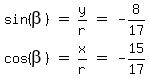
where
Now we're finally ready to calculate
1. sin (a+b)
2. cos (a+b)
3. tan (a+b)
where
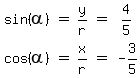 and
and


 Edwin
Edwin
Answer by MathTherapy(10858)  (Show Source): (Show Source):
|
|
|
