Question 1158866: Urn A contains 5 red marbles and 3 white marbles.
Urn B contains 1 red marble and 2 white marbles.
A fair die is tossed; if a 3 or 6 appears, a marble is drawn from B and put into A and then a marble is drawn from B.
a. what is the probability that both marbles are red?
b. what is the probability that both marbles are white?
Answer by KMST(5396)   (Show Source): (Show Source):
You can put this solution on YOUR website! I assume that if the number on the top of the die that was tossed is neither 3 nor 6, no marbles are drawn. Your turn is over. better luck next time.
Each of the 6 faces/numbers on a fair die has the same probability to appear on top :  . .
The probability of getting a 3 is and the probability of getting a 6 is for each draw, the probability of getting either a 3 or a 6 is  . .
A teacher might write that as  . .
Let's think of what happens in the  of the cases when the game gets to the point when marbles can be drawn. of the cases when the game gets to the point when marbles can be drawn.
Urn B starts with  marbles. marbles.
After transferring one marble from urn B to urn A,
urn A will have 9 marbles, either 6red and 3 while or 5red and 4 white,
depending on the color of the marble drawn from urn B
The entire play sequence can be diagrammed as follows

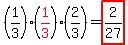
a. what is the probability that both marbles are red?
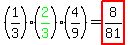
b. what is the probability that both marbles are white?
After the die shows a 3 or a 6, when drawing one of the 3 marbles from urn B, the probability of getting each one of them is ,
so the probability of drawing the only one that is red is .
A teacher could write that as 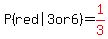 . .
However, drawing that red marble only happens in that happens in  of the of the plays when the die was a 3 or 6. of the of the plays when the die was a 3 or 6.
It happens in  of the plays. of the plays.
A teacher could write that as  = = . .
What happens if the marble drawn from urn B is not red, and what is the probability of that?
If the marble drawn from urn B is not red, it must be one of the 2 white marbles.
The probability of that happening after getting a 3 or 6 on the die is 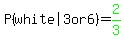 , ,
and that will happen in  of the of plays when the die showed a 3 or a 6. of the of plays when the die showed a 3 or a 6.
That happens in  of the plays. of the plays.
A teacher could write that as  = = . .
A teacher would say that red and white are "mutually exclusive" events, that it has to be one or the other, so if red happens of the times , white has to happen the other  out of the out of the  of the total of times. of the total of times.
What happens to urn A, after drawing a marble from urn B?
The game starts with  marbles in urn A. marbles in urn A.
After drawing a marble from urn B and putting it into urn A,
urn A will contain  marbles, marbles,
and the probability of drawing each of them is  . .
We know that if the die shows a 3 or a 6 and the marble drawn from urn B (and added to urn A) is red,  of the 9 marbles in urn A will be red and in that case, the probability of drawing one of them would be of the 9 marbles in urn A will be red and in that case, the probability of drawing one of them would be  . .
The total probability of getting two red marbles is the product of probabilities of the desired outcome for all 3 steps (the die toss, urn B draw, and urn A draw):
.
If the marble drawn from urn B (and added to urn A) is white,  of the 9 marbles in urn A will be red and the probability of drawing one of them would be of the 9 marbles in urn A will be red and the probability of drawing one of them would be 
In that case, you got 2 white marbles, and the probability of that is the product of the probabilities for each step
|
|
|
