Question 1158473: An isosceles trapezoid has a height of 4cm and bases 3cm and 7cm long. How long are its diagonals? Use the law of cosines.
Answer by KMST(5396)   (Show Source): (Show Source):
You can put this solution on YOUR website! In the USA, a trapezoid is a quadrilateral with two parallel sides, and an isosceles trapezoid is one whose other two sides have the same length.
The names of trapezium and trapezoid are not the same in all English-speaking countries.
Here is the American isosceles trapezoid ABCD described in the question, with diagonal AC and BD:
 Diagonal AC is a side in triangles ACD and ACB. Diagonal BD is a side of BDA and BDC. Diagonal AC is a side in triangles ACD and ACB. Diagonal BD is a side of BDA and BDC.
All we know about each of the triangles mentioned above is the length of one side. No angle measures.
The law of cosines allows us to find the length of one side of a triangle when we know the measure of the opposite angle and the length of the other two sides.
Had the lengths of sides AB and CD been given, using the law of cosines would make sense.
Height BP cuts right triangle ABP from the rest of the trapezoid,
and it is easy to figure out that  . .
From that we can easily calculate measure of the angle PAB (angle A, for short).
We can also calculate the length of AB
However, as soon as we figure out that  , we can calculate , we can calculate  , ,
and then it would be easy to calculate  as the hypotenuse of right triangle PBD using the Pythagorean theorem: as the hypotenuse of right triangle PBD using the Pythagorean theorem:
 (rounded) (rounded)
To use the law of cosines on triangle ABD to calculate the length of BD, it appears like I would need the measure of angle A, and the length of AB.
Based on right triangle ABP, 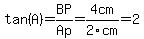 --> --> (rounded) (rounded)
Using the Pythagorean theorem:
 (rounded) (rounded)
The law of cosines for triangle ABD would give us BD from

With the length in cm,
 however however  , so we did not need the measure of angle A, or the length of AB, and , so we did not need the measure of angle A, or the length of AB, and
   (rounded) (rounded)
|
|
|
