Question 1158466: Ruth purchased some furniture on credit and has secured a loan from her bank at 12% per year compounded monthly. Under the terms of her finance agreement, she his required to make payments of $116.25 at the end of each month for 36 months. What was the purchase price of Ruth's furniture?
Answer by KMST(5396)   (Show Source): (Show Source):
You can put this solution on YOUR website! This question was classified as Money_Word_Problems.
That is correct, and so would be Algebra in Finance.
It is a Word_Problem, it is about financing a purchase, and the algebra in it needs to be understood.
Someone in Finance will probably apply a formula thinking "I never used what they taught me in that Algebra course".
However, if you understand algebra and the word problem, you do not need formulas, and you can even write your own valid formula.
Here is my formula for this word problem:
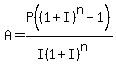 , where , where
  amount financed (in $) amount financed (in $)
 monthly payment (in $) monthly payment (in $)
 interest rate per compounding period, as a decimal interest rate per compounding period, as a decimal
 number of equal payments number of equal payments
In this case  , and , and  (rounded). (rounded).
So, applying that formula with trust without even trying to understand, we get:
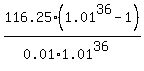 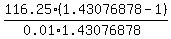 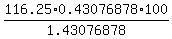   
What if we do not like to trust and mindlessly apply formulas?
Then we think. The interest of 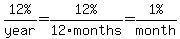 is applied every month, is applied every month,
so 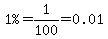 times the balance is added to the debt each month. times the balance is added to the debt each month.
After 1 month, the interest is added to the initial amount , and the new balance would be
 . .
Applying the interest for the month means multiplying times 
If there were no payments, the balance with interest applied each month would be would be
 , ,  , and , and 
at the end of the second, third, and fourth months respectively.
At the end of 36 month, it would be  if no payments were ever made, but Ruth will pay $116.25 at the end of each month. if no payments were ever made, but Ruth will pay $116.25 at the end of each month.
Those payments add into the balance as negative amounts and the interest applies to anything positive or negative added into the balance.
After 36 months, the balance will be zero if Ruth always pays on time.
At the end of each month the payment of 116.25 would be credited,
so the balance after exactly 1 month would be
 . .
After 2 months, it would be

After 3 months, it would be
 . .
After 36 months, the balance can be calculated as

I am sure that the sum in brackets above is   . .
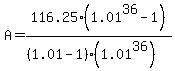
So substituting the nicer expression for that sum, we get:
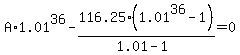 --> --> 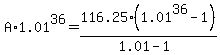 --> --> 
Substituting 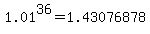 (rounded), and simplifying, we calculate an approximated result as (rounded), and simplifying, we calculate an approximated result as
 (rounded). (rounded).
So the purchase price of Ruth's furniture was  . .
I can calculate that sum  as the sum of a geometric sequence, where as the sum of a geometric sequence, where
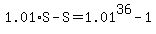 --> -->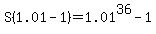 --> --> 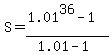 . .
Or maybe I remember those special polynomial products where
 --> --> 
|
|
|
