Question 1158028: determine the specified trigonometric ratio for each angle with a terminal side that passes through the given point.
1.Sin0; (-8,6)
2.csc0; (2,-1)
3.tan0;(0,1)
4.cos0; (-4,-2)
Answer by KMST(5377)   (Show Source): (Show Source):
You can put this solution on YOUR website! The standard position of an angle is vertex at the origin, initial side along the positive x-axis.
We measure angles counterclockwise, and could define an angle measure as negative or greater than 360 degree,
but the trigonometric functions only care about the position of the terminal side.
I will assume  for all angles. for all angles.
Terminal side passing through  : :
 There is a large right triangles with hypotenuse There is a large right triangles with hypotenuse  and a similar triangle whose hypotenuse, and a similar triangle whose hypotenuse,  , is a radius of the unit circle shown in red. , is a radius of the unit circle shown in red.
The large one has legs of length  and and  , and hypotenuse , and hypotenuse 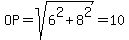 . The length of the small right triangle's hypotenuse, . The length of the small right triangle's hypotenuse,  } ,is 10 times smaller, and so are the legs. } ,is 10 times smaller, and so are the legs.
The function  is defined as the y-coordinate of point A, is defined as the y-coordinate of point A,  , and , and  is defined as the x-coordinate of point A, is defined as the x-coordinate of point A,  . .
We can calculate 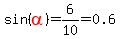 as a trigonometric ratio. and determine that as a trigonometric ratio. and determine that  . .

Trigonometric cosine and sine functions of  , defined as the x-coordinate and the y-coordinate of point A respectively are numerically the same as those for , defined as the x-coordinate and the y-coordinate of point A respectively are numerically the same as those for  , but may be positive or negative depending on the quadrant. , but may be positive or negative depending on the quadrant.
The sign will be the same for coordinates of any point on the terminal side.
Terminal side passing through  : :
is in quadrant IV, with positive x-coordinate, so  . .
The large right triangle, in this case, has leg lengths of 2, and 1, and a hypotenuse length of 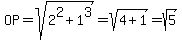 . .
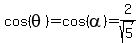 and and 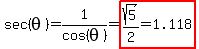 (rounded) (rounded)
The angles involved would be  , , 
Terminal side passing through  : :
P is on the unit circle, so its x-coordinate and y-coordinate are  and and  respectively. respectively.
 , ,  and and 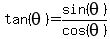 is undefined. is undefined.
Terminal side passing through  : :
Booth coordinates are negative, and so will be sine and cosine.
OP would be the hypotenuse of a right triangle with leg lengths 4, and 2.
The hypotenuse length is 
|
|
|
