Question 1157983: Show that (−2, 10), (1, 11), (6, 10), and (9, 7) are concyclic.
Answer by solver91311(24713)   (Show Source): (Show Source):
You can put this solution on YOUR website!
Choose three of the given points.
Find the center and radius of the unique circle that passes through these three points.
Show that the distance from the circle center to the fourth point is equal to the radius of the circle. Alternatively, show that the fourth point satisfies the equation of the circle that can be written directly using the coordinates of the center and the square of the radius.
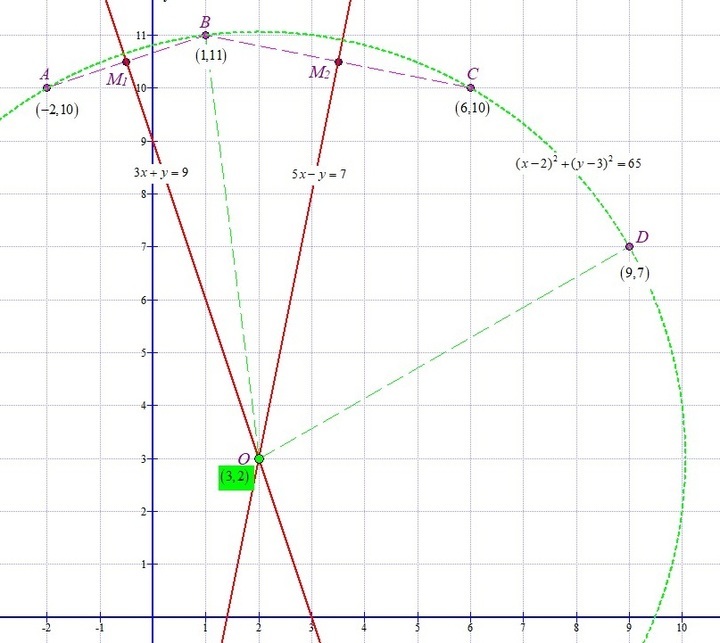
The perpendicular bisector of any chord passes through the center of the circle. Beginning with the chord  , the slope of which is: , the slope of which is:
}\ =\ \frac{1}{3})
Since the slope of a line perpendicular to a line is the negative reciprocal of the slope of the line, the slope of the perpendicular bisector must be  . .
And the midpoint coordinates:


So the midpoint of is )
From this information, we write the equation of the perpendicular bisector of chord :
)

Similarly, an equation of the perpendicular bisector of chord  is: is:

The details are an exercise for the student.
From these two equations, we can find the point of intersection of the two perpendicular bisectors.



\ +\ 9\ =\ 3)
Hence, the point of intersection, and therefore the center of the circle is )
The distance from the center to any of the three points is the radius of the circle and can be found using the distance formula:
^2\ +\ (3-11)^2}\ =\ \sqrt{65})
So if the distance from the center to the fourth point is equal to  , the fourth point is concyclic with the other three points. , the fourth point is concyclic with the other three points.
^2\ +\ (3-7)^2}\ =\ \sqrt{65})
Alternatively, we note that the equation of the circle is:
^2\ +\ \(y\,-\,3\)\ =\ 65)
And since
^2\ +\ \(7\,-\,3\)^2\ \equiv\ 65)
Point D is on the circle. Q.E.D.
John

My calculator said it, I believe it, that settles it


|
|
|
