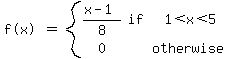
 Its graph is this:
 In order for it to be a probability density function, it must be such that when
we shade the area between it and the x-axis, that area must be exactly 1.
In order for it to be a probability density function, it must be such that when
we shade the area between it and the x-axis, that area must be exactly 1.
 It's a probability density function because the area between it and the x-axis
is a triangle whose base is 4 and whose height is 1/2 or 0.5 since when we
substitute x=5 in (𝑥−1)/8 we get 4/8 or 1/2 or 0.5 and the area of a triangle is
It's a probability density function because the area between it and the x-axis
is a triangle whose base is 4 and whose height is 1/2 or 0.5 since when we
substitute x=5 in (𝑥−1)/8 we get 4/8 or 1/2 or 0.5 and the area of a triangle is
 Since the entire area between the graph and the x-axis is 1, it is indeed a
probability density function. So the problem was telling the truth when it said
this is a probability density function.
The probability that 𝑋 is between two values is the area between the graph and
the x-axis between those two values.
Since the entire area between the graph and the x-axis is 1, it is indeed a
probability density function. So the problem was telling the truth when it said
this is a probability density function.
The probability that 𝑋 is between two values is the area between the graph and
the x-axis between those two values.
A. Find the probability that 𝑋 lies between 2 and 4.
This asks for the area between 2 and 4, which is this shaded area:
 This is a trapezoid (or 'trapezium' if you live in the UK), and if you turn your
head 90° it has two bases b1=0.125 and b2=0.25, and
height = 2. The formula for the area is
This is a trapezoid (or 'trapezium' if you live in the UK), and if you turn your
head 90° it has two bases b1=0.125 and b2=0.25, and
height = 2. The formula for the area is
 So that's the answer.
B. Find the probability that 𝑋 is less than 3.
 the shaded area between between the graph the x-axis is a triangle whose base is
2 and whose height is 1/4 or 0.25 since when we substitute x=2 in (𝑥−1)/8 we get
1/8 or 0.125 and the area of a triangle is
the shaded area between between the graph the x-axis is a triangle whose base is
2 and whose height is 1/4 or 0.25 since when we substitute x=2 in (𝑥−1)/8 we get
1/8 or 0.125 and the area of a triangle is
 That's the answer.
Edwin
That's the answer.
Edwin


