Question 1147397: find the canonical form and determine the nature of conics
8x^2-12xy+17y^2+16x-12y+3=0
Answer by KMST(5398)   (Show Source): (Show Source):
You can put this solution on YOUR website! A quadratic equation of the form  , like , like  , could represent a circle, ellipse, hyperbola, parabola. , could represent a circle, ellipse, hyperbola, parabola.
In special cases it could represent a point, a line, a pair of lines, or no point that could exist, depending on the values of the coefficients.
The value  , called the discriminant, suggests parabola, ellipse, or hyperbola if it is zero, negative, or positive respectively. , called the discriminant, suggests parabola, ellipse, or hyperbola if it is zero, negative, or positive respectively.
In the case of , with  , ,
 suggest that the equation represents an ellipse. suggest that the equation represents an ellipse.
If there was no term in  , the axes of symmetry of the ellipse would be parallel to the x- an y-axes. , the axes of symmetry of the ellipse would be parallel to the x- an y-axes.
If there is term in , one of the axes of symmetry will be at a positive angle  to the positive x-axis such that to the positive x-axis such that  . .
Rotating the coordinate axes counterclockwise any angle such that ,
a point  would be called the point would be called the point  with coordinates referencing the new axes, with coordinates referencing the new axes,
with  and and  . .
For the reverse conversion,  and and  . .
The points represented by equation would be represented in the new set of axes
by a new equation in  and and  , with new coefficients. , with new coefficients.  . .
Substituting  for for and and  for for  into the original equation, into the original equation,
we would get the equation .
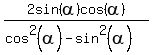
Expressions to calculate the new coefficients can be found, including  we must find a value for that makes we must find a value for that makes 
 --> -->  --> -->   
That can be converted into 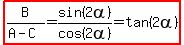 by using the trigonometric identities by using the trigonometric identities  and and 
From there the values for  and its trigonometric functions can be found. and its trigonometric functions can be found.
With those values the other coefficients can be calculated as
 , ,
 , ,
 , and , and  . .
After that, the canonical form for the equation in and can be found.
FINDING AND ITS TRIGONOMETRIC FUNCTIONS:
As a quadratic equation of the form , has 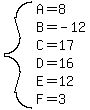
     
A calculator could provide a good approximation of the value of  (rounded) and that value could be used to get approximated values for (rounded) and that value could be used to get approximated values for  , ,  , , , ,  , and , and  . .
Alternatively, exact values can be found using trigonometric identities.
Because we know that 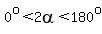 }, but because }, but because 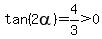 we conclude we conclude  as well, and al trigonometric functions will be positive. as well, and al trigonometric functions will be positive.
From  <--> <--> 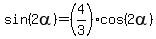 and trigonometric identity and trigonometric identity  we get we get
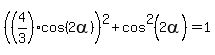 --> -->  --> --> 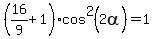 --> --> 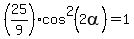 --> --> 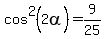 --> --> 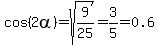 and and  . .
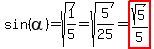
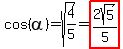
From  and the trig identities for half angles we can find and the trig identities for half angles we can find  , , , ,  , , as , , as
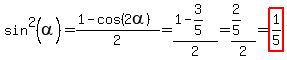 --> --> 
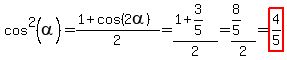 --> --> 
We could also get the product 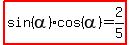 from from 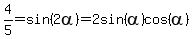 --> -->  . .
CALCULATING  , ,  , ,  AND AND  : :
Now we can substitute the highlighted values above into the equations to calculate , , , and :
 = =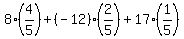 = =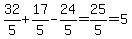 , ,
  , and , and
 . .
FINDING THE CANONICAL FORM AND THE NATURE OF THIS CONIC:
For now, substituting the values found for and , we can write the equation of the conic in terms of and as:
 , ,
and we can and need to transform it into something of the form 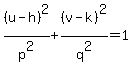 which would be equivalent to which would be equivalent to
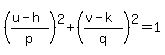 . .
That is the equation of a circle of radius  , stretched in the u and v directions by factors , stretched in the u and v directions by factors  and and  , centered in point (h,k) . , centered in point (h,k) .
In other words, that represents an ellipse centered in (h,k) .
To get that transformation we need to form the squares 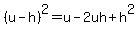 and and 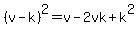 from from  and and  respectively . respectively .
--> 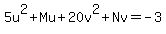 --> -->  --> -->

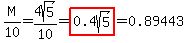 , ,
and  . .
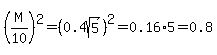
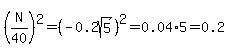
Then, the right hand side term is 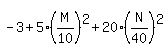 = = = = , and the equation is , and the equation is

From there, we continue:
 --> -->  --> -->
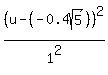  
The center of the ellipse is at      . .
The numbers squared in the denominators are the semi-major and semi-minor axes of the ellipse.
The greater one, , is the semi-major axis, and the other I the semi-minor axis
The extreme values for happen when  , and then , and then
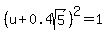 --> -->  --> -->  . .
The y-coordinate of the center and the extremes show the vertices are at a distance of from the center .
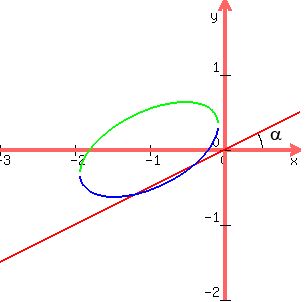
Using the equations and , we can find the coordinates of the center and vertices of the ellipse.
For the center,  = =

 = =

| |
|
