|
Question 1036786: The height of a projectile t seconds after being launched with an initial
velocity of 96 ft/sec from an initial height of 200 ft above the ground is given by the
following formula:
s(t) = −16t^2 + 96t + 200
(a) At what moment in time is the height of the projectile the greatest?
(b) At what moment in time does the projectile return to the ground?
(c) The slope of the line through points (t0, s(t0)) and (t1, s(t1)) is the average velocity
on the time interval [t0, t1]. What is the average velocity of the particle from the
moment it was launched to the moment when it reaches its greatest height?
Answer by Alan3354(69443)   (Show Source): (Show Source):
You can put this solution on YOUR website! The height of a projectile t seconds after being launched with an initial
velocity of 96 ft/sec from an initial height of 200 ft above the ground is given by the
following formula:
s(t) = -16t^2 + 96t + 200
(a) At what moment in time is the height of the projectile the greatest?
"moment in time" is redundant.
---
(a) At what time is the height of the projectile the greatest?
It's the vertex of the parabola, at t = -b/2a
t = -96/-32 = 3 seconds.
=========================
(b) At what time does the projectile return to the ground?
When s(t) = 0.
-16t^2 + 96t + 200 = 0
-2t^2 + 12t + 25 = 0
| Solved by pluggable solver: SOLVE quadratic equation (work shown, graph etc) |
Quadratic equation  (in our case (in our case 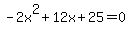 ) has the following solutons: ) has the following solutons:

For these solutions to exist, the discriminant  should not be a negative number. should not be a negative number.
First, we need to compute the discriminant :  . .
Discriminant d=344 is greater than zero. That means that there are two solutions: 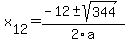 . .


Quadratic expression 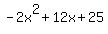 can be factored: can be factored:

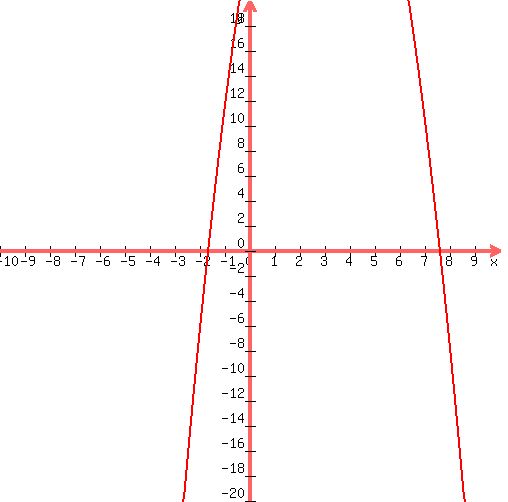
Again, the answer is: -1.63680924774785, 7.63680924774785.
Here's your graph:
 |
======
Ignore the negative solution.
t =~ 7.637 seconds
===============
(c) The slope of the line through points (t0, s(t0)) and (t1, s(t1)) is the average velocity
on the time interval [t0, t1]. What is the average velocity of the particle from the
moment it was launched to the moment when it reaches its greatest height?
--
t0 = 0, t1 = 3
s0 = 200, s1 = s(3) = -16*9 + 96*3 + 200 = 344
--> (344-200)/3 = 48 ft/sec
|
|
|
| |
