Question 103016: Solve by graphing.
x-y=5
x+y=3
Am I the only person that does not get graphing?
Answer by edjones(8007)   (Show Source): (Show Source):
You can put this solution on YOUR website! Study this information hard and you will become expert.
Ed
| Solved by pluggable solver: Graphing Linear Equations |
 Start with the given equation Start with the given equation
 Subtract Subtract  from both sides from both sides
 Multiply both sides by Multiply both sides by 
 Distribute Distribute
 Multiply Multiply
 Rearrange the terms Rearrange the terms
Reduce any fractions
So the equation is now in slope-intercept form ( ) where ) where  (the slope) and (the slope) and  (the y-intercept) (the y-intercept)
So to graph this equation lets plug in some points
Plug in x=-4

 Multiply Multiply
 Add Add
So here's one point (-4,-9)

Now lets find another point
Plug in x=-3

 Multiply Multiply
 Add Add
So here's another point (-3,-8). Add this to our graph

Now draw a line through these points
 So this is the graph of through the points (-4,-9) and (-3,-8) So this is the graph of through the points (-4,-9) and (-3,-8)
So from the graph we can see that the slope is  (which tells us that in order to go from point to point we have to start at one point and go up 1 units and to the right 1 units to get to the next point) the y-intercept is (0, (which tells us that in order to go from point to point we have to start at one point and go up 1 units and to the right 1 units to get to the next point) the y-intercept is (0, )and the x-intercept is ( )and the x-intercept is ( ,0) . So all of this information verifies our graph. ,0) . So all of this information verifies our graph.
We could graph this equation another way. Since this tells us that the y-intercept (the point where the graph intersects with the y-axis) is (0,).
So we have one point (0,)

Now since the slope is , this means that in order to go from point to point we can use the slope to do so. So starting at (0,), we can go up 1 units

and to the right 1 units to get to our next point
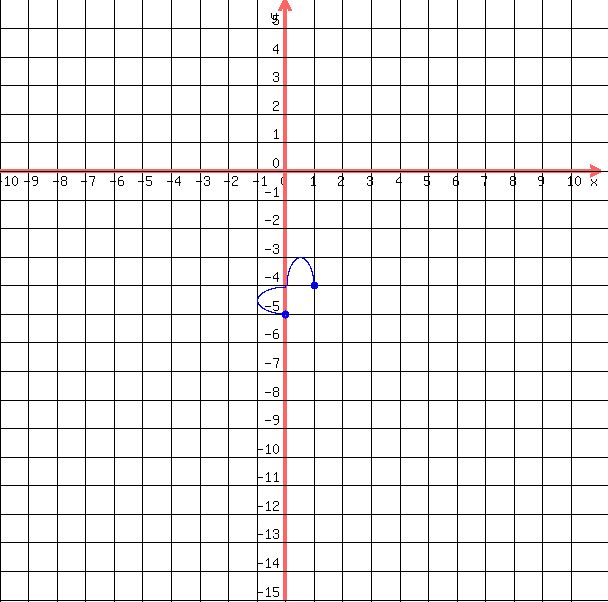
Now draw a line through those points to graph
 So this is the graph of through the points (0,-5) and (1,-4) So this is the graph of through the points (0,-5) and (1,-4)
|
| Solved by pluggable solver: Graphing Linear Equations |
 Start with the given equation Start with the given equation
 Subtract from both sides Subtract from both sides
 Multiply both sides by Multiply both sides by 
 Distribute Distribute
 Multiply Multiply
 Rearrange the terms Rearrange the terms
Reduce any fractions
So the equation is now in slope-intercept form () where  (the slope) and (the slope) and  (the y-intercept) (the y-intercept)
So to graph this equation lets plug in some points
Plug in x=-6

 Multiply Multiply
 Add Add
So here's one point (-6,9)

Now lets find another point
Plug in x=-5

 Multiply Multiply
 Add Add
So here's another point (-5,8). Add this to our graph

Now draw a line through these points
 So this is the graph of through the points (-6,9) and (-5,8) So this is the graph of through the points (-6,9) and (-5,8)
So from the graph we can see that the slope is  (which tells us that in order to go from point to point we have to start at one point and go down -1 units and to the right 1 units to get to the next point), the y-intercept is (0, (which tells us that in order to go from point to point we have to start at one point and go down -1 units and to the right 1 units to get to the next point), the y-intercept is (0, )and the x-intercept is (,0) . So all of this information verifies our graph. )and the x-intercept is (,0) . So all of this information verifies our graph.
We could graph this equation another way. Since this tells us that the y-intercept (the point where the graph intersects with the y-axis) is (0,).
So we have one point (0,)

Now since the slope is , this means that in order to go from point to point we can use the slope to do so. So starting at (0,), we can go down 1 units

and to the right 1 units to get to our next point

Now draw a line through those points to graph
 So this is the graph of through the points (0,3) and (1,2) So this is the graph of through the points (0,3) and (1,2)
|
| Solved by pluggable solver: Solve the System of Equations by Graphing |
Start with the given system of equations:


In order to graph these equations, we need to solve for y for each equation.
So let's solve for y on the first equation
Start with the given equation
 Subtract Subtract  from both sides from both sides
 Rearrange the equation Rearrange the equation
 Divide both sides by Divide both sides by
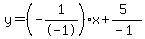 Break up the fraction Break up the fraction
 Reduce Reduce
Now lets graph (note: if you need help with graphing, check out this solver)
 Graph of Graph of
So let's solve for y on the second equation
Start with the given equation
 Subtract from both sides Subtract from both sides
 Rearrange the equation Rearrange the equation
 Divide both sides by Divide both sides by
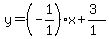 Break up the fraction Break up the fraction
 Reduce Reduce
Now lets add the graph of to our first plot to get:
 Graph of (red) and (green) Graph of (red) and (green)
From the graph, we can see that the two lines intersect at the point ( ,) (note: you might have to adjust the window to see the intersection) ,) (note: you might have to adjust the window to see the intersection) |
|
|
|
