Question 22105: River flows at 2 mph. Phil can paddle in still water at 8 mph. If he is 4 miles downstream from a log floating toward him,
how long will it take him to reach the log?
Found 5 solutions by Paul, JWG, ikleyn, MathTherapy, math_tutor2020:
Answer by Paul(988)   (Show Source): (Show Source):
Answer by JWG(21) (Show Source): (Show Source):
You can put this solution on YOUR website! I hope that I am not messing things up around here:
Question says log is floating toward Phil, so it implies that the log is traveling the same speed of the stream while Phil paddles. Furthermore, Phil had his speed plus the streams speed
Stream Speed: 2mph
Phil Speed and stream speed working together: 8mph+2mph=10mph
Combined Speed: 2+8+2=12mph
Distance of log from Phil: 4miles
Distance/Speed=Time: 4/12=1/3
Will take 1/3 of an hour for Phil and the log to meet, and an hour is 60 minutes.
(60/1)*(1/3)=20 minutes
Answer: Phil and the log will meet in 20 minutes.
Answer by ikleyn(54018)  (Show Source): (Show Source):
You can put this solution on YOUR website! .
River flows at 2 mph. Phil can paddle in still water at 8 mph. If he is 4 miles downstream from a log floating toward him,
how long will it take him to reach the log?
~~~~~~~~~~~~~~~~~~~~~~~~~~~~
The solutions in the posts by @Paul and by @JWG both are incorrect.
For the correct solution see that follows in my post.
According to the problem's context, Phil paddles upstream, while the log is floating toward him, i.e. downstream.
The Phil effective rate relative the river's banks is 8-2 = 6 miles per hour.
The log floats toward Phil with the rate 2 miles per hour, so their approaching rate is 6+2 = 8 miles per hour.
Hence, the time when Phil will reach the log is  = =  of an hour, or 30 minutes. ANSWER of an hour, or 30 minutes. ANSWER
Solved.
Answer by MathTherapy(10864)  (Show Source): (Show Source):
You can put this solution on YOUR website!
River flows at 2 mph. Phil can paddle in still water at 8 mph. If he is 4 miles downstream from a log floating toward him,
how long will it take him to reach the log?
*******************************************
Two of the persons who responded don't have a clue, and that's why their answers don't make sense.
Let the time he takes to get to the log, be T
Going downstream, his total average speed is his speed in still water, plus the speed of the current, or 8 + 2 = 10 mph
Of the 4 miles between he and the log, Phil will cover 10T miles when he gets to the log
Going upstream towards Phil, the log's speed is its speed in still water (0 mph), less the speed of the current, or 0 - 2 = - 2 mph
Of the 4 miles between the log and Phil, the log will cover - 2T miles when Phil catches up to it.
A speed of - 2 mph, and a distance of - 2T miles might seem strange and non-sensical, but this actually means that the log is
actually travelling/drifting BACKWARDS, or AWAY from Phil.
We now get the following DISTANCE equation: 10T + - 2T = 4
8T = 4
Time it takes Phil to get to the log, or  ANECDOTE**
Phil actually traveled 10T, or 10() = 5 miles to get to the log, although he started out just 4 miles from it. With the log travelling
backwards, or drifting away from him, he had to travel an extra mile to get to it. Incidentally, the log travelled/drifted - 2() = - 1
mile, or 1 mile, BACKWARDS, which is the extra distance Phil ended up making up/travelling to get to it.
Quite INTERESTING, isn't it?
ANECDOTE**
Phil actually traveled 10T, or 10() = 5 miles to get to the log, although he started out just 4 miles from it. With the log travelling
backwards, or drifting away from him, he had to travel an extra mile to get to it. Incidentally, the log travelled/drifted - 2() = - 1
mile, or 1 mile, BACKWARDS, which is the extra distance Phil ended up making up/travelling to get to it.
Quite INTERESTING, isn't it?
Answer by math_tutor2020(3847) (Show Source):
You can put this solution on YOUR website!
Answer: 1/2 of an hour or 30 minutes
Explanation
Let's say the river flows south.
Define points A, B, and C such that:
A = log's starting location
B = Phil's starting location
C = point in between A and B where Phil reaches the log
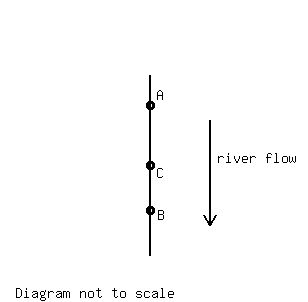
The diagram is optional but could be handy.
Phil's speed is 8 mph in still water.
But since Phil has to swim upstream against the 2 mph current, it slows him down to 8-2 = 6 mph.
So he travels 6x miles where x is the length of time in hours.
I'm using the formula: distance = rate*time Meanwhile, the log travels at 2 mph for the same amount of time x.
It travels 2x miles.
To recap so far we have these distances
AC = 2x
BC = 6x
These two distance subtotals must add to the 4 mile gap between the points A and B.
AC+BC = AB
2x+6x = AB
2x+6x = 4
8x = 4
x = 4/8
x = 1/2 of an hour aka 30 minutes
| |
|
