Question 1210603: I came across this in an old book:
Determine logarithm of 6253.
In table, the mantissa is .7959 (The same mantissa of 6250). The next larger is .7966, mantissa of 6260.
6260 - 6250 = 10 (difference of 10).
.7966 - .7959 = 0.0007
This is part I don't understand:
Each increase of 1 unit (6250 increase of 10 to 6260), mantissas of their logs increase by 0.0007, an increase of .1 of 0.0007. 3 added to 0250 will add .3 of 0.0007 or 0.0002 to the mantissa of 6253.
Why is .1 and .3 added ?
Found 2 solutions by KMST, greenestamps:
Answer by KMST(5434)   (Show Source): (Show Source):
You can put this solution on YOUR website! A table with entries like this:
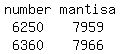
can be used to find the mantissa (sort-of the decimal part) of a logarithm in base 10 of a number with 4 significant digits.
The table does not have a mantissa for 6253, so you have to interpolate.
Not worrying for now about decimal places, we are looking for a mantissa between 7959 and 7966.
For an increase between 6250 and 6260 of 10, there is an increase of 7=7966-7959
for the mantissa.
That is a 0.7 increase in mantissa for each unit increase in the number.
The increase in mantissa corresponding the difference between 6250 and 6253 is
3x0.7=2.1, but we round it to 2.
So the mantissa for 6253 is 7959+2=7961
Not worrying for now about decimal places, we are looking for a mantissa between 7959 and 7966.
The mantissa is the same, for  , , 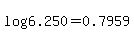 , and and , and and  . Those logarithms . Those logarithms
No matter where the decimal point is located, those logarithms are all found by adding  plus some integer. plus some integer.
The integer depends on how the number of digits to the left of the decimal point
6250 and 6250.00 have 4 digits to the left, just like 1000=10^3
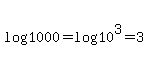
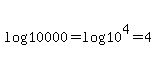
6253 is more than 1000 and less than 10000, so  is more than 3 but less than 4. is more than 3 but less than 4.
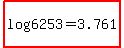
To find we add  to the mantissa to the mantissa 
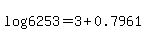 --> --> 
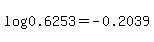
What about  ? ?
0.6253 is between 1 and 0.1, with 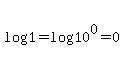 and and 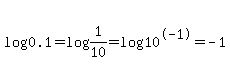 , ,
so, must be more than -1 and less than 0.
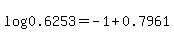 --> --> 
Answer by greenestamps(13382)  (Show Source): (Show Source):
You can put this solution on YOUR website!
The wording here (as you show it) is not at all clear:
"Each increase of 1 unit (6250 increase of 10 to 6260), mantissas of their logs increase by 0.0007, an increase of .1 of 0.0007. 3 added to 0250 will add .3 of 0.0007 or 0.0002 to the mantissa of 6253."
If that is actually the way the problem was presented to you, it is not surprising that you don't understand.
The table gives us log(6250) = 3.7959 and log(6260) = 3.7966.
To determine log(6253), we need to interpolate.
For a small change in the number, the change in the logarithm is approximately linear.
In this example, a change of 10 (from 6250 to 6260) in the number produces a change of .0007 (from 3.7959 to 3.7966) in the logarithm. Since 6253 is 3/10 of the distance from 6250 to 6260, the logarithm of 6253 is 3/10 of the way from log(6250) to log(6260).
3/10 of .0007 is .00021, so log(6253) is log(6250) + .00021 = 3.7959 + .00021 = 3.79611.
But since the logarithms in the table are given to only 4 decimal places, we probably don't want to have more than 4 decimal places in our answer. So
ANSWER: log(6253) = 3.7961
(Or, if the problem asks you only for the mantissa of the logarithm, then the answer is just 0.7961)
| |
|
