Question 1187361: The human body contains approx. 30 trillion red blood cells. If these cells were placed tightly together, they would fit into a cube approx. 5 in. on each edge.
1) Determine outside surface of cube in sq. yds.
2)If the outside surface of cube was divided into 30 trillion pieces, determine outside surface in sq. yds.
Unsure how to solve.
Found 4 solutions by Alan3354, KMST, Theo, ikleyn:
Answer by Alan3354(69443)   (Show Source): (Show Source):
You can put this solution on YOUR website! The human body contains approx. 30 trillion red blood cells. If these cells were placed tightly together, they would fit into a cube approx. 5 in. on each edge.
1) Determine outside surface of cube in sq. yds.
The surface area is 6s^2 = 6*25 sq inches.
1 yard = 36 inches
======================
2)If the outside surface of cube was divided into 30 trillion pieces, determine outside surface in sq. yds.
-----------------
There's no inside surface area, so what does "outside surface area" mean?
Divide the SA by 30,000,000,000,000.
Answer by KMST(5344)  (Show Source): (Show Source):
You can put this solution on YOUR website! Strange problem.
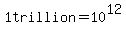 in the USA in the USA
(Between different countries, we do not agree on the definitions of billion, trillion, trapezoid, pavement, pants, hood, trunk, engine, and other terms).

A cube with  edges has an outside surface area of edges has an outside surface area of
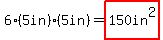
If that outside surface area was divided into
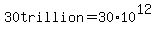 pieces of equal area, pieces of equal area,
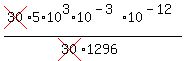
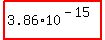
each piece would have an area of
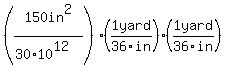 = =  = =
= = =
Hopefully, that is an acceptable answer, and there is no objection to having 3 significant figures in the result.
Otherwise, maybe  , with 2 significant figures, may be the expected answer, since 30 trillion appears to have 2 significant figures. , with 2 significant figures, may be the expected answer, since 30 trillion appears to have 2 significant figures.
Answer by Theo(13342)  (Show Source): (Show Source):
You can put this solution on YOUR website! the cube measures 5 inches on each edge.
the volume of the cube is equal to 5^3 cubic inches = 125 cubic inches.
the surface area of the cube is equal to 6 * 5^3 square inches = 150 square inches.
there are 12 inches to a foot.
there are 36 inches to a yard (3 feet * 12 = 36 inches).
if you take inches and divide them by 36, you get yards.
if you take square inches and divide them by 36^2, you get square yards.
if you take cubic inches and divide them by 36^3, you get cubic yards.
the volume = 125 cubic inches divided by 36^3 = .0026791830 cubic yards.
the surface area = 6 * 25 = 125 square inches divided by 36^2 = .1157407407.
the cube holds 30 trillion red blood cells.
that is equal to 30 * 10^12 red blood cells.
that's the volume of the cube in numbers of red blood cells.
since the volume of the cube is equal to one edge cubed, then each edge contains the cube root of 30 * 10^6 red blood cells.
simplify that to get 31,072.32506 red blood cells per edge.
since the surface area of the cube is equal to 6 * one edge squared, then the surface area of the cube contains 6 * 31072.32506^2 = 5,792,936,308 red blood cells.
that should be everything i can calculate for the cube, except, perhaps, the ratio of red blood cells to yards.
we have one edge is equal to 5 inches which is equal to 31,072.32506 red blood cells
take that and divide it by 5 and you get 6214.465012 red blood cells per inch.
since 1 inch / 36 = /.02777777..... yards, then you get:
6214.465012 / .0277777.... = . 223720.7404 red blood cells per yard.
we know from above that the volume of the cube is equal to .0026791830 cubic yards.
1 cubic yard is equal to 223720.7402^3 = 1.119744 * 10^16 red blood cells.
multiply that by .0026791830 to get a volume of 3 * 10^13 = 30 trillion red blood cells.
the figures work out (painfully, i might add), but they now look good.
best i can do.
take what you can and let me know if you have any further questions.
theo
Answer by ikleyn(53742)  (Show Source): (Show Source):
You can put this solution on YOUR website! # 1187361 (KMST)
The human body contains approx. 30 trillion red blood cells. If these cells were placed tightly together,
they would fit into a cube approx. 5 in. on each edge.
1) Determine outside surface of cube in sq. yds.
2)If the outside surface of cube was divided into 30 trillion pieces, determine outside surface in sq. yds.
~~~~~~~~~~~~~~~~~~~~~~~~~~~~~~~
In this post, the problem is formulated incorrectly.
It is also incorrectly interpreted, incorrectly treated and incorrectly solved by the other tutor.
The meaning of the problem is totally different, and after proper solution
the answer will shock you, because it will disclose absolutely unexpected phenomena.
The correct formulation is (and should be) as follows
The human body contains approx. 30 trillion red blood cells. If these cells were placed tightly together,
they would fit into a cube approx. 5 in. on each edge.
1) Determine outside surface area of cube in sq. yds.
2) If the volume of cube was divided into 30 trillion pieces/(small cubes), determine their total
outside surface area in sq. yds.
S O L U T I O N, step by step
(1) surface area of the cube with the side 5 inches is  = 6*25 = 150 square inches.
It is the same as = 6*25 = 150 square inches.
It is the same as  = =  = 0.11574 sq. yards (approximately).
(2) Now we are going to divide the 5x5x5-inches cube into 30 trillions smal cubes.
30 trillions = = 0.11574 sq. yards (approximately).
(2) Now we are going to divide the 5x5x5-inches cube into 30 trillions smal cubes.
30 trillions =  .
To find the linear size of small cube, we should divide 5 inches by .
To find the linear size of small cube, we should divide 5 inches by  = 31072.325.
By doing it, we get the size of small cube s = = 31072.325.
By doing it, we get the size of small cube s =  = 0.000160915 inches.
Then the surface area of this small cube is = 0.000160915 inches.
Then the surface area of this small cube is  square inches.
It is very small area - - - but we have 30 trillions such small cubes,
so, to get the total surface area of these 30 trillions small cubes,
we should multiply by .
By doing it, we get for the total surface area the value square inches.
It is very small area - - - but we have 30 trillions such small cubes,
so, to get the total surface area of these 30 trillions small cubes,
we should multiply by .
By doing it, we get for the total surface area the value
 = 4660848.759 square inches,
which is the same as = 4660848.759 square inches,
which is the same as  = 3596.333919 square yards.
Now the two values for the surface area to compare are 0.11574 square yards from part (1)
and 3596.3 square yards from my last calculation.
It tells us that the surface area of the red blood cells in dispersed state (as it is in the live human body)
is approximately 35000 times greater than the surface area of the 5x5x5-inches cube.
It is that unexpected phenomena which I pointed at the beginning of my post,
and it explains and discloses the fact that dispersed red blood cells distribute oxygen very effectively
in the lungs and in all human's body.
These facts are of common knowledge.
I learned it in my 12 - 13 - 14 years, reading Children Encyclopedia on Biology.
I think that it should be clear to an analytical chemist @KMST as 2 x 2 x 2 = 8. = 3596.333919 square yards.
Now the two values for the surface area to compare are 0.11574 square yards from part (1)
and 3596.3 square yards from my last calculation.
It tells us that the surface area of the red blood cells in dispersed state (as it is in the live human body)
is approximately 35000 times greater than the surface area of the 5x5x5-inches cube.
It is that unexpected phenomena which I pointed at the beginning of my post,
and it explains and discloses the fact that dispersed red blood cells distribute oxygen very effectively
in the lungs and in all human's body.
These facts are of common knowledge.
I learned it in my 12 - 13 - 14 years, reading Children Encyclopedia on Biology.
I think that it should be clear to an analytical chemist @KMST as 2 x 2 x 2 = 8.
Solved to satisfy your curiosity.
|
|
|
