Question 459: What is the measure of the angle formed by the hands of a clock at 7:20.
Found 2 solutions by KMST, greenestamps:
Answer by KMST(5484)   (Show Source):
You can put this solution on YOUR website! This refers to analog clock, which must be unfamiliar to student who grew used to digital clocks.
THE SHORT ANSWER:
The edge of the dial in an analog clock has the numbers 1 through 12 for the hours,
places at equal intervals, of  .
It also has 60 ticks corresponding to 60 minutes.
The ticks are too many to number, but the hours and minutes are counted at the top (labeled 12),
so that 20 minutes is the point labeled as 4.
At 7:20, the minutes hand points to 4, and the hours hand points between 7 and 8.
The arc between 4 and 7 on the dial measures
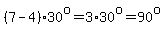 .
Whithin the  angle between 7 and 8, by 7:20 the hours hand has already swept
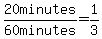 of the way.
That is 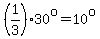 .
The angle between the two hands is 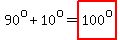 .
THE LONG STORY, WITH PICTURES:
Analog clocks had a dial divided by ticks into 60 sections each representing one minute.
Twelve of those larger, equally spaced, were labeled with the hours from 1 through 12.
I am not going to draw all 60 ticks, I will draw just a few so you get the idea.
You did not have to count ticks to figure out the position representing 20 minutes,
because the hours ticks marked the positions for 0, 5, 10, 15, 20, 35, 30 minutes and so on.
A long pointer called the minute hand, would point to the minutes after the hour.
At the hour it would be pointing up, and it would move to the right from there,
rotating one turn in 60 minutes, at a rate of
   .
At 7:20, the minute hand would be pointing to the 20th tick, marked as hour 4, like this:
 , and the shorter hours hand would be pointing somewhere between 7 and 8.
From the top-pointing position it had at 7:00, by 7:20,
the minutes hand has has swept an angle measuring
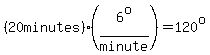
The hours hands takes 12 hours to do the  turn the minutes hand does in 1 hour.
The hours hands moves at 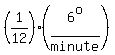 
From the top-pointing position it had at 12:00,
in  ,
it has swept an angle of
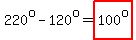
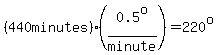 , and the angle between the two hands is

Answer by greenestamps(13392)  (Show Source):
You can put this solution on YOUR website!
One way to solve a problem like this is to find the angles that the hour hand and minute hand make with "noon" (hands straight up).
7:20 is 7 1/3 hours after "noon". At that time...
(1) Relative to "noon", the hour hand has moved for 7 1/3 hours at 30 degrees per hour (360 degrees every 12 hours), so the hour hand is pointing (7 1/3)*(30) = 220 degrees past "noon"; and
(2) relative to "noon", the minute hand has moved for 1/3 hour at 360 degrees per hour, so the minute hand is pointing (1/3)*(360) = 120 degrees past "noon"
So the angle between the hands is 220-120 = 100 degrees
ANSWER: 100 degrees
| |
|
