Question 1137073: Two cones are similar in shape. The ratio of the diameters of their bases is 2:7. The radius of the smaller cone is 4.5 inches. A) find the radius of the larger cone B) write the ratio of the height of the smaller cone to the height of the larger cone.
Found 3 solutions by mananth, greenestamps, ikleyn:
Answer by mananth(16949)   (Show Source): (Show Source):
You can put this solution on YOUR website! wo cones are similar in shape.
The ratio of the diameters of their bases is 2:7.
The radius of the smaller cone is 4.5 inches. Diameter = 9 inches.
Let diameter of larger cone be x inches
2/7 = 9/x
diameter of larger cone x= 63/2
radius of larger cone = 63/4
let h1 be the height of smaller cone
h2 be the height of the larger cone

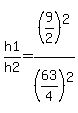
simplify to get the ratio of 4/49
ratio of the height of the smaller cone to the height of the larger cone=4/49
Answer by greenestamps(13382)  (Show Source): (Show Source):
You can put this solution on YOUR website!
The answer from tutor @mananth for the second question is wrong; what she did to get the answer makes no sense.
If the ratio of the diameters of the two cones is 2:7, then the ratio of ANY corresponding linear measurements between the two cones is 2:7.
A) 4.5 * (7/2) = 9/2*7/2 = 63/4
B) 2:7
Answer by ikleyn(54018)  (Show Source): (Show Source):
You can put this solution on YOUR website! .
Two cones are similar in shape. The ratio of the diameters of their bases is 2:7.
The radius of the smaller cone is 4.5 inches.
A) find the radius of the larger cone
B) write the ratio of the height of the smaller cone to the height of the larger cone.
~~~~~~~~~~~~~~~~~~~~~~~~~~~~
The solution in the post by @manant is incorrect.
I came to bring a correct solution.
(a) The ratio of the cones radii is the same as the ratio of their diameters
 = =  .
Hence, the radius of the larger cone is
r2 = .
Hence, the radius of the larger cone is
r2 =  = =  = =  inches = 15.75 inches. ANSWER
(b) Since the cones are similar, the ratio of their heights is the same as the ratio of their diameters inches = 15.75 inches. ANSWER
(b) Since the cones are similar, the ratio of their heights is the same as the ratio of their diameters
 = . ANSWER = . ANSWER
Solved correctly.
-------------------------------
Remember that @mananth is not a human - it is a computer code, instead,
which generates his output automatically in correct mode or in wrong mode,
but it does not know in which mode does it currently work, and even does not ask
this question to himself, since it is not programmed to ask such questions
and is not programmed to think, to self-check or to self-control itself.
In other words, when you get answers from @mananth, no one human is personally responsible
if they are correct or wrong.
| |
|
