Question 18: By receiving two successive discounts, a dealer bought merchandise for $9 that was listed at $20. What were the discounts in percent if the first discount was 5 times the second?
Found 4 solutions by AnlytcPhil, KMST, ikleyn, MathTherapy:
Answer by AnlytcPhil(1814)   (Show Source):
You can put this solution on YOUR website! By receiving two successive discounts, a dealer bought merchandise for $9 that
was listed at $20. What were the discounts in percent if the first discount
was 5 times the second?
---------------------------------------------------------------------------
There are two ways of expressing discounts, so we have to be careful not to
get them confused. There are DOLLAR discounts and there are PERCENT
discounts.
Let the first DOLLAR discount be $x
Let the second DOLLAR discount be $y
>>...bought merchandise for $9 that was listed at $20...<<
Translation: $20 minus the 1st DOLLAR discount minus the 2nd DOLLAR discount
equals $9, or
$20 - $x - $y = $9
20 - x - y = 9
11 = x + y
x + y = 11
>>...the first discount was 5 times the second...<<
Note: This is badly worded because it is not clear whether that's talking
about the DOLLAR or the PERCENT discount. I will assume it means the
DOLLAR discount and is to be taken as:
>>...the first DOLLAR discount was 5 times the second...<<
Translation: x = 5y.
So we have this system of equation to solve:
x + y = 11
x = 5y
From the second equation, substitute 5y for x in the first equation
x + 5x = 11
6x = 11
x = 11/6 = $1.83 1/3
Then substitute 11/6 for x in the first equation
11/6 + y = 11
11 + 6y = 66
6y = 55
y = 55/6 = $9.16 2/3
>>...What were the discounts in percent...?...<<
So you are asked for PERCENT discounts, not DOLLAR discounts
So we need to ask: "What percent of $20 is $1.83 1/3?" or
"What percent of 20 is 11/6?"
So we divide 11/6 by 20: 11/6 divided by 20 = (11/6)×(1/20) = .09 1/6 or
(9 1/6)%. That is the first PERCENT discount.
After the first discount, the price was reduced to
$20 - $x = 20 - 11/6 = 120/6 - 11/6 = 109/6 = $18.16 2/3
After the second discount, the price was reduced to
($18.16 2/3) - ($9.16 2/3) = $9.
So now we need to ask: "What percent of $18.16 2/3 is $9.16 2/3?" or
"What percent of 109/6 is 55/6?"
So we divide 55/6 by 109/6: 55/6 divided by 109/6 = (55/6)×(6/109) = 55/109
or .50 50/109 which when changed to a percent becomes
(50 50/109)%
That is the second PERCENT discount.
Because this came out with terrible answers, it may have supposed
to have been
>>...the first PERCENT discount was 5 times the second...<<
which would have changed the answer. Check with your teacher as to which
it was supposed to be.
Edwin
Answer by KMST(5484)  (Show Source):
You can put this solution on YOUR website! Edwin called the dollar amount of the second discount  ,
which would make dollar amount of the first discount 
The two discounts added to the reduction in price from $20 to $9, a dollar amount of  .
That makes  -->  --> 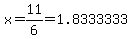 .
That would make it a $1.83 and 1/3 of a cent.
We could use  , an approximate amount, or  for the small second reduction in price.
The first reduction in price, in $, is 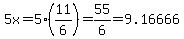
We can use  or the approximate value of  dollars,
and that amount applied to 20 would reduce it to  .
Then, a second reduction of 1.833, would bring the final price to  dollars.
The dollar amounts of those discounts add up.
Now we have to calculate percentages those discounts represents,
and that is where the rounding each of the discounts may get us into trouble.
The first discount was applied to the full $20 price.
As a fraction of the full price, that discount is 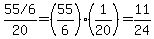
As a decimal it is  or approximately 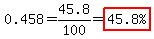
However, if we apply that discount as 45.8%,
the dollar amount is reduced by  to  .
Then, a second discount of $1.83 would further reduce the price in $ to  .
If we do not round the percentage of the first discount, or round it to a lesser degree,
applying a discount of  to the original $20 price,
the first discount is  ,
the first reduced price is  ,
and the further discount to get to  is  ,
which is 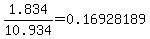 .
As a fraction of $10.84, $1.83 discount is 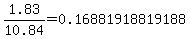 .
Rounded, it would be 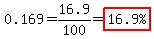 as decimal and percent.
A 16.9% discount applied to $10.84 would be  , which rounds to  .
Answer by ikleyn(54062)  (Show Source):
You can put this solution on YOUR website! .
By receiving two successive discounts, a dealer bought merchandise for $9 that was listed at $20.
What were the discounts in percent if the first discount was 5 times the second?
~~~~~~~~~~~~~~~~~~~~~~~~~~~
Let x be the second discount as a decimal number.

Then the first discount is 5x, according to the problem.


After two successive discounts, the listed $20 became 20*(1-5x)*(1-x) dollars for a buyer.


So, we have this equation

    20*(1-5x)*(1-x) = 9.


Simplify

    1-x - 5x + 5x^2 = 9/20,

    5x^2 - 6x +1 = 0.45,

    5x^2 - 6x + 0.55 = 0.


Solve this quadratic equation using the quadratic formula.  You will get two roots

    x = 0.1 and x = 1.1.


The second root is too big, and we reject it.  The other root, x = 0.1, is perfect, as you can check

    20*(1-0.5)*(1-0.1) = 20*0.5*0.9 = 10*0.9 = 9 dollars.


ANSWER.  The first discount was 0.5, or 50%. The second discount was 0.1, or 10%.
Solved. At this point, after getting a brilliant solution, we can celebrate a victory.
The lesson from my solution When you deal with  discounts in a way as described in this problem,
you should not and can not add them. You should use this telescoping formula.
The word "successive" is the keyword in the problem.
It signals that you should pay attention (like a steam locomotive whistle).
Answer by MathTherapy(10898)  (Show Source):
You can put this solution on YOUR website!
By receiving two successive discounts, a dealer bought merchandise for $9 that was listed at $20.
What were the discounts in percent if the first discount was 5 times the second?
********************************************************************************
Let 2nd percent-discount be S
As 1st percent-discount was 5 times the 2nd, 1st percent-discount = 5S
With the ORIGINAL price being $20, and 1st percent-discount, 5S, cost after 1st percent-discount, was:
 With the COST after the 1st discount being 20 - S, and 2nd percent-discount, S, cost after 2nd discount, was: 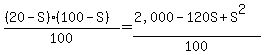 With the FINAL cost, after 1st and 2nd discounts being $9, we get: 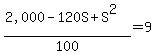
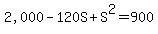 ---- Cross-multiplying 
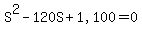 (S - 10)(S - 110) = 0
S - 10 = 0 OR S - 110 = 0
S, or 2nd percent-discount = 10 OR S = 110 (ignore)
5S, or 1st percent-discount = 5(10) = 50
| |
|
