Simplify expressions containing nested radicals
You can meet many assignments requiring to simplify expressions of the form  with integer numbers x, y, z
to the form  +
 with integer numbers 'a' and 'b'. This lesson teaches you how to solve such problems.
Problem 1
Find integer positive numbers 'a' and 'b' such that  is equal to + .
Solution
We are going to find positive integer numbers 'a' and 'b' such that
= + . (1)
To do this, square both sides of this equation. You will get
 =
 . (2)
From (2), it is natural to assume that
a + b = 7, (3)
 =
 . (4)
Square both sides of (4)
4ab = 48, ab = 48/4 = 12.
So, now you have two equations to determine the unknowns 'a' and 'b'
a + b = 7,
ab = 12.
You can reduce it to a quadratic equation and solve it using the quadratic formula or factoring.
Alternatively, you can easily guess two possible solutions in integer numbers
(a) a = 3, b = 4, or (b) a = 3, b = 4.
ANSWER. There are two possible solutions in integer numbers
(a) a = 3, b = 4; (b) a = 4, b = 3.
CHECK. Left side value in (1) is = 3.732050808 (approximately).
Right side in (1) is
 =
 = 3.732050808 (approximately).
The approximate values coincide; this confirms the correctness of the solution.
Notice that the instruction stating that numbers 'a' and 'b' are integers is an essential part.
Without it, the problem would have infinitely many solutions in real numbers 'a' and 'b'.
Problem 2
Find positive integer numbers 'a' and 'b' such that  = - .
Solution
We are going to find positive integer numbers 'a' and 'b' such that
 = - . (1)
To do this, square both sides of this equation. You will get
 =
 . (2)
From (2), it is natural to assume that
a + b = 12, (3)
=
 . (4)
Square both sides of (4)
4ab = 80, ab = 80/4 = 20.
So, now you have two equations to determine the unknowns 'a' and 'b'
a + b = 12,
ab = 20.
You can reduce it to a quadratic equation and solve it using the quadratic formula or factoring.
Alternatively, you can easily guess two possible solutions in integer numbers
(a) a = 10, b = 2, or (b) a = 2, b = 10.
Since the left side of equation (1) is positive, its right side should be positive, too.
It leaves only one solution to the problem a = 10, b = 2.
CHECK. Left side value in (1) is = 1.748064098 (approximately).
Right side in (1) is
 = 1.748064098 (approximately).
The approximate values coincide; this confirms the correctness of the solution.
ANSWER. a = 10, b = 2.
Problem 3
Simplify expression 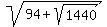 to the form + with positive integers 'a' and 'b'.
Solution
We are going to find positive integer numbers 'a' and 'b' such that
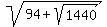 = + . (1)
Square both sides of this equation. You will get
 = . (2)
From (2), it is natural to assume that
a + b = 94, (3)
=
 . (4)
Square both sides of (4)
4ab = 1440, ab = 1440/4 = 360.
So, now you have two equations to determine the unknowns 'a' and 'b'
a + b = 94,
ab = 360.
You can reduce it to a quadratic equation and solve it using the quadratic formula or factoring.
Alternatively, you can easily guess two possible solutions in integer numbers
(a) a = 90, b = 4, or (b) a = 4, b = 90.
ANSWER. There are two possible solutions in integer numbers
(a) a = 90, b = 4; (b) a = 4, b = 90.
CHECK. Left side value in (1) is = 11.48683298 (approximately).
Right side in (1) is
 =
 = 11.48683298 (approximately).
The approximate values coincide; this confirms the correctness of the solution.
Problem 4
The nested radical 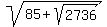 can be expressed as + ,
where 'a' and 'b' are positive integer numbers. Find the integers 'a' and 'b'.
Solution
We are going to find positive integer numbers 'a' and 'b' such that
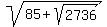 = + . (1)
Square both sides of this equation. You will get
 = . (2)
From (2), it is natural to assume that
a + b = 85, (3)
=
 . (4)
Square both sides of (4)
4ab = 2736, ab = 2736/4 = 684.
So, now you have two equations to determine the unknowns 'a' and 'b'
a + b = 85, (5)
ab = 684. (6)
From (5), express b = 85-a and substitute it into equation (6). You will get
a*(85-a) = 684,
a^2 - 85a + 684 = 0.
You have a quadratic equation for 'a'. Solve it using the quadratic formula
 =
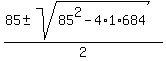 =
 =
 .
So, we have two possible positive values for 'a'
(a)
 =
 = 9,
(b)
 =
 = 76.
The value = 9 produces the value of b = 85-9 = 76.
The value = 76 produces the value of b = 85-76 = 9.
ANSWER. There are two possible solutions in integer numbers
(a) a = 76, b = 9; (b) a = 9, b = 76.
CHECK. Left side value in (1) is = 11.71779789 (approximately).
Right side in (1) is
 =
 = 11.71779789 (approximately).
The approximate values coincide; this confirms the correctness of the solution.
Problem 5
Simplify an expression  to the form
 with integer positive integers 'a' and 'b'.
Solution
Let's assume that
 = a + b*sqrt(5) (1)
with some real values 'a' and 'b'. Our goal is to find 'a' and 'b'.
If we find appropriate values 'a' and 'b' (and as soon as we find them), we will solve the problem.
From (1), we have
2 + sqrt(5) =
 ,
2 + sqrt(5) =
 +
 +
 +
 =
= +
 +
 +
 =
= + +
 + =
=
 +
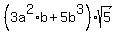 From this last form, it is natural to assume that
= 2, (2)
 = 1. (3)
Equations (2) and (3) are equivalent to
 = 2, (4)
 = 1. (5)
We now have a system of two non-linear equations for 'a' and 'b'.
To solve it, let's divide equation (4) by equation (5). We will get
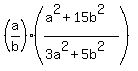 = 2. (6)
In this equation (6), divide the numerator by b^2 and divide the denominator by b^2.
This is an equivalent transformation, so equation (2) takes the form
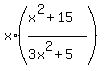 = 2, (7)
where x =
 is introduced for brevity.
Equation (7) is easy to solve. For it, multiply both sides by
 and simplify further
x*(x^2 + 15) = 2*(3x^2 + 5),
x^3 + 15x = 6x^2 + 10,
x^3 - 6x^2 + 15x - 10 = 0. (8)
For this equation (8), one of the roots is x = 1, which is easy to check.
By dividing the left side of equation (8) by (x-1), we find the quadratic polynomial, which has no real roots,
so x=1 is the unique real root to equation (8).
Thus we found that x = = 1.
This means that a = b, and we can substitute it into equation (2).
We will find then that a^3 = b^3 =
 , so a = b =
 =
 .
Thus we find from (1)
= +
 =
 .
ANSWER. = .
CHECK. It is always a good idea to check calculations.
The left side value is = 1.618034 (approximately).
The right side value is = 1.618034 (approximately).
It confirms the solution.
Another way to check the solution is to calculate directly
 and compare it with
 .
By doing this, you get =
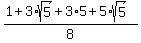 =
 =
 ,
 .
My other lessons on Evaluating expressions in this site are
- HOW TO evaluate expressions involving  ,
 and

- Advanced lesson on evaluating expressions
- HOW TO evaluate functions of roots of a square equation
- HOW TO evaluate functions of roots of a cubic and quartic equation
- Problems on Vieta's formulas
- Advanced problems on Vieta's theorem
- Miscellaneous problems on Vieta's theorem
- Evaluating expressions that contain infinitely many square roots
- Solving equations that contain infinitely many radicals
- Problems on evaluating in Geometry
- Evaluating trigonometric expressions
- Evaluate the sum of the coefficients of a polynomial
- Miscellaneous evaluating problems
- Advanced evaluating problems
- Lowering a degree method
- Find the number of factorable quadratic polynomials of special form
- Evaluating a function defined by functional equation
- Math circle level problems on evaluating expressions
- Math circle level problems on finding polynomials with prescribed roots
- Math Olympiad level problem on evaluating a 9-degree polynomial
- Upper league problem on evaluating the sum
- Finding coefficients of decomposition of a rational function
- Upper level problem on evaluating an expression of polynomial roots
- A truly miraculous evaluating problem with a truly miraculous solution
- Entertainment problems on evaluating expressions
- OVERVIEW of lessons on Evaluating expressions
Use this file/link ALGEBRA-I - YOUR ONLINE TEXTBOOK to navigate over all topics and lessons of the online textbook ALGEBRA-I.


