Question 1158813: A group of 2519 students were surveyed about the courses they were taking at their college with the following results:
1390 students said they were taking History.
1181 students said they were taking English.
1318 students said they were taking Science.
666 students said they were taking English and Science.
613 students said they were taking History and English.
744 students said they were taking History and Science.
359 students said they were taking all three courses.
a) Fill in the following Venn Diagram with the cardinality of each region.
History = I,II,IV,V
English = II,III,V,VI
Science = IV, V,VI,VII
students took none of the courses = 294
I. = 392
II. = 254
III. = 261
IV. = 385
V. = 359
VI. = 307
VII. = 267
VIII. = 294
a) How many students took History or didn't take English?
b) How many students took History & English or took English & Science?
c) How many students took History or Science, but not English?
d) How many students took History, English, or Science?
e) How many students took none of the courses?
f) How many students took English and Science, but not History?
Answer by KMST(5458)   (Show Source): (Show Source):
You can put this solution on YOUR website! The Venn diagram to be filled was not included in the question, so I will draw one.
We need 3 circles to "hold in" all the students that were taking one of the 3 courses mentioned.
The circles have to intersect, so that there is a region that is included in all 3 circles at the same time.
I will add color to the diagram to more easily identify the circles for  , ,  , and , and  . .
I will outline the circles in the corresponding color, and will arrange them in that order going left to right and top to bottom.

a) Fill in the Venn Diagram with the cardinality (number of students) of each region.
The diagram shows 7 regions that are part of at least one circle.
An additional 8th region, the part not included in any circle, would "hold" the students who are not taking any of the courses mentioned.
Presumably. there was a blank Venn diagram given with those 8 regions labeled with the Roman numerals  , , , ,  , etc, , etc,
but I assume the number of students corresponding to each region was not given, but found by the student, so I will not use that data.
The almost triangular region in the center of the diagram "holds" the students who are taking all 3 of the courses mentioned.
We are given the number of students there, so I will enter that number:  in that region of the diagram. in that region of the diagram.

Numbers of students taking exactly 2 of the subjects listed:
The number of students in the lense-shaped circle overlaps are given as
 students that said they were taking English and Science, students that said they were taking English and Science,
 students that said they were taking History and English, and students that said they were taking History and English, and
 students that said they were taking History and Science. students that said they were taking History and Science.
All of those could also have been taking the other listed subject.
Subtracting from each of those numbers the number of student who were taking all 3 courses, we can calculate the number of students who were taking only 2 of the subjects:
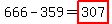 students that were taking English and Science, but not History, students that were taking English and Science, but not History,
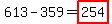 students that were taking History and English, but not students that were taking History and English, but not
Science, and
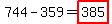 students that were taking History and Science, but not English. students that were taking History and Science, but not English.
Numbers of students taking only 1 of the subjects listed can be calculated based on the results above, or independently.
The part of the circle that is not in any other circle represents the number of students that were taking History, but not another of the listed subjects.
That number can be calculated as
 , found by subtracting from the number that said they were taking history, the numbers that were history and just one other subject, and the number that were taking all 3 subjects. , found by subtracting from the number that said they were taking history, the numbers that were history and just one other subject, and the number that were taking all 3 subjects.
It can also be calculated without relying on the previous results as  , ,
found by subtracting from the number that said they were taking history, the numbers that were taking a second subject,
and then adding the number of those subtracted twice because they were taking all 3 subjects.
The two results should be the same, an could be used as verification.
The other regions that are part of only one circle can be calculated similarly.
The part of the circle that is not in any other circle represents the number of students that were taking English, but not another of the listed subjects.
That number can be calculated as  , or as , or as
 . .
The part of the circle that is not in any other circle represents the number of students that were taking science, but not another of the listed subjects.
That number can be calculated as  , or as , or as

Number of students who took at least one of the courses listed:
Calculated as the sum of the numbers for all 7 regions in side one or more circles, that number is

Number of students who did not take any of the courses listed:
That number can be calculated as 
Entering the cardinalities (numbers of students) for those regions and the roman numerals for them as given by the person posting the question, we have:

a) How many students took History or didn't take English?
The students who took History are represented in regions I, II, IV, and V.
The students who didn't take English are in regions I,IV, VII, and VIII.
All of those regions are involved because it says or, so it's a union of both sets.
The union of those two sets includes regions I,II, IV, V, VII, and VIII.
That leaves out only regions III, and VI, so the number can be calculated subtracting the number in those 2 regions from the total as

b) How many students took History & English or took English & Science?
The students who took History & English are represented in regions II and V.
The students who took English & Science are represented in regions V and VI.
The answer is again in the union of those 2 sets: regions II, V, and VI:

c) How many students took History or Science, but not English?
That's those who took one of the courses listed but did not take English.
I could calculate their number as  . .
I could also calculate it as the number in regions I, IV, and VII,  . .
d) How many students took History, English, or Science?
That's those who took at least one of the courses listed, so it can be calculated as  . .
e) How many students took none of the courses?
That's the number in region VIII: 
f) How many students took English and Science, but not History?
The students who took English and sciences are represented by regions V and VI.
The students in region V had taken also History, so they are not included in the answer.
So, the answer is the  students in region VI. students in region VI.
| |
|
