Question 68: A field bordering a straight stream is to be inclosed. The side bordering the stream is not to be fenced. If 1000yards of fencing material is to be used, what are the dimensions of the largest rectangle field that can be fenced What is the maximum area?
Found 3 solutions by mhapich, KMST, ikleyn:
Answer by mhapich(1)   (Show Source):
You can put this solution on YOUR website! You want to start with a picture, in which one side of the field is the stream, and the other three sides of the field are labeled. In my picture, I have the stream on the left, and the top and bottom labeled with x and the right side labeled with y. Now, you write an equation with the given perimeter:

Next, you write an equation for the area, which you are trying to maximize:

Now, solve the perimeter formula for y (the easier variable for which to solve):

Subsitute that in for y in the area equation:

Simplify:

Now, take the derivative of the area function. Remember, taking the derivative and setting it equal to zero, then testing intervals surrounding this value for signs, will tell where the area function increased then decreased, thus finding its maximum.

Setting dA/dx equal to zero, we get:


Now, test values on either side. Plugging 1 into the derivative:

which is positive, so A is increasing on all values of x up to 250.
And, plugging 300 into the derivative:

which is negative, so A is decreasing on all values of x after 250.
Thus, the desired dimensions are 250 feet by 500 feet.
(Plug 250 in for x back into the above equation:
 ).
Also, remember to answer all questions -- "What is the maximum area?"
The area is
which will give you 250 * 500, or 125000 square yards.
Answer by KMST(5456)  (Show Source):
You can put this solution on YOUR website! Making  = the length in yards of the fenced rectangle sides attached to the stream's edge,
the length in yards of the other fenced side would be  .
It would look like this:
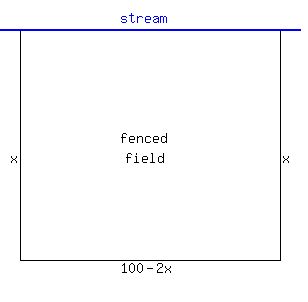
The fenced area is  , the area of the fenced rectangle.
We can rewrite it as 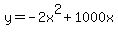 ,
but there is no doubt that it is a quadratic function.
We see that the function is defined for all values of x, including the ones who make the value of  negative or zero, which is not a good value for the area of a rectangle.
we realize that  for  and  .
The maximum will happen halfway between those two values, at .
For that value of , the area fenced (in square yard) is
 .
ABOUT QUADRATIC FUNCTIONS:
We know a thing or two about quadratic functions, and do not need Calculus or derivatives to solve this problem.
We know the shape of their graph.
We know that their graph is symmetrical, with a maximum or minimum at the vertex  .
The function takes that maximum of minimum value  for only  ,
and that is the value we need to find.
All the other values of the function takes happen exactly twice, at two values of symmetrically placed at equal distance from .
Quadratic functions are polynomials of degree 2, like  and 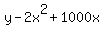 .
The mother of all quadratic functions is  whose graph, looks like this:
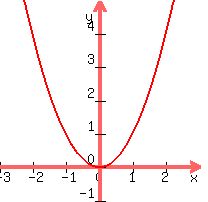 .
The graph for  is the flipped version, 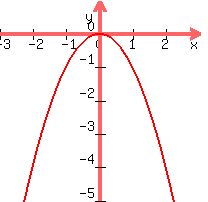 , of course.
All quadratic functions' graphs have that shape, and are flipped, and/or stretched, and/or shifted versions of the graph for .
That shape is called a parabola, and it has a vertex, and two symmetrical arms that go on to infinity (or to minus infinity if the coefficient of the term in  is negative.
The axis of symmetry is the vertical line that goes through the vertex.
Points with the same value for are in pairs, at the same horizontal distance from the axis of symmetry.
Answer by ikleyn(54052)  (Show Source):
You can put this solution on YOUR website! .
A field bordering a straight stream is to be  enclosed.
The side bordering the stream is not to be fenced. If 1000 yards of fencing material is to be used,
what are the dimensions of the largest rectangle field that can be fenced? What is the maximum area?
~~~~~~~~~~~~~~~~~~~~~~~~~~~~~~
I want to present a totally different solution, which uses a totally different idea.
For what ? - To develop your mind.
So, we have a fenced area/field along the straight stream.

Let’s reflect this area and the fence across the "edge of the stream" as in the mirror.
This gives us a fully enclosed rectangular area with a total fence length of 2000 yards.

Thus, we arrive to the problem of finding a rectangle of the maximum area with the perimeter of 2000 yards.


But you should just know the solution to this problem, since it is a prerequisite to the problem in the post.


So, you know the answer for the modified problem:

    this rectangle is a square  of the side length of one fourth of the perimeter,
    i.e., 500 yards, in this case.


Hence, in the original problem given in the post, the maximum-area rectangle has 500 yards along the stream
and half of 500 yards, i.e., 250 yards perpendicularly to the stream.
Solved using a symmetry idea.
Notice that, using this reasoning, I solved the problem mentally, without equations or calculations.
| |
|
