.
Recall that an integer d is said to be a divisor of an integer a if a/d is also an integer.
For how many integers a between -200 and -1 inclusive is the product of the divisors of a negative?
It is not 0.
~~~~~~~~~~~~~~~~~~~~~~~
Let N be an integer between -200 and -1, -200 <= N <= -1.
Consider the absolute value |N|, the opposite integer to N, which is a positive integer number.
Let
|N| = 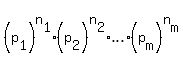 be the decomposition of number |N| into the product of prime factors
  ,
,  , . . . ,
  .
Then the number of all positive divisors of |N| is
.
Then the number of all positive divisors of |N| is  .
It is a well-known fact from number theory.
The number of all possible negative divisors of the negative integer N is .
The product of all negative divisors of N is a negative number if and only if the number of its divisors is
an odd number.
Thus, the product of all negative divisors of N is a negative number if and only if
the product is an odd number.
In turn, the product is an odd number if and only if
each factor
.
It is a well-known fact from number theory.
The number of all possible negative divisors of the negative integer N is .
The product of all negative divisors of N is a negative number if and only if the number of its divisors is
an odd number.
Thus, the product of all negative divisors of N is a negative number if and only if
the product is an odd number.
In turn, the product is an odd number if and only if
each factor  ,
,  , . . . ,
  is an odd number.
It is so if and only if each index / degree
is an odd number.
It is so if and only if each index / degree  ,
,  , . . . ,
  is an even number.
It happens if and only if the number N is a negative square.
The negative squares between -1 and -200 are -1, -4, -9, -16, -25, -36, -49, -64, -81, -100, -121, -144, -169, -196.
In all, there are 14 such negative squares.
So, the answer to the problem question is 14.
is an even number.
It happens if and only if the number N is a negative square.
The negative squares between -1 and -200 are -1, -4, -9, -16, -25, -36, -49, -64, -81, -100, -121, -144, -169, -196.
In all, there are 14 such negative squares.
So, the answer to the problem question is 14.
Solved.
///////////////////////////////
To the person who posted this problem,
to the person who created this post/problem (to the composer),
and to readers of this post.
I have a fundamental professional Math education from a renowned university.
I have read tons of mathematical literature, from popular Math books through
textbooks of all possible levels to professional articles and monographs.
As such, I say that the formulation of this problem in the incoming post is not a professional:
there remain many questions for the reader.
Therefore, below is my reformulation of how the problem should be.
    Let's consider negative integer numbers { N } between -200 and -1, inclusive.
    For every such number N, let D(N) be the set of all its negative integer divisors
    (each such set includes -1 and N itself).
    For every such number N, let P(N) be the product of all integers of the set D(N).
    We call a number N favorable if the number P(N) is negative.
    How many favorable negative integers N are there in the interval [-200,-1]?
For you to better understand the meaning of the problem and the idea of the solution,
I'll say that it is equivalent to this question:
    Describe all natural numbers from 1 to 200 inclusive
    that have an odd number of divisors.


