Tutors Answer Your Questions about logarithm (FREE)
Question 686407: Please help me solve this equation:
Solve: log2 (x+5) + log2 (x+1) = 5
Answer by MathTherapy(10806)   (Show Source): (Show Source):
Question 287532: Solve Log2(x+1)=5
Answer by MathTherapy(10806) (Show Source):
You can put this solution on YOUR website!
Solve Log2(x+1)=5
*****************
The other person who responded has the following, which makes
ABSOLUTELY no SENSE, in this author's opinion!
"log ( 2x + 2 ) = 5
=> e^5 = 2x + 2
=> 2x = e^5 -2
Now do the rest....
Happy"
 , with x > - 1 , with x > - 1
 ------ Converting to EXPONENTIAL form
x + 1 = 32
x = 32 - 1 = 31
That's IT!! ------ Converting to EXPONENTIAL form
x + 1 = 32
x = 32 - 1 = 31
That's IT!!
Question 865839:  - -  + +  = 2 = 2
Please solve for x
Please show all steps
Answer by MathTherapy(10806) (Show Source):
Question 734457: log10x-log(x-3)=log2
Answer by MathTherapy(10806) (Show Source):
You can put this solution on YOUR website!
log10x-log(x-3)=log2
********************
 is NOT a solution to this logarithmic equation, as stated by the other person, since it's EXTRANEOUS!
log (10x) - log (x - 3) = log (2)
x - 3 is the smaller of the 2 variable-arguments, and so, MUST be > 0. This gives us: x - 3 > 0 ====> x > 3
We then have: log (10x) - log (x - 3) = log (2), with x > 3
While the solution to this equation is x = , this value is NOT > 3, and so, is INVALID/UNACCEPTABLE.
As a result, NO SOLUTION exists for this equation!. is NOT a solution to this logarithmic equation, as stated by the other person, since it's EXTRANEOUS!
log (10x) - log (x - 3) = log (2)
x - 3 is the smaller of the 2 variable-arguments, and so, MUST be > 0. This gives us: x - 3 > 0 ====> x > 3
We then have: log (10x) - log (x - 3) = log (2), with x > 3
While the solution to this equation is x = , this value is NOT > 3, and so, is INVALID/UNACCEPTABLE.
As a result, NO SOLUTION exists for this equation!.
Question 883161: log2(x - 6) + log2(x - 4) = log2 x solve the logarithmic equation. and round.
Answer by MathTherapy(10806) (Show Source):
You can put this solution on YOUR website!
log2(x - 6) + log2(x - 4) = log2 x solve the logarithmic equation. and round.
****************************************************************************
x = 3 or x = 8, as stated by the other person, is partly WRONG!
 Looking at the logarithmic equation, the smallest log argument, x - 6 MUST be > 0.
So, x - 6 > 0, and therefore, x > 6.
We then have: , with x > 6
The x-value 3 is NOT > 6, which makes it EXTRANEOUS and an INVALID/UNACCEPTABLE solution. On the
other hand, the x-value 8 is > 6, which makes it the ONLY solution to this equation.
Looking at the logarithmic equation, the smallest log argument, x - 6 MUST be > 0.
So, x - 6 > 0, and therefore, x > 6.
We then have: , with x > 6
The x-value 3 is NOT > 6, which makes it EXTRANEOUS and an INVALID/UNACCEPTABLE solution. On the
other hand, the x-value 8 is > 6, which makes it the ONLY solution to this equation.
Question 954792: Solve log2(x-2)-log2(x+5)=3
Answer by MathTherapy(10806) (Show Source):
You can put this solution on YOUR website!
Solve log2(x-2)-log2(x+5)=3
*****
The solution, x = - 6, by the other person who responded, is WRONG!!
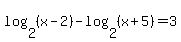 The SMALLER of the 2 log arguments, x - 2 MUST be > 0. So, x - 2 > 0 ===> x > 2.
We then have: , with x > 2.
The SMALLER of the 2 log arguments, x - 2 MUST be > 0. So, x - 2 > 0 ===> x > 2.
We then have: , with x > 2.
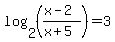 ----- Applying ----- Applying 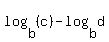 = = 
 ---- Converting to EXPONENTIAL form ---- Converting to EXPONENTIAL form
 8(x + 5) = x - 2 ----- Cross-multiplying
8x + 40 = x - 2
8x - x = - 2 - 40
7x = - 42
8(x + 5) = x - 2 ----- Cross-multiplying
8x + 40 = x - 2
8x - x = - 2 - 40
7x = - 42
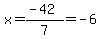 The x-value, - 6, is NOT > 2, and is therefore an EXTRANEOUS solution, which makes it an INVALID/UNACCEPTABLE solution.
So, this equation DOESN'T have a solution!!
The x-value, - 6, is NOT > 2, and is therefore an EXTRANEOUS solution, which makes it an INVALID/UNACCEPTABLE solution.
So, this equation DOESN'T have a solution!!
Question 22137: log2x+log2(x-6)=4
Answer by MathTherapy(10806) (Show Source):
You can put this solution on YOUR website!
log2x+log2(x-6)=4
*****************
The solution, (x = 8, or x = - 2) by the other person who responded, is PARTIALLY WRONG!!
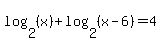 The SMALLER log argument, x - 6, MUST be > 0. So, x - 6 > 0 ===> x > 6.
We then have: , with x > 6.
The SMALLER log argument, x - 6, MUST be > 0. So, x - 6 > 0 ===> x > 6.
We then have: , with x > 6.
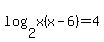 ----- Applying ----- Applying 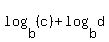 = = 
 --- Converting to EXPONENTIAL form <=== Note that the other person has --- Converting to EXPONENTIAL form <=== Note that the other person has  i/o i/o  ,
but both have the same value, 16 ,
but both have the same value, 16

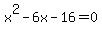 (x - 8)(x + 2) = 0
x - 8 = 0 OR x + 2 = 0 ---- Setting each FACTOR equal to 0
x = 8 OR x = - 2
The x-value, 8, is > 6, but - 2 is NOT. This makes - 2 an EXTRANEOUS solution!! So, x = 8 is the only VALID/ACCEPTABLE solution!!
(x - 8)(x + 2) = 0
x - 8 = 0 OR x + 2 = 0 ---- Setting each FACTOR equal to 0
x = 8 OR x = - 2
The x-value, 8, is > 6, but - 2 is NOT. This makes - 2 an EXTRANEOUS solution!! So, x = 8 is the only VALID/ACCEPTABLE solution!!
Question 735204: Please show how to solve:
Log base10(n^2 � 90n) = 3
Thank you
Answer by MathTherapy(10806) (Show Source):
You can put this solution on YOUR website!
Please show how to solve:
Log base10(n^2 � 90n) = 3
Thank you
*************************************
To this author, what the other person who responded wrote, as a solution to this equation, doesn't make any sense.
That's, "....n^2 - 90n = log base 10 (3) = .48
use quadratic formula and we get (note that b is --90 or 90)
n=(90+square root (90^2-4*1*-.48)) / 2 = 90"
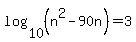 <== Base 10 is OPTIONAL, because we work in the decimal system, so usually, base 10 is NOT entered.
Since the log argument <== Base 10 is OPTIONAL, because we work in the decimal system, so usually, base 10 is NOT entered.
Since the log argument  MUST be greater than 0, we have: MUST be greater than 0, we have:  ===> ===>  .
The SOLUTIONS to the INEQUALITY, 0 and 90 are the CRITICAL POINTS, with 3 intervals: Interval 1: n-values < 0
Interval 2: 0 < n-values < 90
Interval 3: n-values > 90
When tested, we find that the n-values that'll satisfy the INEQUALITY are < 0, and > 90. So, based on that, we get:
, with n < 0, or > 90. .
The SOLUTIONS to the INEQUALITY, 0 and 90 are the CRITICAL POINTS, with 3 intervals: Interval 1: n-values < 0
Interval 2: 0 < n-values < 90
Interval 3: n-values > 90
When tested, we find that the n-values that'll satisfy the INEQUALITY are < 0, and > 90. So, based on that, we get:
, with n < 0, or > 90.
 ---- Converting to EXPONENTIAL form ---- Converting to EXPONENTIAL form
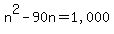
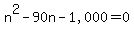 (n - 100)(n + 10) = 0
n - 100 = 0 OR n + 10 = 0 ----- Setting each factor equal to 0
n = 100 OR n = - 10
As seen, 100 is > 90, and - 10 is < 0, so both solutions are VALID/ACCEPTABLE!
(n - 100)(n + 10) = 0
n - 100 = 0 OR n + 10 = 0 ----- Setting each factor equal to 0
n = 100 OR n = - 10
As seen, 100 is > 90, and - 10 is < 0, so both solutions are VALID/ACCEPTABLE!
Question 1111913: Rachel Spender wants to invest $4000 in savings certificates which bear an interest rate of 7.25% compounded semi-anually. How long a time period should she choose in order to save an amount of $4700?
Answer by MathTherapy(10806) (Show Source):
You can put this solution on YOUR website!
Rachel Spender wants to invest $4000 in savings certificates which bear an interest rate of 7.25% compounded semi-anually. How long a time period should she choose in order to save an amount of $4700?
*****************************************************
Future-value-of-$1 formula: 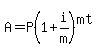 , with , with  = Future Value (Unknown, in this case) = Future Value (Unknown, in this case)
 = Principal/Initial Deposit ($4,000, in this case) = Principal/Initial Deposit ($4,000, in this case)
 = Interest rate, as a decimal (7.25%, or .0725, in this case) = Interest rate, as a decimal (7.25%, or .0725, in this case)
 = Number of ANNUAL compounding periods (semiannually, or 2, in this case) = Number of ANNUAL compounding periods (semiannually, or 2, in this case)
 = Time Principal/Initial Deposit has been invested, in YEARS (t, in this case)
How long a time period should she choose in order to save an amount of $4700? = Time Principal/Initial Deposit has been invested, in YEARS (t, in this case)
How long a time period should she choose in order to save an amount of $4700?
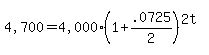 ----- Substituting $4,700 for A, $4,000 for P, .0725 for i, and 2 for m ----- Substituting $4,700 for A, $4,000 for P, .0725 for i, and 2 for m
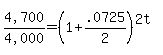
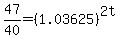
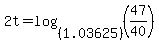 ----- Converting to LOGARITHMIC form
Time it'll take the $4,000 investment to increase to $4,700, or ----- Converting to LOGARITHMIC form
Time it'll take the $4,000 investment to increase to $4,700, or 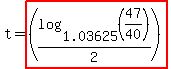 = 2.26446601 years, which needs to be ROUNDED UP
to = 2.26446601 years, which needs to be ROUNDED UP
to  years, or 2 years, 6 months.
** Notice that although 2.26446601 rounds off to about years, or 2 years, 6 months.
** Notice that although 2.26446601 rounds off to about  years, the $4,000 investment, at the -year juncture, will increase to about
$4,695.16 (< $4,700). This is why it's necessary to ROUND UP to year , or 2.5 years (at the semi-annual point), at which time, the $4,000
initial deposit will exceed $4,700 (about $4,779.50, to be exact). years, the $4,000 investment, at the -year juncture, will increase to about
$4,695.16 (< $4,700). This is why it's necessary to ROUND UP to year , or 2.5 years (at the semi-annual point), at which time, the $4,000
initial deposit will exceed $4,700 (about $4,779.50, to be exact).
Question 1112016: A roasted turkey is taken from an oven when its temperature has reached 185 Fahrenheit and is placed on a table in a room where the temperature is 75 Fahrenheit.
a). If the temperature of the turkey is 141 Fahrenheit after half an hour, what is its temperature after 45 minutes?
b). When will the turkey cool to 100 Fahrenheit?
Answer by MathTherapy(10806) (Show Source):
You can put this solution on YOUR website!
A roasted turkey is taken from an oven when its temperature has reached 185 Fahrenheit and is placed on a
table in a room where the temperature is 75 Fahrenheit.
a). If the temperature of the turkey is 141 Fahrenheit after half an hour, what is its temperature after 45 minutes?
b). When will the turkey cool to 100 Fahrenheit?
************************************************
You can use Newton's Law of Cooling.......any of the following 3 formulae should work:  This author's preference is the 1st formula. In this case, the cooling rate (k) is first needed, and is derived as follows:
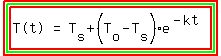 , where: = time taken to get to a COOLED temperature ( , where: = time taken to get to a COOLED temperature ( an hr, or 30 minutes, in this case) an hr, or 30 minutes, in this case)
 = TEMPERATURE (T) at a given time (t)___(141oF, in this case) = TEMPERATURE (T) at a given time (t)___(141oF, in this case)
 = SURROUNDING Temperature (75oF, in this case) = SURROUNDING Temperature (75oF, in this case)
 = ORIGINAL/INITIAL temperature (185oF, in this case) = ORIGINAL/INITIAL temperature (185oF, in this case)
 = the CONSTANT or COOLING rate (UNKNOWN, in this case) = the CONSTANT or COOLING rate (UNKNOWN, in this case)
 ---- Substituting 30 for t, 75o for , and 185o for ---- Substituting 30 for t, 75o for , and 185o for
 ----- Substituting 141o for T(30) ----- Substituting 141o for T(30)

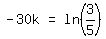 ----- Converting to NATURAL LOGARITHMIC (ln) form ----- Converting to NATURAL LOGARITHMIC (ln) form
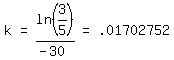 ******************************************************************************************
a). If the temperature of the turkey is 141 Fahrenheit after half an hour, what is its temperature after 45 minutes?
******************************************************************************************
a). If the temperature of the turkey is 141 Fahrenheit after half an hour, what is its temperature after 45 minutes?
 ---- Substituting 45 for t, 75o for , 185o for ,
and .01702752 for k
Temperature, after 45 minutes, or ---- Substituting 45 for t, 75o for , 185o for ,
and .01702752 for k
Temperature, after 45 minutes, or  , or approximately 126oF.
******************************************************************************************
b). When will the turkey cool to 100 Fahrenheit? , or approximately 126oF.
******************************************************************************************
b). When will the turkey cool to 100 Fahrenheit?
 ---- Substituting 100 for T(t), 75o for , 185o for ,
and .01702752 for k ---- Substituting 100 for T(t), 75o for , 185o for ,
and .01702752 for k

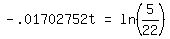 ---- Converting to NATURAL LOGARITHMIC (ln) form
Time taken for the turkey to cool to 100oF, or ---- Converting to NATURAL LOGARITHMIC (ln) form
Time taken for the turkey to cool to 100oF, or 
Question 1130119: Could someone please assist with the question:
A pot of boiling soup with an internal temperature of 100� Fahrenheit was taken off the stove to cool in a 69�F room. After fifteen minutes, the internal temperature of the soup was 93�F.
To the nearest minute, how long will it take the soup to cool to 81�F?
Here is my work:
69+(100-69) * e= 69+31*e
93=69+31*e(-k*15)
31*e^(-k *15)= 93-69= 24
e^-15k= 24/31= .7742
-15K= ln(.7742)
k= -ln(0.7742)/ 15=0.017
T(t)= 69+31*e (0.017)=81
e(-0.017*t)= 81-69/31=.387
-0.017*t= ln(.387)
t= - ln (.387)/ (0.017)= 55.8 min
Found 2 solutions by ikleyn, MathTherapy:
Answer by ikleyn(53751)  (Show Source): (Show Source):
You can put this solution on YOUR website! .
Hello, in your post (in your problem's formulation), there is a fatal error,
which equates the problem's creator to zero.
Concretely, the boiling temperature of 100 degrees Celsius is missed with 100 degrees Fahrenheit,
which has no any relation to boiling.
Answer by MathTherapy(10806) (Show Source):
You can put this solution on YOUR website!
Could someone please assist with the question:
A pot of boiling soup with an internal temperature of 100� Fahrenheit was taken off the stove to cool in a 69�F room.
After fifteen minutes, the internal temperature of the soup was 93�F.
To the nearest minute, how long will it take the soup to cool to 81�F?
Here is my work:
69+(100-69) * e= 69+31*e
93=69+31*e(-k*15)
31*e^(-k *15)= 93-69= 24
e^-15k= 24/31= .7742
-15K= ln(.7742)
k= -ln(0.7742)/ 15=0.017
T(t)= 69+31*e (0.017)=81
e(-0.017*t)= 81-69/31=.387
-0.017*t= ln(.387)
t= - ln (.387)/ (0.017)= 55.8 min
*********************************
You can use Newton's Law of Cooling.......any of the following 3 formulae should work:
This author's preference is the 1st formula. In this case, the cooling rate is first needed, and is derived as follows:
, where: = time taken to get to a COOLED temperature (15 minutes, in this case)
= TEMPERATURE (T) at a given time (t)___(93oF, in this case)
= SURROUNDING Temperature (69oF, in this case)
= ORIGINAL/INITIAL temperature (100oF, in this case)
= the CONSTANT or COOLING rate (UNKNOWN, in this case)
 ----- Substituting 15 for t, 69o for , and 100o for ----- Substituting 15 for t, 69o for , and 100o for
 ----- Substituting 93o for T(15) ----- Substituting 93o for T(15)
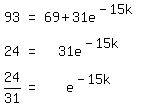
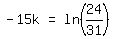 ----- Converting to NATURAL LOGARITHMIC (ln) form ----- Converting to NATURAL LOGARITHMIC (ln) form
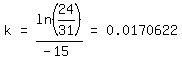 ***********************************************************************
To the nearest minute, how long will it take the soup to cool to 81�F?
***********************************************************************
To the nearest minute, how long will it take the soup to cool to 81�F?
 ----- Substituting 69o for , 100o for , and .0170622 for k ----- Substituting 69o for , 100o for , and .0170622 for k
 ----- Substituting 81o for T(t) ----- Substituting 81o for T(t)

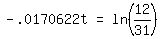 ----- Converting to NATURAL LOGARITHMIC (ln) form
Time it takes for the soup to cool to 81oF, or ----- Converting to NATURAL LOGARITHMIC (ln) form
Time it takes for the soup to cool to 81oF, or  As your answer, 55.8 min, or approximately 56 mins, coincides with mine, it is correct!
Great JOB!!
As your answer, 55.8 min, or approximately 56 mins, coincides with mine, it is correct!
Great JOB!!
Question 1163697: unsolved 2020-08-22 10:07:30 It is believed that two quantities, z and d are Connected by the relationship of the form z=kd^n where k and n are provided that d doesn't exceed some fixed (but unknown)values D.An experiment produced the following data
D 750 810 870 930 990 1050 1110 1170
Z 2.1 2.6 3.2 4.0 4.8 5.6 5.9 6.1
a)Plot the values of log10Z against log10 d.Use these points to suggest a
value for D.
b)It is known tht for d < D,n is a whole number.Use your graph to find the value of n.Show also that k=5×10^-9
c) Use your value of n and the estimate k=5×10^-9 to find the value of d for which z=3.0.
Answer by KMST(5345)  (Show Source): (Show Source):
Question 166689: log3(x-2)+log3(x+4)=3
Answer by MathTherapy(10806) (Show Source):
You can put this solution on YOUR website!
log3(x-2)+log3(x+4)=3
*********************
The other person who responded is WRONG!! His solutions, "x = {3.243, -5.243}" are WRONG.
If he'd checked his answers, he would've realized this.
The SMALLER log argument, x - 2 MUST be > 0, so x - 2 > 0, and we get: x > 2. We now have:
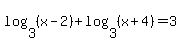 , with x being > 2. , with x being > 2.
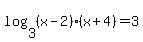 ----- Applying ----- Applying 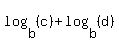 = =
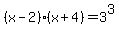 ---- Converting to EXPONENTIAL form ---- Converting to EXPONENTIAL form
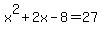
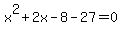
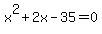 (x - 5)(x + 7) = 0
x - 5 = 0 OR x + 7 = 0
x = 5 OR x = - 7 (ignore)
The constraint above "states" that x MUST be > 2. 5 is > 2, but - 7 is NOT. This makes - 7 an
EXTRANEOUS solution, and the only ACCEPTABLE solution, x = 5.
You can do the CHECK!!
(x - 5)(x + 7) = 0
x - 5 = 0 OR x + 7 = 0
x = 5 OR x = - 7 (ignore)
The constraint above "states" that x MUST be > 2. 5 is > 2, but - 7 is NOT. This makes - 7 an
EXTRANEOUS solution, and the only ACCEPTABLE solution, x = 5.
You can do the CHECK!!
Question 945331: 
Answer by MathTherapy(10806) (Show Source):
Question 1088632: log3 (2x-1) = 2 x =
Answer by MathTherapy(10806) (Show Source):
Question 1026110: simplify the expression
log3 (x+1) -log3 (3x^2-3x-6)+log3 (x-2)
The 3 on each log is lowered
Answer by MathTherapy(10806) (Show Source):
Question 747802: log3(x+6)+log3(x-6)-log3x=2
solve the logarithmic equation
Answer by MathTherapy(10806) (Show Source):
You can put this solution on YOUR website!
log3(x+6)+log3(x-6)-log3x=2
solve the logarithmic equation
******************************
It's heart-wrenching to see how the other person (@MATHLOVER) makes this problem so long and time-consuming! Why??
In my opinion, she should learn how to solve problems much more efficiently.
*************************************************************************
 This log equation starts with 3 log arguments: a1 (x + 6), a2 (x - 6), and a3 (x), the smallest being log argument
a2, or x - 6. Argument "a2" "tells" one that x - 6 MUST be > 0. So, x - 6 > 0_____x > 6
We now have: , with x > 6
This log equation starts with 3 log arguments: a1 (x + 6), a2 (x - 6), and a3 (x), the smallest being log argument
a2, or x - 6. Argument "a2" "tells" one that x - 6 MUST be > 0. So, x - 6 > 0_____x > 6
We now have: , with x > 6
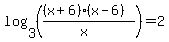 ---- Applying ---- Applying 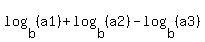 = = 
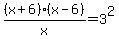 --- Applying --- Applying  , when: , when: 
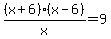

 --- Cross-multiplying --- Cross-multiplying
 (x - 12)(x + 3) = 0
x - 12 = 0 OR x + 3 = 0
x = 12 OR x = - 3
As stated above, x MUST be > 6, so ONLY x = 12 is ACCEPTABLE. This makes x = - 3, an EXTRANEOUS solution to this
equation, and is therefore IGNORED/REJECTED.
(x - 12)(x + 3) = 0
x - 12 = 0 OR x + 3 = 0
x = 12 OR x = - 3
As stated above, x MUST be > 6, so ONLY x = 12 is ACCEPTABLE. This makes x = - 3, an EXTRANEOUS solution to this
equation, and is therefore IGNORED/REJECTED.
Question 815452: if x*x+y*y=7xy, prove
log(x+y)=1/2(logx+logy)+log3
Found 2 solutions by greenestamps, MathTherapy:
Answer by greenestamps(13330)  (Show Source): (Show Source):
Answer by MathTherapy(10806) (Show Source):
Question 769077: if logx =4 and logy =3 Evaluate log square root of x divided by y squared
Found 2 solutions by greenestamps, MathTherapy:
Answer by greenestamps(13330) (Show Source):
You can put this solution on YOUR website!
Algebraic expressions written in words are often ambiguous and open to different interpretations, as the other tutor indicated.
Assuming this is a problem from a student learning basic rules of logarithms, the most likely interpretation of the expression to be evaluated is
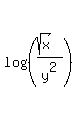
In that case, use basic logarithm rules to evaluate the expression.
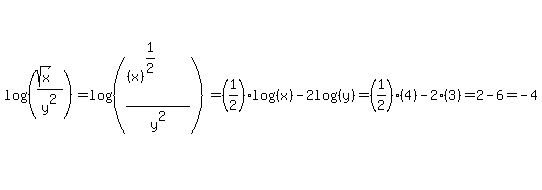
Answer by MathTherapy(10806) (Show Source):
Question 717220: log(base x)(1/4) = (-2/3)
log(
Found 2 solutions by greenestamps, MathTherapy:
Answer by greenestamps(13330) (Show Source):
Answer by MathTherapy(10806) (Show Source):
Question 250018: solve:

Unfortunately I do not know how to put this without all the words. But this is a problem on one of my take home tests. I dont understand how to solve because I get  for the log in the parentheses but now I don't knwo what to do? for the log in the parentheses but now I don't knwo what to do?
Answer by MathTherapy(10806) (Show Source):
You can put this solution on YOUR website!
solve:
Unfortunately I do not know how to put this without all the words. But this is a problem on one of my take home tests. I dont understand how to solve because I get for the log in the parentheses but now I don't knwo what to do?
===============================================
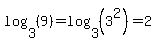
In this problem, x is one of the 3 bases given. So, being a LOG-BASE, x CANNOT be 0, and also, x MUST be GREATER than 1.
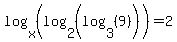 , with x > 1 , with x > 1
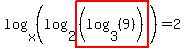
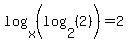 --- --- 
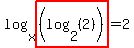
 --- --- 
 ----- Converting to EXPONENTIAL form ----- Converting to EXPONENTIAL form
 However, as stated above, x MUST be > 1, so There are NO SOLUTIONS to this equation.
The other person is WRONG, as he/she states that the value of x is 1.
However, as stated above, x MUST be > 1, so There are NO SOLUTIONS to this equation.
The other person is WRONG, as he/she states that the value of x is 1.
Question 1129970: Find the exact value of e^LOGe^2 16
The answer is 4, but I am unsure as to why.
If possible, please show multiple methods (with step by step breakdown). Here is what I've gathered so far:
Method 1:
1. e^LOGe^2 2^4
2. e^(4/2)LOGe 2 ( I don't understand where the 4 divided by 2 comes into play, and which property dictates it )
3. e^2LOGe 2
4. e^LOGe 4 (Where did the 4 come from? Did both of the 2's get multiplied?)
5. =4
Method 2:
1. e^LOGe^2 16
2. e^(1/2)LN 16 (Where did the 1/2 come from?)
3. sqrt(e^LN 16) (Why is the entire expression inside the square root?)
4. sqrt(16) (Why did the "e^LN" portion inside the square root disappear?)
5. =4
Is it also possible to solve this problem by using the base change method?
Thanks in advance.
Answer by MathTherapy(10806) (Show Source):
Question 130716: I have tried to figure this equation but it doesn't come out with the right answer. Please can you help me?
9^x = 1/3sqrt 3
Answer by MathTherapy(10806) (Show Source):
Question 71721: log base 2 x ^(log base 2 x) =4
Found 2 solutions by greenestamps, MathTherapy:
Answer by greenestamps(13330) (Show Source):
Answer by MathTherapy(10806) (Show Source):
Question 492608: I need help with these questions
5^x=125
8^x+1=16^x
81^(3/4)=x
8^(-2/3)=x
Answer by MathTherapy(10806) (Show Source):
Question 80251: log 4x= log 5+log(x+1)
Answer by MathTherapy(10806) (Show Source):
You can put this solution on YOUR website!
log 4x= log 5+log(x+1)

Other person's solution. x = - 5. is EXTRANEOUS, so there are NO SOLUTIONS to this equation!
For a VALID solution, x MUST be > 0
Question 617405: if log base b (2)=x and log base b (3)=y, evaluate the following terms of x and y:
log base b (24)=
log base b (216)=
log base b (16/27)=
(log base b (27))/(log base b (4))=
Answer by MathTherapy(10806) (Show Source):
Question 895678: log base 2 (log base 3 (log base 5 of x)) = 0
Answer by MathTherapy(10806) (Show Source):
Question 5994: This equation is giving me issues.
log(base2)(x-6)+log(base2)(x-4)-log(base2)x = 2
Solve for x. Reject any value of x that produces the logarithm of a negative number or 0.
What I've done:
log(base2)(x-6)(x-4)-log(base2)x = 2
log(base2)(x-6)(x-4)/x = 2
(x-6)(x-4)/x = 2^2 = 4
4 = (x-6)(x-4)/x
There is where I am stuck.
Some help on this would be great. Thanks.
Answer by MathTherapy(10806) (Show Source):
You can put this solution on YOUR website!
This equation is giving me issues.
log(base2)(x-6)+log(base2)(x-4)-log(base2)x = 2
Solve for x. Reject any value of x that produces the logarithm of a negative number or 0.
What I've done:
log(base2)(x-6)(x-4)-log(base2)x = 2
log(base2)(x-6)(x-4)/x = 2
(x-6)(x-4)/x = 2^2 = 4
4 = (x-6)(x-4)/x
There is where I am stuck.
Some help on this would be great. Thanks.
The person who responded is PARTIALLY WRONG!!
 The smallest of the 3 logs is x - 6, so x - 6 MUST be > 0, and so, x > 6.
So, we get: , with x > 6
The person who responded has solutions, x = 12 and x = 2, but as you can see, the x value, 12 is > 6, but the
other value 2, is NOT, thereby making the solution, x = 12, ACCEPTABLE, and x = 2, EXTRANEOUS, and UNACCEPTABLE!
The person must've missed this: Reject any value of x that produces the logarithm of a negative number or 0.
The smallest of the 3 logs is x - 6, so x - 6 MUST be > 0, and so, x > 6.
So, we get: , with x > 6
The person who responded has solutions, x = 12 and x = 2, but as you can see, the x value, 12 is > 6, but the
other value 2, is NOT, thereby making the solution, x = 12, ACCEPTABLE, and x = 2, EXTRANEOUS, and UNACCEPTABLE!
The person must've missed this: Reject any value of x that produces the logarithm of a negative number or 0.
Question 492607: I need help with these questions
5^x=125
8^x+1=16^x
81^(3/4)=x
8^(-2/3)=x
log(base2)32=x
log(base x) (1/9)=-2
log(base4)x=3
Log(base3)(x+7)=Log(base3)(2x-1)
Answer by MathTherapy(10806) (Show Source):
Question 174799: log(base2)log(base3)log(base4)2^n=2
I don't understand how to solve this.
Answer by MathTherapy(10806) (Show Source):
Question 1076081: solve log base 5(x+2) + log base 8(x+4) = log abse 8(2) + log base 8(4)
Answer by MathTherapy(10806) (Show Source):
You can put this solution on YOUR website!
solve log base 5(x+2) + log base 8(x+4) = log abse 8(2) + log base 8(4)

Does this start with: log5(x + 2) or  log8(x + 2)?

The person who responded has the latter. Does he know something I don't?
Question 206454: 2 log(base 4) 9 - log(base 2) 3
Found 2 solutions by greenestamps, MathTherapy:
Answer by greenestamps(13330) (Show Source):
Answer by MathTherapy(10806) (Show Source):
Question 416851: log base 2 (x-2)+log base 2(8-x)-log base 2(x-5)=3
Answer by MathTherapy(10806) (Show Source):
You can put this solution on YOUR website!
log base 2 (x-2)+log base 2(8-x)-log base 2(x-5)=3
 Looking at the above, we see that x - 5 is SMALLER than x - 2, so we'll have: x - 5 > 0, which means that x > 5.
Also, 8 - x MUST be > 0, so - x > - 8, and x <
Looking at the above, we see that x - 5 is SMALLER than x - 2, so we'll have: x - 5 > 0, which means that x > 5.
Also, 8 - x MUST be > 0, so - x > - 8, and x <  , so x < 8. We now get:
, with 5 < x < 8 , so x < 8. We now get:
, with 5 < x < 8
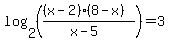
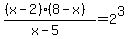
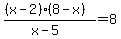 (x - 2)(8 - x) = 8(x - 5)
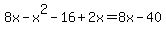

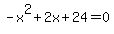 <=== As seen HERE, the quadratic equation is NOT x^2 - 18x - 24 = 0, as @Stanbon states. <=== As seen HERE, the quadratic equation is NOT x^2 - 18x - 24 = 0, as @Stanbon states.
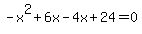 - x(x - 6) - 4(x - 6) = 0
(x - 6)(- x - 4) = 0
x - 6 = 0 OR - x - 4 = 0
x = 6 OR - 4 = x (IGNORE)
Of the 2 solutions above, ONLY the value 6, for x, is > 5, but < 8. This is why x = 6 is ACCEPTED as a solution, while x = - 4
is IGNORED/REJECTED!!
- x(x - 6) - 4(x - 6) = 0
(x - 6)(- x - 4) = 0
x - 6 = 0 OR - x - 4 = 0
x = 6 OR - 4 = x (IGNORE)
Of the 2 solutions above, ONLY the value 6, for x, is > 5, but < 8. This is why x = 6 is ACCEPTED as a solution, while x = - 4
is IGNORED/REJECTED!!
Question 840261: log (base 3) of x minus log (base 3) of (x-5) = log (base 3) of A
Answer by MathTherapy(10806) (Show Source):
Question 414908: solve log(base a)x= 2log (base a)3+ log(base a)5
Answer by MathTherapy(10806) (Show Source):
Question 744476: 1. Show that log(base 1/c)x = log(base c)1/x
Can you please help me out? Thanks so much in advance:)
Can you please show all the steps it would really help me understand:)
Answer by MathTherapy(10806) (Show Source):
Question 244998: given log(base a)x=4, log(base a)y=3, and log(base a)z=2 for constants x, y,z. find the value of the logarithm.
log(base a)((5th root of y^3 times x^6 times z^4)/(5th root of z^6 times x^2)
Found 2 solutions by n2, CPhill:
Answer by n2(79) (Show Source): (Show Source):
You can put this solution on YOUR website! .
I checked the solution by @MathTherapy to this problem, and I confirm that his solution and his answer
to this problem  = 4 = 4 = 4.2 are correct. = 4.2 are correct.
The final answer 23.4 in the post by @CPhill is INCORRECT.
In addition, the post by @CPhill is absolutely inappropriate due to its form, since critically important
calculations are intentionally omitted. Such calculations should be presented explicitly -
without them, the post is a pure speculation.
More than strange a behavior of @CPhill at this forum.
I recommend to a reader to ignore the post by @CPhill.
Answer by CPhill(2189)  (Show Source): (Show Source):
You can put this solution on YOUR website! To find the value of the logarithmic expression, we use the properties of logarithms to expand and simplify the expression into terms we already know.
### Given:
1.
2.
3.
### Expression to find:
---
### Step 1: Simplify the expression inside the logarithm
Using the laws of exponents ( and ):
* For :
* For :
* For :
The expression simplifies to:
---
### Step 2: Use Logarithm Rules to expand
Applying the product rule () and the power rule ():
---
### Step 3: Substitute the given values
Substitute , , and :
Combine the fractions:
Convert to decimal form:
**Final Answer:**
The value of the logarithm is **23.4**.
|
Older solutions: 1..45, 46..90, 91..135, 136..180, 181..225, 226..270, 271..315, 316..360, 361..405, 406..450, 451..495, 496..540, 541..585, 586..630, 631..675, 676..720, 721..765, 766..810, 811..855, 856..900, 901..945, 946..990, 991..1035, 1036..1080, 1081..1125, 1126..1170, 1171..1215, 1216..1260, 1261..1305, 1306..1350, 1351..1395, 1396..1440, 1441..1485, 1486..1530, 1531..1575, 1576..1620, 1621..1665, 1666..1710, 1711..1755, 1756..1800, 1801..1845, 1846..1890, 1891..1935, 1936..1980, 1981..2025, 2026..2070, 2071..2115, 2116..2160, 2161..2205, 2206..2250, 2251..2295, 2296..2340, 2341..2385, 2386..2430, 2431..2475, 2476..2520, 2521..2565, 2566..2610, 2611..2655, 2656..2700, 2701..2745, 2746..2790, 2791..2835, 2836..2880, 2881..2925, 2926..2970, 2971..3015, 3016..3060, 3061..3105, 3106..3150, 3151..3195, 3196..3240, 3241..3285, 3286..3330, 3331..3375, 3376..3420, 3421..3465, 3466..3510, 3511..3555, 3556..3600, 3601..3645, 3646..3690, 3691..3735, 3736..3780, 3781..3825, 3826..3870, 3871..3915, 3916..3960, 3961..4005, 4006..4050, 4051..4095, 4096..4140, 4141..4185, 4186..4230, 4231..4275, 4276..4320, 4321..4365, 4366..4410, 4411..4455, 4456..4500, 4501..4545, 4546..4590, 4591..4635, 4636..4680, 4681..4725, 4726..4770, 4771..4815, 4816..4860, 4861..4905, 4906..4950, 4951..4995, 4996..5040, 5041..5085, 5086..5130, 5131..5175, 5176..5220, 5221..5265, 5266..5310, 5311..5355, 5356..5400, 5401..5445, 5446..5490, 5491..5535, 5536..5580, 5581..5625, 5626..5670, 5671..5715, 5716..5760, 5761..5805, 5806..5850, 5851..5895, 5896..5940, 5941..5985, 5986..6030, 6031..6075, 6076..6120, 6121..6165, 6166..6210, 6211..6255, 6256..6300, 6301..6345, 6346..6390, 6391..6435, 6436..6480, 6481..6525, 6526..6570, 6571..6615, 6616..6660, 6661..6705, 6706..6750, 6751..6795, 6796..6840, 6841..6885, 6886..6930, 6931..6975, 6976..7020, 7021..7065, 7066..7110, 7111..7155, 7156..7200, 7201..7245, 7246..7290, 7291..7335, 7336..7380, 7381..7425, 7426..7470, 7471..7515, 7516..7560, 7561..7605, 7606..7650, 7651..7695, 7696..7740, 7741..7785, 7786..7830, 7831..7875, 7876..7920, 7921..7965, 7966..8010, 8011..8055, 8056..8100, 8101..8145, 8146..8190, 8191..8235, 8236..8280, 8281..8325, 8326..8370, 8371..8415, 8416..8460, 8461..8505, 8506..8550, 8551..8595, 8596..8640, 8641..8685, 8686..8730, 8731..8775, 8776..8820, 8821..8865, 8866..8910, 8911..8955, 8956..9000, 9001..9045, 9046..9090, 9091..9135, 9136..9180, 9181..9225, 9226..9270, 9271..9315, 9316..9360, 9361..9405, 9406..9450, 9451..9495, 9496..9540, 9541..9585, 9586..9630, 9631..9675, 9676..9720, 9721..9765, 9766..9810, 9811..9855, 9856..9900, 9901..9945, 9946..9990, 9991..10035, 10036..10080, 10081..10125, 10126..10170, 10171..10215, 10216..10260, 10261..10305, 10306..10350, 10351..10395, 10396..10440, 10441..10485, 10486..10530, 10531..10575, 10576..10620, 10621..10665, 10666..10710, 10711..10755, 10756..10800, 10801..10845, 10846..10890, 10891..10935, 10936..10980, 10981..11025, 11026..11070, 11071..11115, 11116..11160, 11161..11205, 11206..11250, 11251..11295, 11296..11340, 11341..11385, 11386..11430, 11431..11475, 11476..11520, 11521..11565, 11566..11610, 11611..11655, 11656..11700, 11701..11745, 11746..11790, 11791..11835, 11836..11880, 11881..11925, 11926..11970, 11971..12015, 12016..12060, 12061..12105, 12106..12150, 12151..12195, 12196..12240, 12241..12285, 12286..12330, 12331..12375, 12376..12420, 12421..12465, 12466..12510, 12511..12555, 12556..12600, 12601..12645, 12646..12690, 12691..12735, 12736..12780, 12781..12825, 12826..12870, 12871..12915, 12916..12960, 12961..13005, 13006..13050, 13051..13095, 13096..13140, 13141..13185, 13186..13230, 13231..13275, 13276..13320, 13321..13365, 13366..13410, 13411..13455, 13456..13500, 13501..13545, 13546..13590, 13591..13635, 13636..13680, 13681..13725, 13726..13770, 13771..13815, 13816..13860, 13861..13905, 13906..13950, 13951..13995, 13996..14040, 14041..14085, 14086..14130, 14131..14175, 14176..14220, 14221..14265, 14266..14310, 14311..14355, 14356..14400, 14401..14445, 14446..14490, 14491..14535, 14536..14580, 14581..14625, 14626..14670, 14671..14715, 14716..14760, 14761..14805, 14806..14850, 14851..14895, 14896..14940, 14941..14985, 14986..15030, 15031..15075, 15076..15120, 15121..15165, 15166..15210, 15211..15255, 15256..15300, 15301..15345, 15346..15390, 15391..15435, 15436..15480, 15481..15525, 15526..15570, 15571..15615, 15616..15660, 15661..15705, 15706..15750, 15751..15795, 15796..15840, 15841..15885, 15886..15930, 15931..15975, 15976..16020, 16021..16065, 16066..16110, 16111..16155, 16156..16200, 16201..16245, 16246..16290, 16291..16335, 16336..16380, 16381..16425, 16426..16470, 16471..16515, 16516..16560, 16561..16605, 16606..16650, 16651..16695, 16696..16740, 16741..16785, 16786..16830, 16831..16875, 16876..16920, 16921..16965, 16966..17010, 17011..17055, 17056..17100, 17101..17145, 17146..17190, 17191..17235, 17236..17280, 17281..17325, 17326..17370, 17371..17415, 17416..17460, 17461..17505, 17506..17550, 17551..17595, 17596..17640, 17641..17685, 17686..17730, 17731..17775, 17776..17820, 17821..17865, 17866..17910, 17911..17955, 17956..18000, 18001..18045
|
