Rachel Spender wants to invest $4000 in savings certificates which bear an interest rate of 7.25% compounded semi-anually. How long a time period should she choose in order to save an amount of $4700?
*****************************************************
Future-value-of-$1 formula: 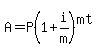 , with
  = Future Value (Unknown, in this case)
 = Principal/Initial Deposit ($4,000, in this case)
 = Interest rate, as a decimal (7.25%, or .0725, in this case)
 = Number of ANNUAL compounding periods (semiannually, or 2, in this case)
 = Time Principal/Initial Deposit has been invested, in YEARS (t, in this case)
How long a time period should she choose in order to save an amount of $4700?
= Time Principal/Initial Deposit has been invested, in YEARS (t, in this case)
How long a time period should she choose in order to save an amount of $4700?
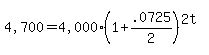 ----- Substituting $4,700 for A, $4,000 for P, .0725 for i, and 2 for m
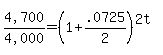
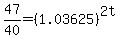
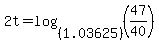 ----- Converting to LOGARITHMIC form
Time it'll take the $4,000 investment to increase to $4,700, or
----- Converting to LOGARITHMIC form
Time it'll take the $4,000 investment to increase to $4,700, or 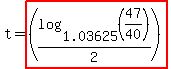 = 2.26446601 years, which needs to be ROUNDED UP
to
= 2.26446601 years, which needs to be ROUNDED UP
to  years, or 2 years, 6 months.
** Notice that although 2.26446601 rounds off to about
years, or 2 years, 6 months.
** Notice that although 2.26446601 rounds off to about  years, the $4,000 investment, at the -year juncture, will increase to about
$4,695.16 (< $4,700). This is why it's necessary to ROUND UP to year , or 2.5 years (at the semi-annual point), at which time, the $4,000
initial deposit will exceed $4,700 (about $4,779.50, to be exact).
years, the $4,000 investment, at the -year juncture, will increase to about
$4,695.16 (< $4,700). This is why it's necessary to ROUND UP to year , or 2.5 years (at the semi-annual point), at which time, the $4,000
initial deposit will exceed $4,700 (about $4,779.50, to be exact).


